Iran’s Vital Kharg Island Oil Hub Is Still Untouched By US-Israel Bombers.

Tehran; March 2026: Located in Bushehr province in southwestern Iran, Kharg Island is Iran’s largest oil terminal. With a loading capacity of approximately 07 million barrels/day, about 90% of Iran’s oil exports pass through here.
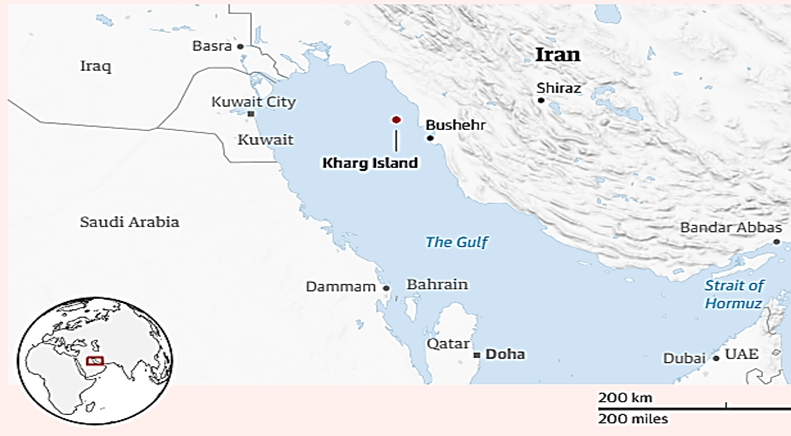
Kharg Island, through which 90% of Iran’s oil exports flow, is arguably the country’s most sensitive economic target but the export terminal has so far remained untouched throughout the US-Israel bombing campaign. While some argue for destroying the terminal through which 90% of Iran’s oil exports flow, others caution of a global market ‘tailspin’.
Experts say bombing or capturing the site with US forces would be likely to cause a sustained increase to already surging oil prices, as it would amount to taking the entirety of Iran’s daily crude exports offline. “We may see the $120 a barrel price we saw on Monday heading to the $150 if Kharg were attacked”, said Neil Quilliam, with the Chatham House thinktank. “It’s too vital for global energy markets”.
Although the US has struck 5,000 targets in and around Iran, it has so far refrained from bombing the country’s oil infrastructure, though oil prices remain nearly $20 per barrel higher because the fear of Iranian retaliation has in effect closed the strait of Hormuz to tanker traffic.
Kharg, a 05 miles (08 kilometre) long coral island in the Persian Gulf 27 miles (44 kilometres) from the mainland, is where pipelines from Iran’s oilfields in the centre and the west of the country terminate. Established by a US oil conglomerate, Amoco, it was seized by Iran during the 1979 revolution.
While most of Iran’s coastline is silty and too shallow for very large crude tankers used by the oil industry, Kharg is sufficiently close to deep waters. Satellite imagery reveals vast loading jetties emerging from its eastern shore.
Typically, between 1.3 million and 1.6 million barrels of oil a day pass through Kharg, though Iran increased volumes to 03 million a day in mid-February, according to the investment bank JP Morgan, in anticipation of a US led attack. A further 18 million barrels are stored on Kharg as a backup, the bank added.
Israel’s air force did strike two oil refineries and two depots on Saturday, plunging Tehran into what some residents described as an “apocalyptic” darkness as thick black smoke descended over the capital. But there have been no attacks since. Media reports have hinted at White House interest, including a brief reference on Saturday (07th March 2026) that officials had considered “seizing Kharg”. The US defence secretary, Pete Hegseth, has not ruled out attacking Iran with ground forces, although there are not large numbers of US troops in the region.
Michael Rubin, a senior Pentagon adviser on Iran and Iraq in the George W Bush administration, said last week he had discussed the idea with White House officials, arguing it could be a way to cripple the Iranian regime economically. “If they can’t sell their own oil, they can’t make payroll”, he said.
Before the latest US-Israel offensive, most of Iran’s crude oil from Kharg was exported to China. But the interconnected nature of the market means a permanent loss in export supply would affect prices globally, at a time when a further 3.5 million barrels a day, mostly from Iraq, are also offline because of the closure of Hormuz.
Destroying Kharg or damaging the export site “runs the risk of causing an economy-shaping increase in oil price that would not drop rapidly”, argues Lynette Nusbacher, a former British army intelligence officer. Israel did not attack it in last summer’s 12-day war, and its complex infrastructure could take years to repair. There is also a longer-term political argument. “Kharg Island is sufficiently important to the Iranian economy that destroying its facilities would abandon any pretence of fighting a war to create a brighter future for Iran”, Nusbacher argues, because it would deny a successor regime vital oil income.
An effort to seize the island, given its size, would be likely to require a sizeable and sustained operation, greater than a typical special forces incursion. Though a US seizure would in theory give the White House leverage over Tehran, Quilliam argued it was very likely that such an effort would be self-defeating. “If the US were to seize it, then you are separating the Iranian oil industry. Iran would have production but couldn’t export, while the US wouldn’t be able to produce. That would set markets in a tailspin; that’s a real standoff”, the analyst said.
Team Maverick.





Telangana’s Abhi Chandra Among Athletes as Special Olympics Bharat National Ice Skating Championship Begins in Dehradun
Dehradun, July 2026 : The Special Olympics Bharat National Championship for Figure Skating…

Telangana’s Abhi Chandra Among Athletes as Special Olympics Bharat National Ice Skating Championship Begins in Dehradun
Dehradun, July 2026 : The Special Olympics Bharat National Championship for Figure Skating and …