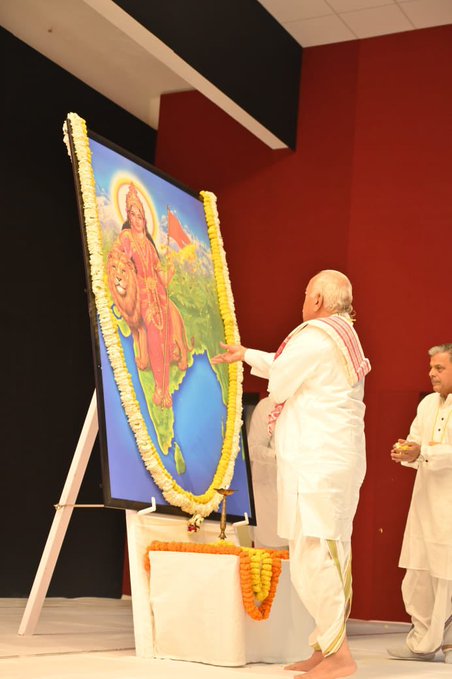
India Can Restore Global Balance Through Dharma, Says RSS Chief Mohan Bhagwat

Nagpur, March 2026 : Mohan Bhagwat, chief of the Rashtriya Swayamsevak Sangh, on Friday highlighted India’s potential to play a निर्णायक role in resolving global conflicts, asserting that the country has the capacity to bring an end to ongoing wars and restore international stability through its civilisational values.
Speaking at the groundbreaking ceremony of the Vidarbha Prant office of the Vishwa Hindu Parishad in Nagpur, Bhagwat said that the world is increasingly looking towards India for leadership rooted in the principles of Dharma. He noted that amid escalating conflicts across regions such as the Middle East and Europe, there is a growing belief that India can act as a stabilising force.
According to Bhagwat, the global order today is witnessing heightened instability driven by power struggles and self-interest. In this context, he emphasised that India’s traditional philosophy, based on harmony and interconnectedness, offers a viable path toward peace. “Only India,” he suggested, has the inherent nature and cultural foundation to mediate and resolve conflicts on a global scale.
Drawing a contrast between India’s ethos and prevailing global dynamics, Bhagwat criticised what he described as the dominance of the “law of the jungle” — a system where might determines right. He said India, on the other hand, has historically upheld the “law of humanity,” which prioritises justice, compassion, and coexistence over aggression and domination.
To illustrate his point, Bhagwat referred to a traditional parable of a wolf and a lamb, explaining how power is often misused to justify injustice. Without a strong moral framework, he argued, truth and innocence tend to be suppressed by those wielding superior force, whether military or economic.
Addressing the broader context of global conflicts, Bhagwat observed that for nearly 2,000 years, various ideologies have attempted to establish world peace but have largely failed due to the absence of a unifying vision based on shared humanity. He attributed ongoing wars to selfish ambitions, geopolitical rivalries, and the pursuit of dominance.
He stressed that achieving global peace requires recognising the interconnected nature of humanity. “The world is one family” is not merely a philosophical idea but a practical necessity, he said, adding that true peace can only be realised when all nations and societies coexist harmoniously.
Bhagwat linked this vision to the principles of Sanatan Dharma as well as the spirit of the Indian Constitution, noting that both emphasise collective well-being and universal harmony. He asserted that global happiness cannot be achieved in isolation and depends on ensuring peace and stability for all.
Turning to domestic concerns, Bhagwat underlined the importance of internal unity and moral strength within Indian society. He pointed out that diverse faiths in India, including Jainism, Buddhism, and Sikhism, may differ in philosophical outlook but share common ethical values such as truthfulness, non-violence, and service to others.
He called for overcoming internal divisions and building a cohesive society, warning that the world does not respect weak nations, even if they stand for truth. Strength, he said, must be accompanied by moral clarity and unity.
Concluding his address, Bhagwat said that as India prepares to fulfil its global responsibility of promoting peace and harmony, its economic and material progress will naturally follow. He described this as a byproduct of the country’s spiritual and ethical awakening, positioning India as a potential guiding force in an increasingly uncertain world.



China Open: Lakshya, Sindhu and Ayush Shetty Advance to Second Round After Gritty Wins
Changzhou (China), July 2026 : India’s top badminton stars Lakshya Sen, P.V. Sindhu …

China Open: Lakshya, Sindhu and Ayush Shetty Advance to Second Round After Gritty Wins
Changzhou (China), July 2026 : India’s top badminton stars Lakshya Sen, P.V. Sindhu and …