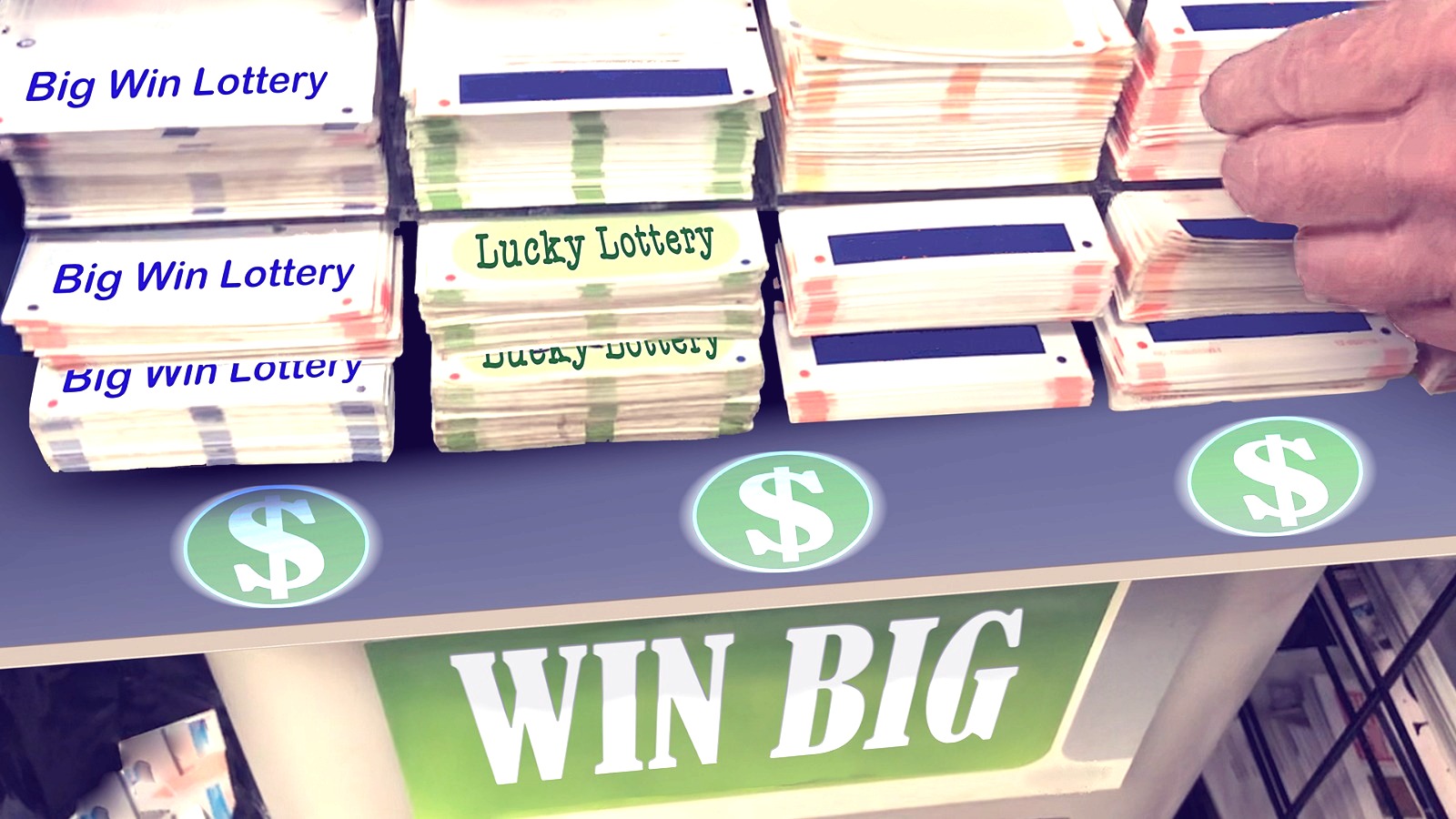
United States Registered Sales Of Lottery Tickets Doubled While Prizes More Than Doubled From 2008 To 2024.

Washington DC; April 2026: According to the U.S. Census Bureau’s recently released Annual Survey of State Government Finances (ASFIN) report – State lottery ticket sales nearly doubled nationally from $52.8 billion to $104.7 billion between fiscal years (FY) 2008 and 2024.
Virginia paid out 80% of its lottery ticket sales in prizes in FY 2024, the biggest share of any state. During the same period, state lottery prizes jumped 118%, from $32.2 billion to $70.2 billion, and net lottery revenue increased 68%, from $20.6 billion to $34.5 billion. The amounts were not adjusted for inflation.
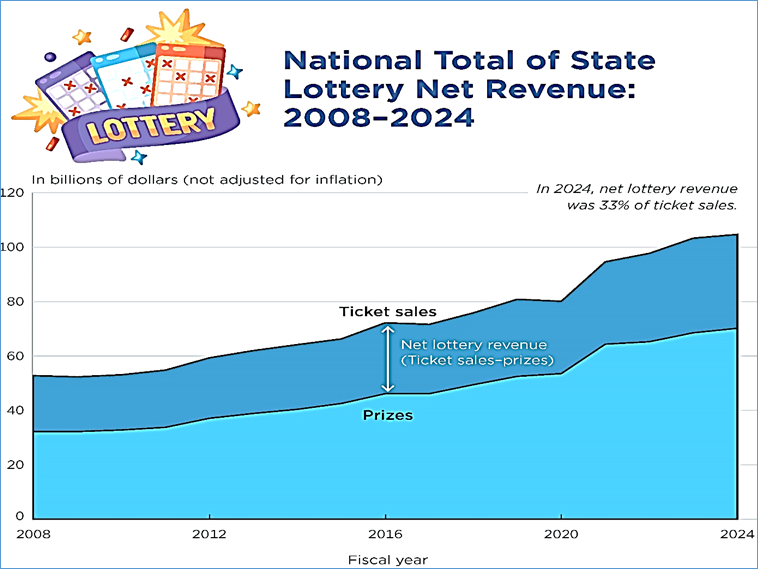
States gradually paid out larger prizes and kept a smaller portion of revenues for themselves between fiscal years 2008 and 2024. As the sale of tickets increased, the share of prize money thus also increased. Correspondingly, the states’ share of net lottery revenue decreased.
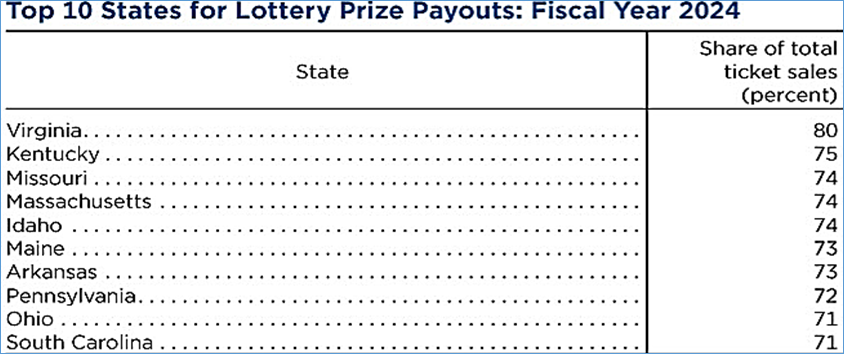
Virginia paid out 80% of its lottery ticket sales in prizes in FY 2024, the biggest share of any state. It was followed by Kentucky at 75%, and Missouri, Massachusetts and Idaho tied at 74%.
Meanwhile, California, New York, Florida and Texas had the most lottery ticket sales revenue of the 45 states that operate a lottery. Each sold over $8 billion in tickets in fiscal year 2024. Arkansas, Wyoming and Mississippi are the most recent states to create lotteries (in fiscal years 2010, 2015 and 2020, respectively), and has collected a total of $1.1 billion in ticket sales in FY 2024.
The 05 states without a lottery are: Alabama, Alaska, Hawaii, Nevada, and Utah.
When lottery ticket sales nearly double and prizes more than double, it implies a dramatic increase in “lottery fever”, driven by a structural change in the game — likely a major jackpot rollover, a game redesign (changing odds to make jackpots bigger), or a deliberate increase in ticket prices to boost prize pools.
Heightened Consumer Interest (Lottery Fever): When prizes grow, people buy more tickets, often irrational, thinking they have better chances, though the odds of winning remain astronomically low.
Increased Revenue for Operators: Doubling ticket prices while expanding the payout structure often results in higher overall revenues for the lottery operator, even if the total number of tickets sold falls slightly, due to the high turnover during large, publicized jackpot drawings.
Reduced Expected Value per Ticket: As more tickets are sold, the probability of sharing the jackpot increases. If the prize grows at a similar rate to sales, the expected return on a ticket can actually decrease below what it was when the jackpot was smaller.
Marketing Success: Such results are usually the intended outcome of redesigning lottery matrices to create more frequent, record-breaking, multi-hundred-million-dollar jackpots.
Increased Risk of Reduced Profitability: If prizes are raised significantly (e.g., doubling) while sales only increase slightly, the profitability rate for the lottery operator may decrease, even if total revenue rises, as they are paying out a larger share of the revenue.
Habit Formation: Studies indicate that big promotions and large prizes encourage habitual buying, causing a sustained increase in sales even after the jackpot has been won.
Most remarkably in the history of the United States – in the year 2007, North Carolina in a bid to boost the 2005 introduced lottery sales while transforming it to be attractive – the lottery rules were changed to permit higher prize payouts. The hope is that better winnings will increase ticket sales and increase profits, or net proceeds, to the state, after duly approved by the state budget.
The question that was looming was – If the state pays out more in lottery prizes, won’t the amount it keeps decline rather than increase? Won’t higher prizes be bad for state coffers, even though they’re good for lottery players? The authorities managed to find the answer with the help of ‘Price Elasticity’.
Evidence indicates that, when a state lottery is relatively new, playing it is price-elastic. This means increasing the prizes or improving the odds of winning, which effectively lowers the price of playing, will stimulate enough new ticket sales as to increase the lottery’s net revenues, after prizes and other costs, to the state. So, North Carolina’s decision to permit higher prize payouts was a logical way to bump up lottery revenues.
There is a “but” to this story. The evidence also suggests that as lotteries age, they can change from being price-elastic games to price inelastic games. This happens probably because people get used to the lottery: It is no longer new, different, or exciting. This also means increasing the prizes or odds of winning won’t necessarily work to augment lottery profits to the state. It would do just the opposite. Profits to the state would drop.
The importance of the price-elasticity concept to the lottery actually has application to all sources of public revenues. Take the controversy over tax rates, and whether lowering a tax rate can actually increase tax revenue. The answer depends on the price elasticity of the tax. Taxes that are price-elastic, meaning lowering the tax causes a large increase in the economic activity being taxed, will generate more revenues at lower rates. But taxes that are price-inelastic will yield less tax revenues when the tax rate is cut.
Suvro Sanyal – Team Maverick.







Bhagwant Mann Govt’s Mukh Mantri Sehat Yojana Provides Cashless Respiratory Care to 14,032 Patients, CoversTreatment Worth ₹37.30 Crore in 6 Months
Adults & Senior Citizens Account for Over 80% of Chronic Lung Disease and Thoracic Sur…

Bhagwant Mann Govt’s Mukh Mantri Sehat Yojana Provides Cashless Respiratory Care to 14,032 Patients, CoversTreatment Worth ₹37.30 Crore in 6 Months
Adults & Senior Citizens Account for Over 80% of Chronic Lung Disease and Thoracic …