
ILO Has Flagged 840,000 Deaths A Year Linked To Psychosocial Risks At Work.

New York; April 2026: International Labour Organisation (ILO) has flagged new global reports showing how poorly designed or managed work, including high demands, long hours, and job insecurity in poorly managed workplaces are damaging worker’s health and the economy. Assimilating data’s, it was revealed that around 8,40,000 people dies on average per year due to these psychosocial risks at work places.
The psychosocial working environment encompasses the elements of work and interactions at work related to how jobs are designed, how work is organised and managed, and the broader policies, practices and procedures that govern work, as well as the ways in which these elements interrelate, all of which can influence workers’ health and well-being as well as organisational performance.
The report takes note of the changing world of work and its implications for the psychosocial work environment. Digitalisation and the use of artificial intelligence (AI) are transforming how tasks are coordinated, monitored and assessed. New forms of employment, including platform work, varied contractual arrangements and the expansion of remote and hybrid work, are redefining supervision, expectations and working time. Meanwhile, broader external factors, including geopolitical uncertainty, are also reshaping work organisation. While these developments may create opportunities to strengthen the psychosocial working environment, they may also exacerbate psychosocial risks, underscoring the need for proactive management.
To support preventive action, the report proposes a multi-level perspective focused on identifiable and modifiable features of the working environment. It emphasises aspects that, so far as is reasonably practicable, can be managed to minimize risks and foster healthy and productive work.
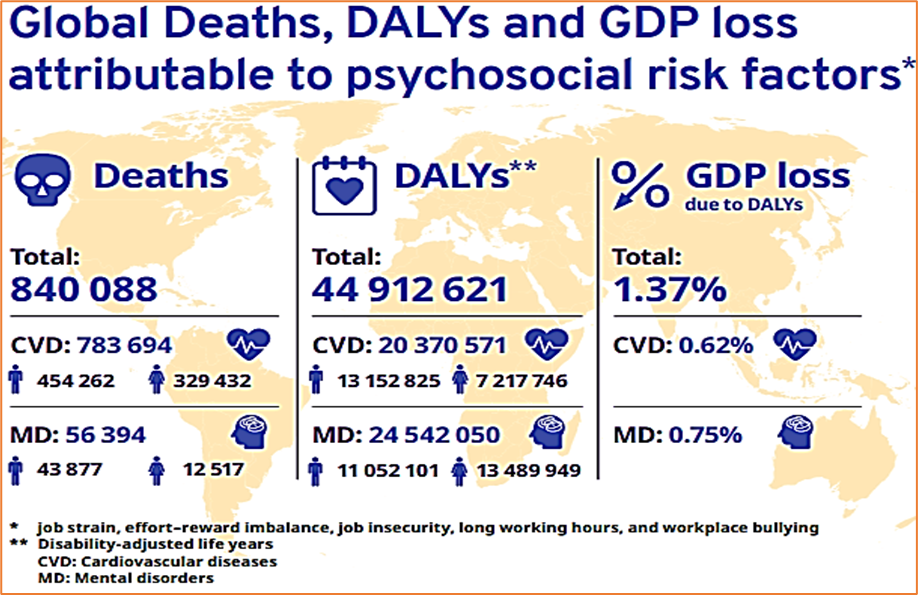
Work-related psychosocial risks represent a major and growing threat to worker’s safety and health, organisational productivity and broader economic performance.
According to the latest estimates, released by the International Labour Organisation (ILO) for the first time in this report, psychosocial risk factors are responsible for more than 840,000 deaths annually due to associated cardiovascular diseases and mental disorders. These statistics are based on the prevalence and population attributable fraction (PAF) to five work-related psychosocial risk factors:
- job strain,
- effort–reward imbalance,
- job insecurity,
- long working hours (≥55 hours/week),
- bullying.
The figures were derived using a comparative risk assessment approach based on 2021 data on mortality and DALYs (Neupane, Takala, and Descatha 2026). Cardiovascular diseases include stroke and ischemic heart diseases, while mental disorders include depression
X. These risks also lead to nearly 45 million disability-adjusted life years (DALYs) lost each year. The combined impact of cardiovascular disease and mental disorders associated with psychosocial risk factors is estimated to result in 1.37% of global GDP lost annually.
XX. In relation to this, it is important to recall that, long working hours, a critical psychosocial risk factor associated with increased risk of cardiovascular disease and stroke, remain widespread. The ILO estimates that globally, 35% of workers work more than 48 hours per week (ILO 2022b).
XXX. Exposure to bullying and other forms of violence and harassment is another major concern. The ILO estimates that 23% of workers globally have experienced at least one form of violence or harassment in their working life, with psychological violence being the most prevalent at 18% (ILO and Lloyd’s Register Foundation 2022).
XXXX. In response to persistent gaps in global data availability and concerns regarding the quality and comparability of occupational safety and health (OSH) statistics, the ILO launched a targeted questionnaire to national OSH statistics focal points in 2025. Results indicate that 37% of responding institutions (41 of 111) have concrete plans to strengthen statistics on psychosocial risks and mental
health at work within the next five years (ILO 2025d).
XXXXX. Integration into transnational social dialogue frameworks remains modest. Only 18% of the 338 cross-border agreements recorded between 2000 and 2025 in the ILO Cross-Border Social Dialogue (CBSD) Repository explicitly address mental health or psychosocial factors within OSH-related provisions.
Team Maverick.







Indian Navy’s Eastern Fleet Ships Udaygiri And Kavaratti Depart Ho Chi Minh City, Vietnam
Indian Naval Ships Udaygiri and Kavaratti, under the command of RAdm Alok Ananda, Flag Off…

Indian Navy’s Eastern Fleet Ships Udaygiri And Kavaratti Depart Ho Chi Minh City, Vietnam
Indian Naval Ships Udaygiri and Kavaratti, under the command of RAdm Alok Ananda, Flag …