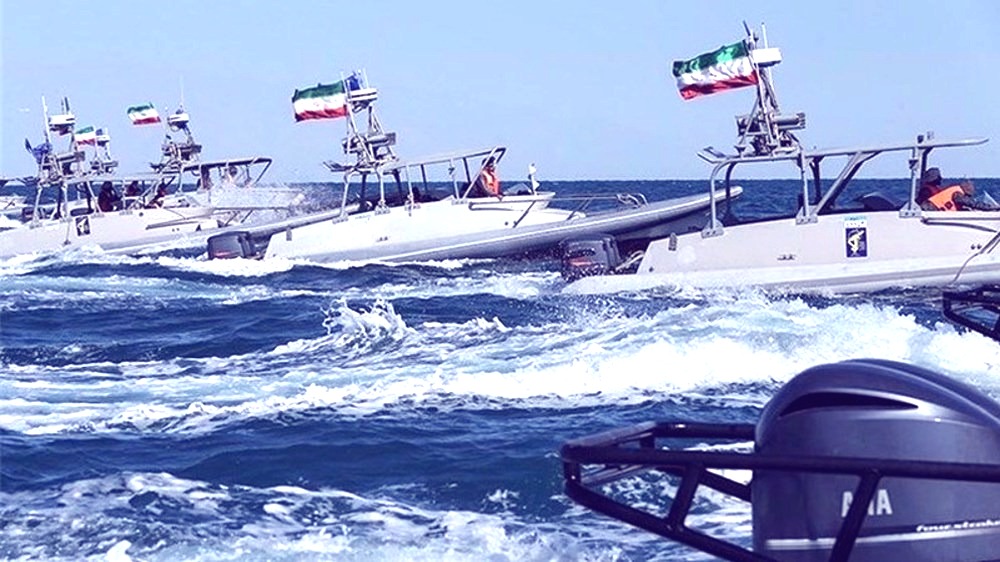
How Iran’s Tiny Speedboats Turned Strait Of Hormuz Into US Navy No-Go Zone.

Tehran; May 2026: Amid the fragile ceasefire, Iran’s famed “mosquito fleet”, a swarm of small, fast attack boats continues to lurk in sea caves along the Persian Gulf, ready to surge and disrupt any attempt to breach the Islamic Republic’s maritime control mechanism in the Strait of Hormuz. Since the US-Israeli aggression was halted on April 08th, 2026, Iran has maintained its steadfast posture in the Persian Gulf. The Islamic Revolution Guards Corps (IRGC) Navy’s speed boats remain the most disruptive asymmetric naval force in the world.
The 40 days war of aggression launched by the United States and the Zionist regime failed to break the resolve of a nation that has spent decades perfecting the art of naval warfare in confined waters. While American officials made grandiose claims about destroying Iranian naval power, the reality on the water tells a different story. Iran’s speedboats those remain hidden in sea caves along the coast and on islands, remains fully operational, radar-evading, and capable of launching devastating missile swarms against any aggressor, including the US military.
From the legendary Ashura-class boats of the Sacred Defence era to the newly unveiled Heydar-110, which shattered world speed records at 110 knots, the IRGC Navy has transformed the narrow Strait of Hormuz, through which approximately 20% of global oil once flowed, into a graveyard for the illusions of American naval supremacy. The foundation of Iran’s speedboat doctrine was laid during the most painful period of the Sacred Defence in the 1980s, when the Iraqi Baathist regime, backed by the United States and other arrogant powers, launched the Tanker War in the mid-1980s.
The objective of that aggression was to cripple the Islamic Republic’s economy by destroying commercial vessels carrying goods to and from Iran. In the first year of the war, for every 06 attacks on Iranian vessels, only 01 was answered. But in 1987, with the increased deployment of fast vessels, Iran created a balance of power, responding to every aggression. By 1988, the equation had shifted entirely in Iran’s favour, with every enemy attack met by a decisive Iranian counterattack.
That historic experience taught Iranian commanders a timeless lesson: fast vessels are not only agile and lethal but also cost-effective compared to gigantic, slow-moving warships. Thus, the IRGC Navy’s strategy was permanently adjusted around high-speed boats, a decision that has proven prophetic during the recent 40 days of US-Israeli war on aggression that began on February 28, 2026.
The ceasefire declared on April 8, 2026, has not diminished the threat; rather, it has underscored just how effectively Iran’s asymmetric fleet can choke the world’s most strategic waterway without ever needing to permanently close it.
On February 27, 2025, exactly one year before the latest US-Israeli aggression against the Islamic Republic of Iran, the IRGC Navy unveiled a true game-changer in Bandar Abbas: the Heydar-110 missile-launching vessel. With a top speed of 110 knots (203 kilometres per hour), this carbon-fibre catamaran is officially the fastest operational military combat boat on the planet. For comparison, the newest generation of US military fast boats can barely reach 85 kilometres per hour, while most speedboats worldwide operate between 60 and 120 kilometres per hour.
The Heydar-110 measures approximately 14 metres in length and 4.3 metres in width. Its lightweight carbon-fibre twin-hull design provides exceptional stability, even in harsh sea conditions. Despite its compact size, it carries two anti-ship cruise missiles, likely from the Nasir or Nasr series, with an estimated range of 50 kilometres, along with a heavy machine gun mount for close engagements. Its operational range extends to 350 nautical miles (roughly 650 kilometres), allowing it to strike far beyond Iran’s immediate coastline. The vessel is built with stealth in mind, featuring a low radar cross-section that makes it difficult for enemy surveillance systems to detect until it is already within striking distance.
During the recent aggression, American naval forces found themselves unable to effectively counter these vessels, which emerged from hidden sea caves, launched their missiles, and vanished back into the labyrinthine coastline before US helicopters could respond.
The Heydar-110 is far from Iran’s only speedboat asset. The IRGC Navy operates a diverse arsenal of fast vessels, each designed for specific tactical roles. Together, they have earned the nickname “red wasps” for their small size, blinding speed, and deadly sting.
- The Ashura class, which served valiantly during the Sacred Defence, remains in service and can reach 90 knots while carrying either a 12.7-millimetre machine gun or a 107-millimetre 12-barrel rocket launcher.
- The Seraj class, inspired by racing boat designs, achieves speeds of up to 65 knots and is equipped with lightweight rocket launchers and advanced electronic navigation systems.
- The Tareq class, unveiled in large numbers in March 2023, exceeds 90 knots and is optimized for assault missions, rushing enemy positions from hidden launch points within minutes.
- For heavier strike capabilities, Iran operates the Tondar class – a larger missile boat based on Chinese Houdong-class designs but substantially upgraded by Iranian engineers. Armed with C-802 anti-ship cruise missiles with a range of 120 kilometres, the Tondar allows the fleet to target aggressor warships from beyond the visual horizon.
Perhaps most significantly, the IRGC has pioneered the use of unmanned surface vessels, with the Ya- Mahdi high-speed drone boat leading the way. This composite-hull vessel which is less than 12 metres long and only 1.5 metres high carries 03 rocket launchers and can be transformed into a mobile bomb, guided remotely from shore or from other vessels without endangering Iranian personnel.
Military analysts have described these unmanned boats as a “weapon of mass disruption” rather than mass destruction, capable of saturating American air defences through sheer volume. During the 40 days of US-Israeli aggression that began on February 28, 2026, the IRGC Navy demonstrated the full maturity of its asymmetric doctrine.
US officials, including President Donald Trump, made boastful claims about having “completely obliterated” the majority of the Iranian navy, even asserting that submarines had been sunk and warships destroyed, with the rest soon to be floating at the bottom of the sea. On the contrary, Iranian media rejected these claims entirely, and the facts on the water proved the American rhetoric hollow.
The mosquito fleet continued to operate from cavernous bunkers hidden beneath mountains and from secret bases on Faror Island, emerging to disrupt US naval formations at will. Analysts estimate that the IRGC could possess anywhere from hundreds to thousands of small attack boats, a number so large that even the most intense American airstrikes could not eliminate them all. These speedboats were used to swarm and open fire on vessels attempting to breach Iran’s blockade of the strait, launching from multiple directions simultaneously to overwhelm American surveillance and defensive systems.
Although the United States responded with Seahawk helicopter attacks that reportedly destroyed some Iranian boats, the IRGC’s decentralised command structure and rapid production capabilities ensured that losses were immediately replaced.
Team Maverick.








End of an Era: Cristiano Ronaldo Bids Farewell to the FIFA World Cup After a Record-Breaking International Career
Dallas, July 2026 : One of football’s greatest chapters came to a close on Tuesday a…

End of an Era: Cristiano Ronaldo Bids Farewell to the FIFA World Cup After a Record-Breaking International Career
Dallas, July 2026 : One of football’s greatest chapters came to a close on …