IAEA Facilitates Transporting High Enriched Nuclear Fuel From Venezuela To The US.

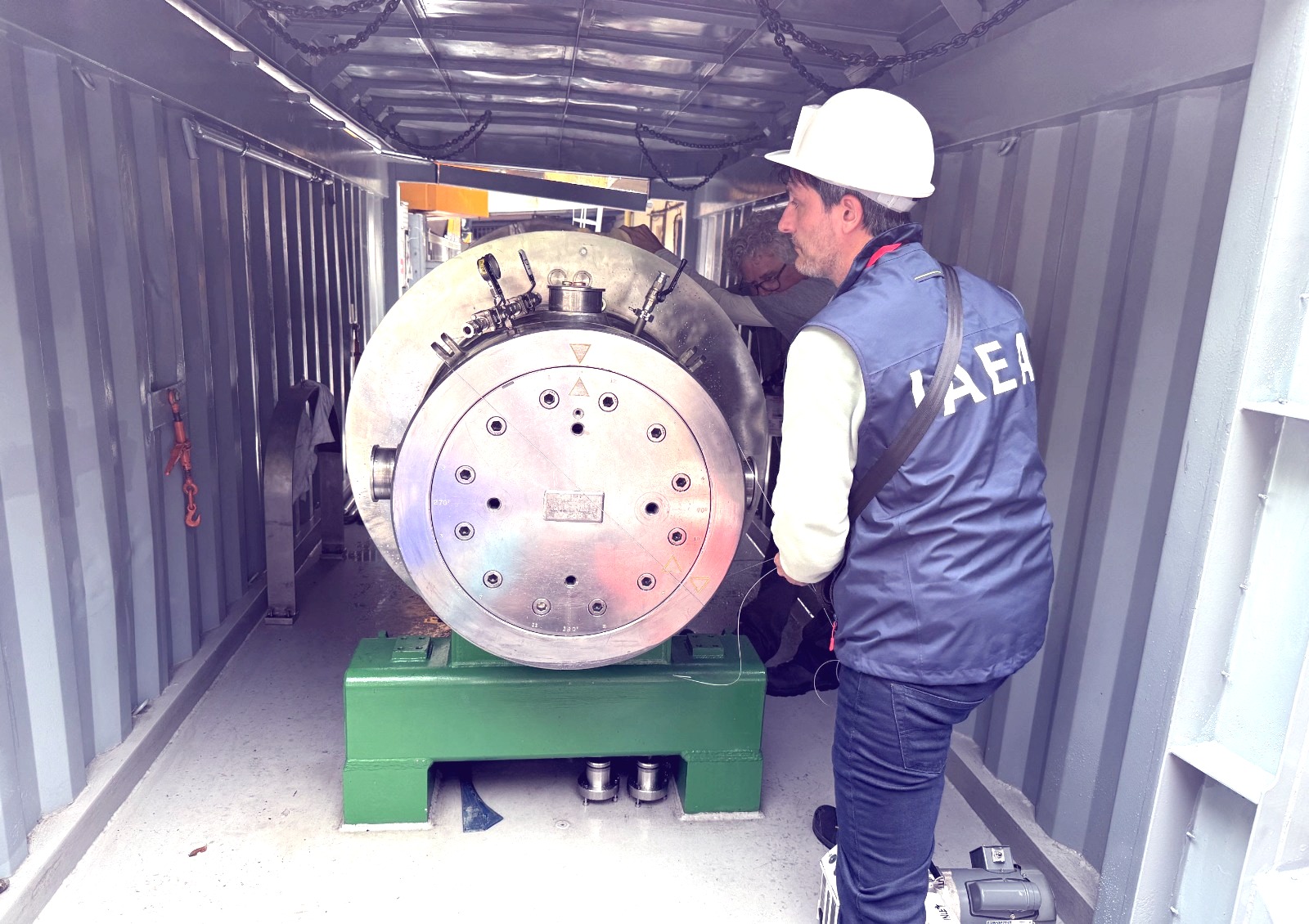
Vienna; May 2026: The International Atomic Energy Agency (IAEA) has played a key role in the successful shipment of high enriched uranium (HEU) from Venezuela to the United States, in a carefully planned joint mission carried out under tight security as such nuclear material can pose a proliferation risk or security threat if it falls into the wrong hands.
Implementing a complex and sensitive operation, the three countries involved: the United Kingdom, the United States and Venezuela, and the IAEA worked closely together to ensure that the cargo of 13 kilograms of HEU was safely and securely transported by land and sea from South to North America.
“This has been an example of the strong will, effective coordination, dedication and professionalism of all the parties involved”, said IAEA Director General Rafael Grossi.
“Working alongside our DOE/NNSA, UK, IAEA and Venezuelan counterparts, we’ve demonstrated how effective partnerships can eliminate nuclear proliferation risks and enhance global nuclear security”, said Christopher T. Yeaw, Assistant Secretary for the Bureau of Arms Control and Non-proliferation at the U.S. Department of State.
The uranium, in the form of nuclear fuel enriched to just above 20% of the fissile isotope uranium-235, was transferred from a shutdown research reactor at the Venezuelan Institute for Scientific Research (IVIC), 15 km southwest of the capital Caracas, to the Savannah River Site of the U.S. Department of Energy in South Carolina.
As the international centre for cooperation in the nuclear field, the IAEA supported the transportation of the fuel from the RV-1 reactor, which operated for three decades until 1991, by providing nuclear safety and security guidance, training and technical expertise. Under its global verification mandate, the IAEA continued to apply safeguards to the nuclear material throughout the process.
In recent decades, the IAEA has supported international efforts to eliminate HEU from research reactor sites worldwide in order to reduce the proliferation risks associated with uranium enriched to higher levels. During its lifetime, the Venezuelan reactor used nuclear fuel containing uranium both from the United States and the United Kingdom. After this mission, no fuel remains in the reactor.
The Venezuelan Government requested the IAEA’s assistance to transport also this fuel from the country, and the U.S. Government decided to accept the material and to provide a special transportation container for the shipment to the Savannah River Site, paving the way for the high-security mission to proceed.
In late April, a night time convoy protected by the Venezuelan military departed the IVIC for the port town of Puerto Cabello, where the fuel container was loaded onto a UK ship, which immediately headed to the United States, where it safely arrived at the Savannah River Site in early May.
While most research reactors were built in the 1960s and 70s with technology that required HEU to perform experiments intended for scientific research, today much of this research can be carried out using low enriched uranium (LEU), in which the concentration of uranium-235 is below 20%.
To date, 111 research reactors and medical isotope production facilities have been converted from the use of HEU to LEU or confirmed as being shut down, and over 6930 kilograms of HEU have been repatriated from dozens of countries to their country of origin or otherwise dispositioned. Nuclear power reactors, which are used to generate electricity, run on LEU.
Team Maverick.







Habuild at 6: ‘We Are Not Just Teaching Yoga, We Are Helping Millions Build Lifelong Healthy Habits’
As Habuild celebrates six years of transforming lives through wellness, its founder reflec…

Habuild at 6: ‘We Are Not Just Teaching Yoga, We Are Helping Millions Build Lifelong Healthy Habits’
As Habuild celebrates six years of transforming lives through wellness, its founder reflects on …