PM Modi’s Cultural Diplomacy Shines Through Handpicked Indian Heritage Gifts During Europe Visit

New Delhi/Amsterdam, May 2026: Prime Minister Narendra Modi’s recent diplomatic tour across Europe and the Middle East was marked not only by strategic discussions and economic partnerships but also by a carefully crafted display of India’s rich artistic and cultural heritage. During his State Visits to the Netherlands and Italy, the Prime Minister presented specially curated Indian gifts to world leaders, showcasing centuries-old craftsmanship, folk traditions, classical arts, and sustainable textile practices that reflect the diversity and depth of Indian civilisation.
The gifts — ranging from Jaipur’s iconic Blue Pottery and Rajasthan’s Meenakari-Kundan jewellery to Assam’s famed Muga silk and Bihar’s Madhubani paintings — carried deep symbolic meaning, blending diplomacy with culture and highlighting shared values between India and its global partners.
Blue Pottery Gift for Dutch King Reflects Shared Ceramic Traditions
During his visit to the Netherlands, Prime Minister Modi gifted King Willem-Alexander a piece of Jaipur Blue Pottery, one of India’s most celebrated traditional crafts and a Geographical Indication (GI)-tagged art form from Rajasthan.
Blue Pottery is renowned for its vibrant cobalt-blue patterns, delicate floral motifs, and intricate bird designs. Unlike conventional pottery, the craft is unique because it does not use clay. Instead, artisans create the pottery using a specialised mixture of quartz powder, powdered glass, Fuller’s earth, borax, gum, and water. This distinctive composition gives the pottery its translucent texture and glass-like finish.
The craft is believed to have Persian origins and later flourished in Jaipur under royal patronage. Over the centuries, it evolved into one of Rajasthan’s most iconic artistic traditions. The pottery is fired at relatively low temperatures, which helps preserve its vivid colours and smooth surface sheen.
The choice of Blue Pottery also carried cultural symbolism relevant to the Netherlands. The gift drew a parallel with the Netherlands’ globally recognised Delft Blue pottery tradition, known for its blue-and-white ceramic artistry. By presenting this gift, Prime Minister Modi highlighted a shared appreciation between India and the Netherlands for fine ceramic craftsmanship, heritage preservation, and artistic excellence.
Royal Jewellery for Queen Maxima
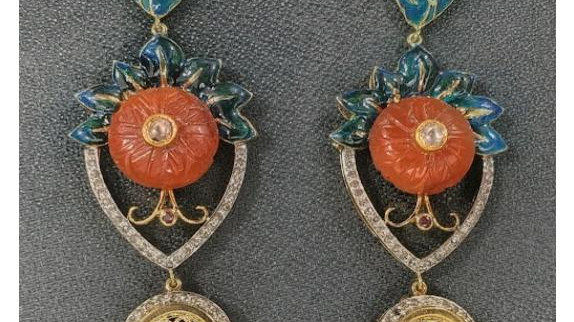
For Queen Maxima of the Netherlands, Prime Minister Modi selected a pair of traditional Meenakari and Kundan earrings, representing two of India’s most refined jewellery-making traditions.
Meenakari is an ancient enamelling technique in which vibrant colours are fused onto metal surfaces to create intricate decorative patterns. The art flourished particularly in Rajasthan and remains associated with royal Indian jewellery traditions. Kundan jewellery, meanwhile, involves the setting of uncut gemstones into gold foil, producing elegant and regal ornaments known for their intricate detailing.
Together, the two techniques symbolise the grandeur of India’s royal craftsmanship traditions. The earrings gifted to Queen Maxima were also designed with colours carrying symbolic significance for the Netherlands. Orange represented the Dutch Royal House of Orange-Nassau and symbolised national pride and unity, while blue reflected openness, calmness, and the Netherlands’ historical relationship with water and maritime culture.
The gift was viewed as a thoughtful blend of aesthetics, symbolism, and diplomatic sensitivity.
Madhubani Painting Highlights Sustainability and Ecology
Prime Minister Modi also gifted Dutch Prime Minister Rob Jetten a traditional Madhubani painting featuring a fish motif, linking Indian folk traditions with environmental consciousness and ecological harmony.
Madhubani art, also known as Mithila painting, originates from the Mithila region spanning parts of Bihar and Nepal. Traditionally practised by women, the art form is characterised by bold colours, geometric patterns, and symbolic imagery drawn from mythology, nature, and daily life.
The fish motif featured in the artwork holds deep cultural significance in Indian tradition. It symbolises fertility, prosperity, harmony, abundance, and continuity of life. In Madhubani art, fish are also considered carriers of positive energy and ecological balance.
The symbolism of the gift extended beyond Indian tradition. It also drew a connection with the Netherlands’ Fish Migration River project at the Afsluitdijk, an environmental initiative aimed at restoring natural aquatic pathways and preserving biodiversity. Through this gesture, the Prime Minister linked Indian folk heritage with contemporary global concerns such as sustainability, environmental restoration, and climate-conscious development.
Assam’s Golden Silk Presented to Giorgia Meloni
During his visit to Italy, Prime Minister Modi continued the cultural diplomacy initiative by presenting Italian Prime Minister Giorgia Meloni with a Muga silk stole and a Shirui Lily silk stole.
Muga silk, often called the “Golden Silk” of Assam, is one of India’s rarest and most prestigious natural textiles. Produced primarily in the Brahmaputra Valley, the silk is known for its natural golden sheen, remarkable durability, and luxurious texture.
Unlike many commercial fabrics, Muga silk is produced without artificial dyes, making it environmentally sustainable and culturally authentic. Its shine naturally deepens over time, and the fabric is valued for its moisture-absorbing and UV-resistant qualities.
For generations, Muga silk has represented prestige and refinement in Assamese culture. The gift also reflected a connection with Italy’s internationally renowned heritage in luxury textiles, fashion, and craftsmanship, creating another subtle cultural bridge between the two nations.
Rare Shirui Lily Symbolises Indigenous Heritage
The second stole gifted to Giorgia Meloni drew inspiration from the rare Shirui Lily flower of Manipur. The flower blooms exclusively in the Shirui Kashong Peak region and is considered a symbol of purity, beauty, and cultural identity by the Tangkhul Naga community.
The stole celebrated not only India’s indigenous textile traditions but also the cultural stories and folklore associated with the Himalayan region. The pale pinkish-white petals of the Shirui Lily have long inspired local art and weaving traditions.
Interestingly, lilies also hold deep symbolic value in Italian culture, where they are associated with grace, artistic refinement, and purity, frequently appearing in Renaissance-era artwork and architecture. The gift therefore represented a shared cultural symbolism between India and Italy despite geographical distance.
Marble Inlay Box Connects Agra and Florence
Prime Minister Modi also presented Italian President Sergio Mattarella with a handcrafted Marble Inlay Work Box, along with musical compilations featuring legendary Indian classical musicians Pandit Bhimsen Joshi and M.S. Subbulakshmi.
The Marble Inlay Box represented the exquisite Indian art of Pacchikari, or Pietra Dura, associated with the craftsmen of Agra. Interestingly, the decorative technique traces its roots to Florence in Italy before flourishing in India during the Mughal era, particularly in monuments such as the Taj Mahal.
Crafted from polished white marble, the box featured intricate inlay work using semi-precious stones including lapis lazuli, turquoise, coral, malachite, and mother-of-pearl. The floral and geometric patterns demonstrated extraordinary precision and craftsmanship.
The gift symbolised a centuries-old artistic dialogue between India and Italy and celebrated the historical exchange of artistic traditions between the two civilisations.
Tribute to India’s Classical Music Heritage
Inside the marble box were recordings of Bharat Ratna awardees Pandit Bhimsen Joshi and M.S. Subbulakshmi, two towering figures in Indian classical music.
Pandit Bhimsen Joshi was one of the greatest exponents of Hindustani classical music, admired globally for his powerful renditions and mastery of the Kirana gharana tradition. M.S. Subbulakshmi, regarded as one of India’s finest Carnatic vocalists, became an international cultural icon through her spiritually uplifting performances, including her historic recital at the United Nations.
By gifting these recordings, Prime Minister Modi highlighted India’s musical legacy and the universal appeal of classical art forms that transcend linguistic and geographical boundaries.
Diplomatic Outreach Beyond Symbolism
Prime Minister Modi’s five-nation diplomatic tour, which included visits to the UAE, the Netherlands, Sweden, Norway, and Italy, combined cultural outreach with strategic diplomacy and economic cooperation.
The visit to Italy proved particularly significant as India and Italy upgraded bilateral relations to a “Special Strategic Partnership.” Both nations also set an ambitious target to expand bilateral trade to €20 billion by 2029.
The two countries signed agreements covering agriculture, prevention of financial crimes, and mobility pathways for Indian healthcare professionals seeking opportunities in Italy. Discussions also advanced cooperation on the India-Middle East-Europe Economic Corridor (IMEC), seen as a major connectivity and trade initiative linking Asia, the Middle East, and Europe.
Through carefully chosen gifts rooted in India’s artistic traditions, Prime Minister Modi’s diplomatic engagements reinforced not only political and economic partnerships but also cultural connections built on shared heritage, creativity, sustainability, and mutual respect.
Team Maverick.



Microsoft Cuts 4,800 Jobs as AI Investments Reshape Business Strategy
New Delhi, July 2026: Microsoft has announced another major round of layoffs, cutting appr…
Recenzja gry zautomatyzowanych w kasynie online Potter Slots Casino: analiza funkcjonalności i rozgrywek hazardowych.
Co to jest Potter Slots Casino? Potter Slots Casino to aplikacja internetowa, która oferuje …