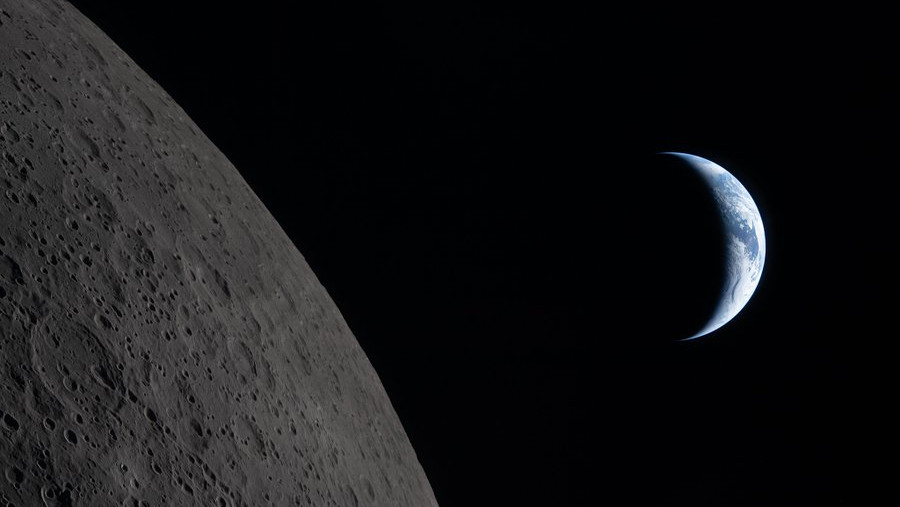
NASA Unveils Ambitious Plan for Permanent Moon Base at Lunar South Pole

Washington, May 2026 : NASA has announced an aggressive and expansive roadmap to establish a permanent Moon Base at the lunar South Pole, marking a major step in its long-term vision for sustained human presence beyond Earth and future missions to Mars.
The US space agency revealed a series of new contracts covering lunar terrain vehicles, cargo landers, and drone-based exploration missions, signaling an accelerated push toward building infrastructure capable of supporting long-duration human habitation on the Moon.
NASA Administrator Jared Isaacman described the initiative as a defining moment in space exploration, calling the Moon Base “America’s and humanity’s first outpost on another celestial world.”
“Every mission, crewed and uncrewed, will be a learning opportunity as we return to the lunar surface, build the infrastructure to stay, and master the skills required to live and operate in one of the most demanding and dangerous environments imaginable,” Isaacman said during a press briefing at NASA Headquarters in Washington.
He further termed the initiative as part of a “Golden Age of lunar exploration,” emphasizing that the program will not only support lunar operations but also prepare NASA for its ultimate goal—human missions to Mars. “We are building capabilities for where we will inevitably go next… Mars,” he said.
Three Early Moon Base Missions Planned
NASA announced three early demonstration missions under the Moon Base programme, all targeted before the end of 2026.
The first mission, Moon Base I, will use Blue Origin’s Blue Moon Mark 1 Endurance lander to deliver scientific payloads to the Shackleton Connecting Ridge near the lunar South Pole, an area of high scientific interest due to its extreme conditions and potential ice deposits.
The second mission, Moon Base II, will deploy Astrobotic’s Griffin lander carrying more than 1,100 pounds of cargo. This includes Astrolab’s FLIP rover, which will be used to test mobility systems designed for future astronaut exploration.
The third mission, Moon Base III, will be carried out using Intuitive Machines’ Nova-C Trinity lander. It will deliver scientific instruments, including the Lunar Vertex payload, which will study unusual “lunar swirls” observed on the Moon’s surface.
Major Contracts for Lunar Rovers and Mobility Systems
NASA also announced significant contracts to develop lunar mobility systems expected to support Artemis programme astronauts by 2028.
Astrolab received a $219 million contract to build advanced lunar terrain vehicles (LTVs), while Lunar Outpost was awarded $220 million for its own rover development programme.
Astrolab’s crewed lunar vehicle, based on its FLEX platform, will be capable of transporting astronauts and cargo across the lunar surface. Meanwhile, Lunar Outpost’s Pegasus rover will be able to operate in manual, autonomous, or teleoperated modes, reaching speeds of more than 9 miles per hour.
NASA officials said these rovers would enable astronauts to travel significantly farther than during the Apollo missions, while also allowing autonomous operations between crewed landings.
“We envision the Moon Base to be hundreds of square miles with different assets all building up to the objective of permanent lunar presence,” said Moon Base programme executive Carlos Garcia Golan.
Drone Missions and Commercial Partnerships
NASA also outlined a new mission concept called “MoonFall”, involving four autonomous lunar drones designed to hop across the Moon’s surface. These drones will survey potential landing zones and search for water ice deposits that could support future human settlements.
Firefly Aerospace has been selected to develop the carrier spacecraft that will deploy these drones into lunar orbit.
NASA officials stressed that the Moon Base programme will rely heavily on commercial partnerships and an iterative development model rather than a single large government-led infrastructure project.
“We are digging up the playbook from the 1960s,” Isaacman said. “We are going to get back to this iterative approach of learning.”
South Pole Chosen for Strategic Importance
NASA said the lunar South Pole was selected due to its scientific value and the possibility of water ice deposits, which could be crucial for sustaining human life and producing rocket fuel in the future.
The agency believes this region will form the foundation of humanity’s first long-term settlement on another world.








Rahul Gandhi Alleges RSS Has Taken Control of Education System, Urges Students to Defend Independent Thinking
New Delhi, July 2026 : Leader of the Opposition in the Lok Sabha Rahul Gandhi on Wednesday…

Rahul Gandhi Alleges RSS Has Taken Control of Education System, Urges Students to Defend Independent Thinking
New Delhi, July 2026 : Leader of the Opposition in the Lok Sabha Rahul …