Rome: Sapienza University Students Awaits The Holy Father’s Visit Tommorow.

Rome; May 2026: The atmosphere at the Sapienza University of Rome is full of excitement as students prepare for Pope Leo XIV’s visit tomorrow – on the morning of Thursday, May 14th. At 10:20 hours (local time; 13:50 hours IST). During the meeting, the Bishop of Rome will have a moment of prayer and time to greet the community before moving to the rectorate and the Aula Magna to deliver a speech.
At the main campus of Europe’s largest university, student’s study, conduct research, organize conferences, exhibitions, and concerts. “This is a laboratory of human hearts”, says chaplain Fr. Gabriele Vecchione, “with 125,000 students from all over the world who will shape tomorrow. Here, we aim to live faith with a rational approach worthy of the 21st century”.
To the young men and women who gather in the Chapel, it has become like home. One student recalls that during her undergraduate years, she never experienced faith on campus, despite her longstanding involvement in her parish since middle school. “Now to find other students like me, who long for something more, is wonderful. It’s like finding inner unity”, she shared. “A year ago, I was in St. Peter’s Square to see the white smoke from the Sistine Chapel. So, this Pope is special for me because I experienced the moment he was elected. It’s historic that he’s coming to Sapienza; it makes me hopeful by placing hope in us young people”. She adds that at Sapienza University she has found a family, “a place slowly showing me what it means to be a daughter, and I needed that”.
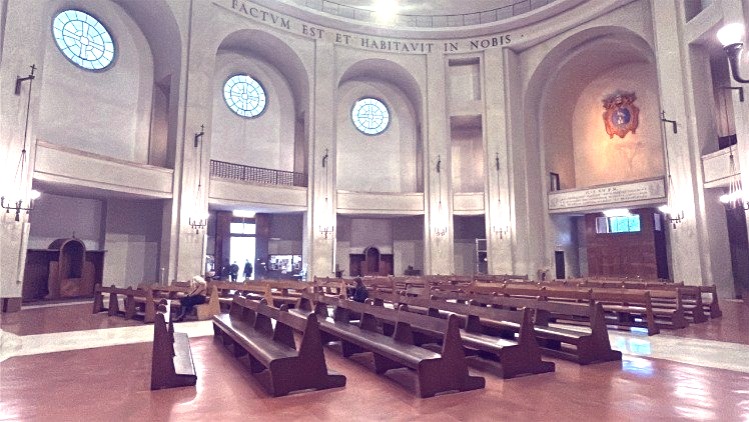
In the late afternoon, some students can be found in adoration before the main altar at the university chapel. Behind it is a small chapel for group meetings. The furnishings are simple, and the light is dim. One floor down is a large circular study hall where students can study.
Beatrice, an Economics and Finance student who helps in organising activities, recalls how she always felt like “a perpetual stranger” because she moved a lot. Now, for her, this chapel means everything. “I come here when I’m sad, scared, happy, in need of company, or even to be alone. Over the years, moving around made it hard to feel like a daughter”. However, at the university, she has found a family. “In my first year, I felt immense loneliness. I was lost, in a dark alley. But gradually, I’ve found my way. Now I feel part of all this wonder”, Beatrice explained.
For a student namely Lorenzo, the Chapel is also a place of refuge in moments of weakness and reflection. “It’s a space in which to question oneself. For us, whether believers or not, it’s fundamental…I come every week just to talk. Often, I just walk by, and I go in”.
A young man from the southern city of Salento who studied Cinema Design and is awaiting work, shares: “At 16, I completely stopped going to church. Two years ago, I started the Ten Commandments course with Fr. Fabio Rosini. I don’t consider myself fully Christian yet, but I’m on a path. Jesus is both human and divine, and that closeness resonates with me”.
Another student of Art History, from Italy’s Molise region, says entrusting everyday life “to the One who knows everything” is essential. “Faith opens many doors in my life”. He emphasised that study and faith are not separate worlds. He recalls an October initiative to collect toys for children at the Umberto I Hospital: “I contributed. Since then, a wonderful group has formed where everyone feels welcome. Our role is to welcome and bring comfort to those in need”.
Two priests living in the Chapel’s basement oversee its activities. Father Claudio Tagliapietra, one of the vice-chaplains, explains the value of being immersed in university life: “We never ask ourselves how to attract young people. Instead, we ask ourselves how to meet them and speak to them about their anxieties. Only then do you speak the same language. Often, they are seeking a father, a brother. Sometimes, a casual conversation leads to something deeper”.
Pope Leo’s upcoming visit, he says, highlights the challenge of uniting two forms of wisdom: God’s and humanities. “Both come from the same source; we just need to listen with our hearts”, he explains.
In response, Father Tagliapietra referred key figures in Church history. St. Thomas Aquinas and his vision of wisdom; St. Augustine who was a teacher with a burning and wise heart; and St. John Henry Newman, who proposed a high ideal of university life. The goal, he explains, is to unify knowledge, which can inspire the Chapel groups that organize meetings and prayer sessions to look beyond their immediate circle.
The vice-chaplain also cites the Italian Constitution, which mentions the spiritual progress of work — often overlooked today. As a professor at the Pontifical University of the Holy Cross in Rome, he reflects: “Educating is one of our noblest missions as teachers: to show students all the beauty God sees in them, and providing them with the tools to become who they are meant to be”.
Education means bringing out the best in ourselves and others. It means stepping outside ourselves to respond to the needs of others. This year on May 04th, for example, at the Chapel Auditorium, a night of remembrance and reflection was held for 16 Gazan students with scholarships, ensuring that Gaza’s suffering is not forgotten.
Another event is the May contemporary literature festival, Giardini d’Inchiostro, organised by Father Gabriele Vecchione, who is also vice-director of the diocesan office for university pastoral care. “In confession, I’ve often heard young people recount how they no longer wanted to live”, he confides. “What I always do is remind them that this period is a phase in life that will pass”.
Father Vecchione avoids oversimplifications, particularly in matters of spirituality. “The Church has an arsenal, an immense reserve of spirituality”, he continues, “St. John of the Cross, in his dark night, described what we would call depression, but also how to pass through it and encounter God. So, the language of the psyche is part of faith, not foreign to it”.
Father Vecchione, who was found to be critical of the pervasive use of social media, describes it as a ‘catastrophe’ because of its addictive impact. He warns of a widespread neural crisis causing attention disorders, depression, and burnout.
The chaplain also criticised uncontrolled AI use: “Even professors have become like prosecutors hunting for plagiarism. The university is a place of effort and reflection, you don’t graduate with a snap of the fingers; you don’t go from zero to one hundred in three days”.
In the world today, Father Vecchione argues that young people are often swept up in a rhetoric that tries to define them. Going further, he says adults have ruined the world, “and then we expect young people not to doze off. They didn’t ask to be born. They are here, and we owe them explanations”.
Moreover, the chaplain explains a growing sense of paternalism regarding young people. “We can’t escape it”, he stressed, “We project certain expectations onto them. Those who teach young people should ask what they truly desire. Instead, we put them on the industrial conveyor belt; they become like objects moving along it, all heading toward jobs they may come to hate”.
First and foremost, we need to re-educate the youth about how to achieve their true goals. “It’s extremely difficult because wishing for something is always something foreign. A child generally desires something different from what their parents want, so living in that otherness is very hard.”
Therefore, here at the Sapienza University, fostering familiarity and encouraging healthy relationships are among the priests’ main endeavours. When someone knocks on the Chapel door, it is usually to ask for guidance, for five minutes of conversation, or for confession. “But ultimately, everyone is seeking fatherhood, but someone who believes in them”.
Team Maverick.


Pakistan Appoint Mike Smith as Test Batting Coach Amid Batting Crisis
Mumbai, Aug 2026 : Pakistan have appointed former South African first-class cricketer and …
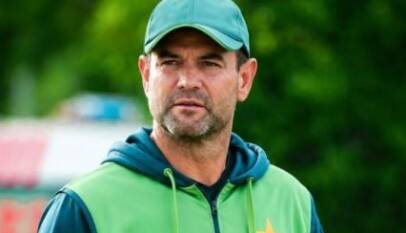
Pakistan Appoint Mike Smith as Test Batting Coach Amid Batting Crisis
Mumbai, Aug 2026 : Pakistan have appointed former South African first-class cricketer and Level …