Nadda Targets Telangana Government, Calls It ‘ATM Sarkar’ for Congress Leadership

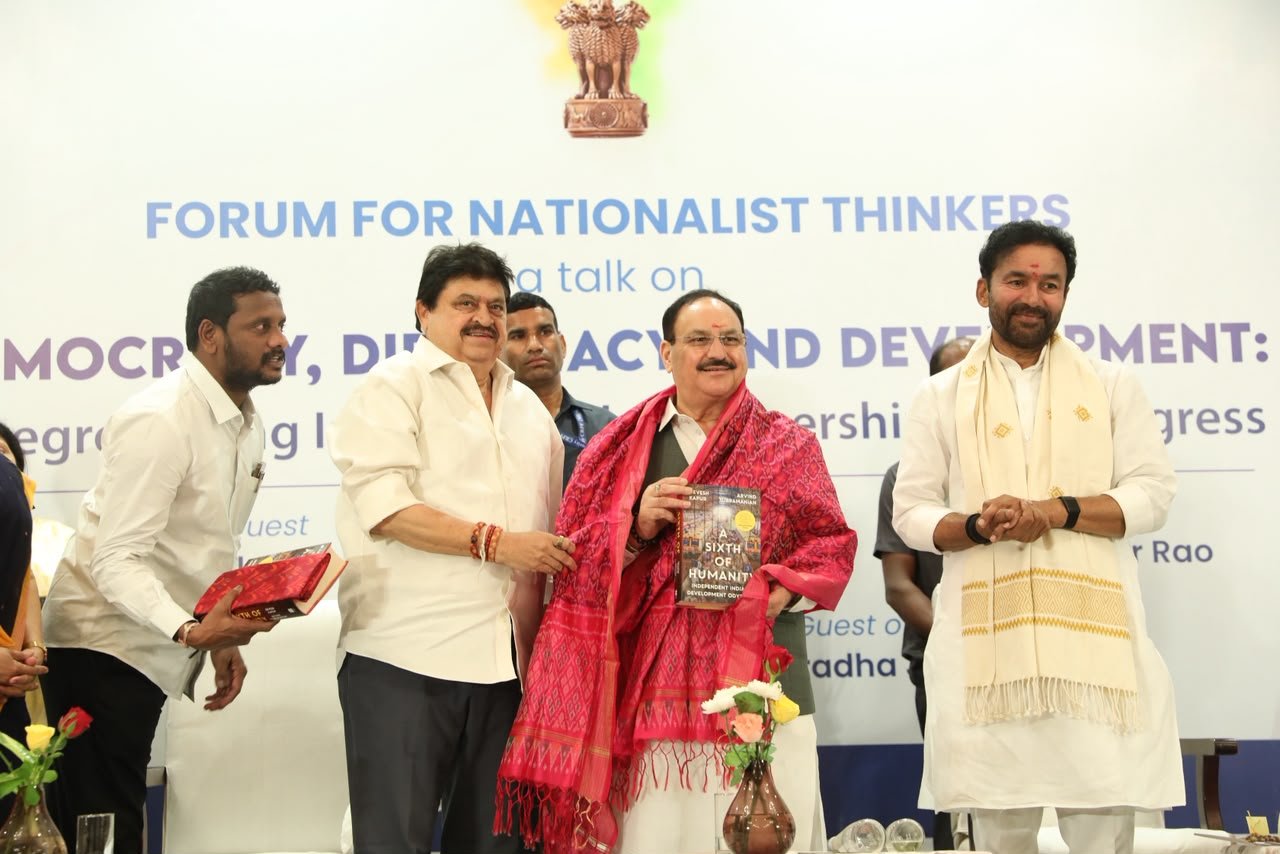
Hyderabad, July 2026 : Union Minister for Health and Family Welfare J.P. Nadda on Thursday launched a sharp political attack on the Congress-led Telangana government, accusing it of functioning as an “ATM Sarkar” for the Congress high command in Delhi. Addressing a gathering of intellectuals during his one-day visit to the state, Nadda alleged that the state administration was diverting public resources to benefit the party’s central leadership while failing to address the aspirations of Telangana’s people.
Claiming that the Congress government had turned governance into a mechanism for political funding, Nadda alleged that, based on statements attributed to Chief Minister A. Revanth Reddy, Telangana was expected to send around Rs 1,000 crore annually to the Congress leadership in Delhi. He said such allegations reflected the priorities of the state government and questioned its commitment to public welfare.
The Union Minister also accused the Congress government of presiding over a corruption-ridden administration. Referring to alleged irregularities in the Kaleshwaram Lift Irrigation Project and the double-bedroom housing scheme, Nadda claimed that project costs had been inflated while many deserving beneficiaries continued to remain outside the ambit of government assistance. He asserted that these examples highlighted what he described as a pattern of financial mismanagement and misuse of public funds.
Contrasting the Centre’s governance model with that of the Telangana government, Nadda said India was moving rapidly towards the goal of becoming a developed nation by 2047 under the leadership of Prime Minister Narendra Modi. He credited the Prime Minister with strengthening democratic institutions, enhancing India’s global reputation and transforming the country into a respected international power.
“Today, every Indian travels abroad with greater confidence and pride because the world recognises India’s growing credibility,” Nadda said. He added that India had evolved from being a nation dependent on international assistance to one that extends support to others. As an example, he cited the government’s ‘Vaccine Maitri’ initiative during the Covid-19 pandemic, under which India supplied vaccines to nearly 100 countries, including free doses to 45 nations.
Highlighting the Centre’s emphasis on transparency, the Union Minister said technology-driven governance had eliminated large-scale leakages in welfare programmes. Referring to the famous observation made decades ago by a former Prime Minister that only 15 paise of every rupee reached the intended beneficiary, Nadda said the situation had changed dramatically under the Modi government.
He claimed that nearly Rs 51 lakh crore had been transferred directly into beneficiaries’ bank accounts through Direct Benefit Transfer (DBT) schemes over the past decade, preventing leakages estimated at around Rs 4.3 lakh crore. According to him, the digital governance framework had significantly improved transparency and ensured that government assistance reached the rightful recipients without middlemen.
Speaking on India’s economic progress, Nadda highlighted the country’s emergence as the “pharmacy of the world.” He said India’s pharmaceutical exports had reached Rs 2.6 lakh crore in 2025, with medicines being supplied to 291 countries worldwide. He also noted that electronics manufacturing in the country had increased by nearly 500 per cent, reflecting the success of the Centre’s push for domestic production and industrial growth.
Rejecting repeated allegations by the Telangana government that the Centre had neglected the state, Nadda described such claims as “a bundle of lies.” He asserted that Telangana had received its full constitutional share of tax devolution amounting to Rs 2.74 lakh crore and accused the Congress of attempting to create an unnecessary “South versus North” narrative for political gains.
The Union Minister also highlighted major infrastructure investments made by the Centre in Telangana. He said the Union government had sanctioned projects worth Rs 1.74 lakh crore for the development of national highways, resulting in the construction of 2,674 kilometres of highways over the past decade. These projects, he said, were aimed at ensuring that every part of Telangana could be connected to Hyderabad within four hours.
He further pointed to the ongoing redevelopment of 42 railway stations across the state as part of the Centre’s efforts to modernise transport infrastructure and improve passenger facilities.
Calling upon citizens to actively participate in the nation-building process, Nadda said achieving the vision of a developed India by 2047 would require the collective efforts of governments, institutions and society.
Earlier in the day, Nadda, accompanied by Union Minister for Coal and Mines G. Kishan Reddy, visited the All India Institute of Medical Sciences (AIIMS) at Bibinagar on the outskirts of Hyderabad. During his visit, he reviewed the progress of the premier healthcare institution and highlighted the Centre’s achievements in expanding India’s medical infrastructure.
He noted that until the end of the 20th century, India had only one AIIMS institution in New Delhi. During the tenure of former Prime Minister Atal Bihari Vajpayee, six additional AIIMS institutions were established. Since 2014, however, the number of AIIMS institutions has risen to 23 under Prime Minister Modi’s leadership. Of these, 18 are already operational, while the remaining institutes are under various stages of construction.
Nadda said the government had built an integrated healthcare system that combines primary healthcare with advanced super-speciality services. He highlighted that nearly 1.85 lakh Ayushman Arogya Mandirs are currently providing primary healthcare services to around 15 lakh people across the country. He also noted that the number of medical colleges had increased from 370 to 820, significantly boosting medical education and healthcare capacity.
Speaking about AIIMS Bibinagar, the Health Minister said the institution, sanctioned in June 2022, had made remarkable progress in a short period. While over Rs 1,000 crore had been sanctioned for its development, approximately Rs 110 crore had already been utilised. The institute currently has 132 faculty members and 133 senior doctors and offers MBBS, MD programmes in 24 disciplines and DM/MCh courses in five super-speciality streams.
According to Nadda, AIIMS Bibinagar now provides all major speciality services through its outpatient department, where nearly 1,800 patients receive treatment every day, making it one of the fastest-growing premier healthcare institutions in the country.

PM Modi, Australian Opposition Leader Angus Taylor Reaffirm Bipartisan Commitment to Stronger India-Australia Ties
Melbourne, July 2026 : Prime Minister Narendra Modi on Friday met Australian Opposition Le…
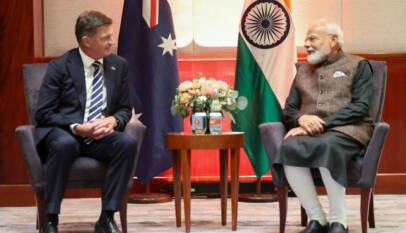
PM Modi, Australian Opposition Leader Angus Taylor Reaffirm Bipartisan Commitment to Stronger India-Australia Ties
Melbourne, July 2026 : Prime Minister Narendra Modi on Friday met Australian Opposition Leader …