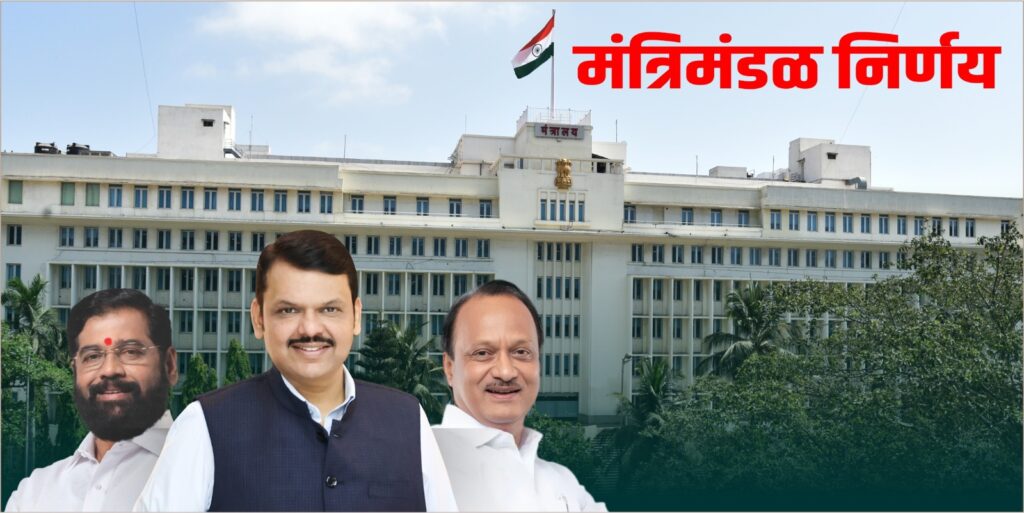
Maharashtra Cabinet Decisions

From April 1, Toll Collection in the State to Be Done Exclusively via FASTag
Starting April 1, 2025, toll collection for all vehicles at toll plazas in the state will be carried out exclusively through FASTag. This decision, which involves amendments to the Public-Private Partnership Policy of 2014, was approved in today’s cabinet meeting chaired by Chief Minister Devendra Fadnavis.
The use of FASTag for toll collection is expected to bring greater efficiency and transparency. It will reduce vehicle congestion at toll plazas, saving both time and fuel. If toll is paid through any means other than FASTag or if a vehicle enters a FASTag lane without an active tag, a penalty of double the toll amount will be imposed.
Currently, toll is being collected at 13 road projects managed by the Public Works Department and 9 projects under the Maharashtra State Road Development Corporation. This decision will apply to these projects as well as any future toll projects.
Revised Maharashtra Government Rules of Business to Streamline Administrative Operations
In today’s cabinet meeting chaired by Chief Minister Devendra Fadnavis, approval was granted to publish a revised version of the Maharashtra Government Rules of Business. The updated rules aim to simplify and expedite administrative operations.
The revisions include provisions for cases to be presented to the cabinet, cases requiring the Chief Minister’s or the Governor’s approval, and the procedural framework for the Cabinet and the Council of Ministers. The original Rules of Business were drafted in 1975, and this marks the third time the rules have been revised.
The revised rules will be published in the Government Gazette following the Governor’s approval. The changes are expected to make government operations more transparent, efficient, and citizen-centric, benefiting the state’s populace.
To ensure the updates were in line with modern requirements, a study group comprising departmental secretaries was formed. The group conducted a comparative analysis of the rules of the Government of India and other states before recommending these revisions.
The updated Rules of Business consist of 48 rules, 4 schedules, and 1 annexure, divided into nine sections.
- The first schedule lists the names of administrative departments.
- The second schedule provides a detailed account of cases to be presented before the Cabinet.
- The third schedule outlines cases requiring the Chief Minister’s approval, while the fourth schedule details those requiring the Governor’s approval.
- The annexure elaborates on the procedures for the Council of Ministers and the Cabinet, including streamlined processes for presenting bills.
Additionally, the new rules incorporate responsibilities of the Planning Department and stipulate that government orders must be issued at the level of at least an Under Secretary.
The revised Rules of Business will help simplify and accelerate decision-making processes, thereby enhancing the efficiency and transparency of government operations.




South Africa Midfielder Jayden Adams Dies at 25, Nation Mourns Rising Football Star
Johannesburg, July 2026 : South African football has been plunged into mourning following …

South Africa Midfielder Jayden Adams Dies at 25, Nation Mourns Rising Football Star
Johannesburg, July 2026 : South African football has been plunged into mourning following the …