
Despite 57 crore devotees bathing, Ganga water remains as pure as alkaline water

Padma Shri Ajay Sonkar, famous for his discussion with APJ Abdul Kalam, scientifically proves Ganga water’s purity
The nation’s leading scientist debunks doubts about Ganga’s purity with laboratory evidence
Sonkar dears skeptics to test Ganga water’s purity in the lab
Prayagraj scientist who created pearls from oyster tissue culture 2,000 km from Andaman makes a major revelation
The scientist who challenged the Japanese supremacy in the world of pearl farming collected Ganga water from not one or two but 05 ghats, including Sangam-Arail, and tested it
Research proves Ganga water is the purest and safest to take bath
Laboratory tests confirm that bacteriophages preserve Ganga water’s remarkable self-purifying ability in every way
Mahakumbh Nagar : Over 57 crore devotees have taken a holy dip in the Ganga during the Mahakumbh, yet its purity remains unaffected. Padma Shri scientist Dr Ajay Kumar Sonkar, who has previously engaged in scientific discussions with Missile Man Dr APJ Abdul Kalam, has proven in his laboratory that Ganga water is not only fit for bathing but is as pure as alkaline water.
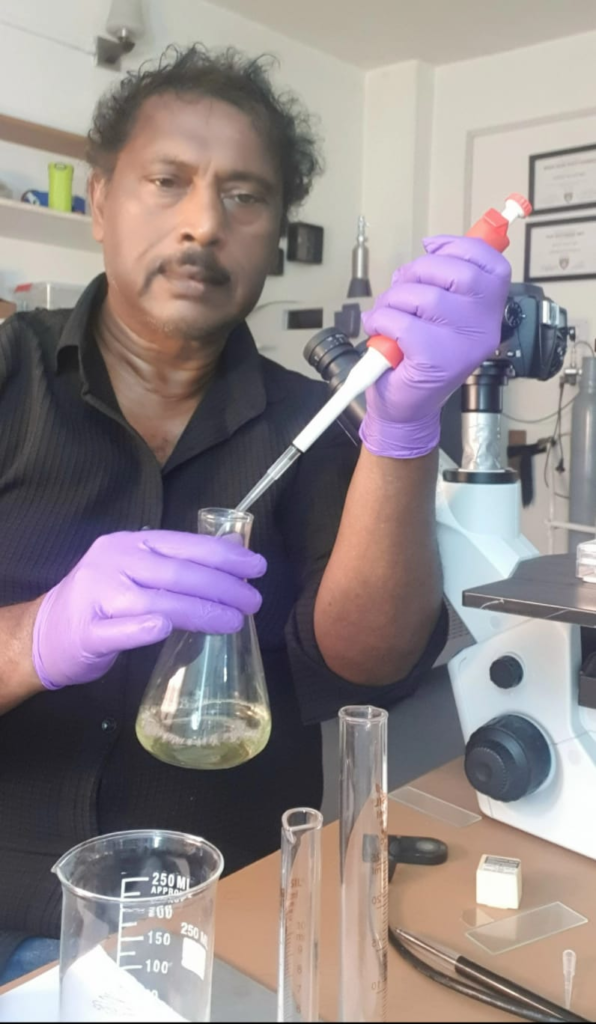
Challenging sceptics, the renowned scientist has debunked doubts about Ganga’s purity with scientific evidence. He has issued an open challenge, inviting anyone with even the slightest doubt to bring Ganga water before him and verify its purity through laboratory testing.
Dr. Sonkar, known for challenging Japan’s dominance in pearl farming, collected Ganga water samples from five ghats, including Sangam and Arail. After three months of rigorous research, he confirmed that Ganga water remains the purest, posing no risk to bathers. Laboratory tests have further validated that, due to the presence of bacteriophages, Ganga water retains its extraordinary self-purifying ability in every way.
India’s top scientist, Dr Ajay Kumar Sonkar, collected water samples from five major bathing ghats, including Sangam Nose and Arail in Mahakumbh Nagar. These samples were then subjected to microscopic examination in his laboratory. To his surprise, despite crores of devotees bathing in the river, there was no bacterial growth or decline in the water’s pH level.
Dr Sonkar’s research revealed that Ganga water contains 1,100 types of bacteriophages—natural viruses that eliminate harmful bacteria. This self-purifying mechanism ensures that the river remains uncontaminated even after 57 crore devotees have taken a dip.
Despite media reports and claims by specific organizations suggesting that Ganga water is unfit for Achman and bathing, Dr Sonkar’s findings have completely disproved these assertions. He confirmed that the river’s pH level, ranging between 8.4 and 8.6, is better than normal and that no foul smell or bacterial growth was detected.
No harmful bacteria developed after incubating the water samples for 14 hours. Dr. Sonkar further emphasized that Ganga water is safe for bathing and does not cause skin diseases upon contact. He has openly challenged sceptics to accompany him to the ghats, collect water samples, and verify their purity in the laboratory. Despite over 57 crore people bathing in the river during the Mahakumbh, Ganga water remains naturally disease-free due to its inherent purifying properties.
Dr Sonkar highlighted a significant aspect of the Mahakumbh—how Ganga water was portrayed as highly polluted even before the event began. He questioned these claims, stating that if the river were indeed contaminated, there would have been a global outcry by now, with hospitals overwhelmed by patients.
However, the extraordinary self-purifying power of Mother Ganga has ensured that even after 57 crore devotees took a holy dip, not a single individual suffered any harm. He challenged those spreading misinformation to explain why not even one of these 57 crore devotees reported any illness if the water were polluted.
Dr Sonkar further explained that bacterial growth in water typically leads to increased acidity, as many bacteria produce acidic byproducts like lactic acid or carbonic acid, which lower the pH level.
However, laboratory tests of five different water samples from the Ganga revealed an alkaline nature, with pH levels consistently ranging from 8.4 to 8.6. This indicates the absence of harmful bacterial activity.
Moreover, the number of living bacteria in the samples was extremely low, and they lacked the biological capability to multiply. Even under incubation at 37°C, bacterial growth remained stagnant, further proving that Ganga water retains its natural purity and remains free from contamination.








Wimbledon Final Locked at One Set Each as Sinner Fights Back Against Zverev
London, July 2026 : World No. 1 Jannik Sinner displayed remarkable resilience to fight bac…

Wimbledon Final Locked at One Set Each as Sinner Fights Back Against Zverev
London, July 2026 : World No. 1 Jannik Sinner displayed remarkable resilience to fight …