Yogi govt brings light and livelihood to people through solar energy

Lucknow : The Uttar Pradesh government is using solar energy not just to light up homes, but also to create jobs for the youth. Under the leadership of Chief Minister Yogi Adityanath, the state has launched a new plan to train and employ 30,000 young people in the solar energy sector by 2027.
This initiative is being carried out by the Uttar Pradesh New and Renewable Energy Development Agency (UPNEDA), in collaboration with the National Institute for Micro, Small and Medium Enterprises (ni-msme) and the Ministry of Skill Development and Entrepreneurship. The initiative is equipping youth across the state with solar technology skills to help them become self-reliant in the future.
Recognizing the rising demand in the solar energy sector, the state government envisions a wave of new job opportunities for youth in roles such as installation technicians, maintenance engineers, and site supervisors. To meet this emerging need, special training programs are being rolled out to equip young people with the necessary skills.
UPNEDA, along with the National Institute for Micro, Small and Medium Enterprises and the Ministry of Skill Development, is training vendors under the “Surya Ghar” scheme. So far, nearly 1,800 people have been trained.
In addition, programs like Surya Mitra Training, Solar Shops, and the Surya Sakhi Yojana are also being implemented. These schemes aim to provide training and jobs not only to youth, but also to women in rural areas. The government’s goal is to make Uttar Pradesh self-reliant in solar energy while also empowering women and youth economically.
Uttar Pradesh has set a target to produce 22,000 megawatts of solar energy by 2027. To meet this goal, specific production targets have been allocated across different sectors. The government aims to generate 4,500 MW from residential rooftop solar systems, 1,500 MW from non-residential rooftops, 2,000 MW through the PM-KUSUM scheme for farmers, and the largest share—14,000 MW—from utility-scale solar projects.
Under the PM-KUSUM scheme, farmers are being provided with solar-powered pumps, which not only reduce irrigation costs but also offer them the opportunity to earn additional income by selling surplus energy. Similarly, under the rooftop solar scheme, both residential and commercial buildings are being encouraged to install solar panels, helping users meet their own electricity needs while cutting power bills.

PM Modi, Australian Opposition Leader Angus Taylor Reaffirm Bipartisan Commitment to Stronger India-Australia Ties
Melbourne, July 2026 : Prime Minister Narendra Modi on Friday met Australian Opposition Le…
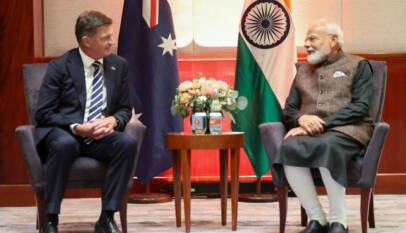
PM Modi, Australian Opposition Leader Angus Taylor Reaffirm Bipartisan Commitment to Stronger India-Australia Ties
Melbourne, July 2026 : Prime Minister Narendra Modi on Friday met Australian Opposition Leader …