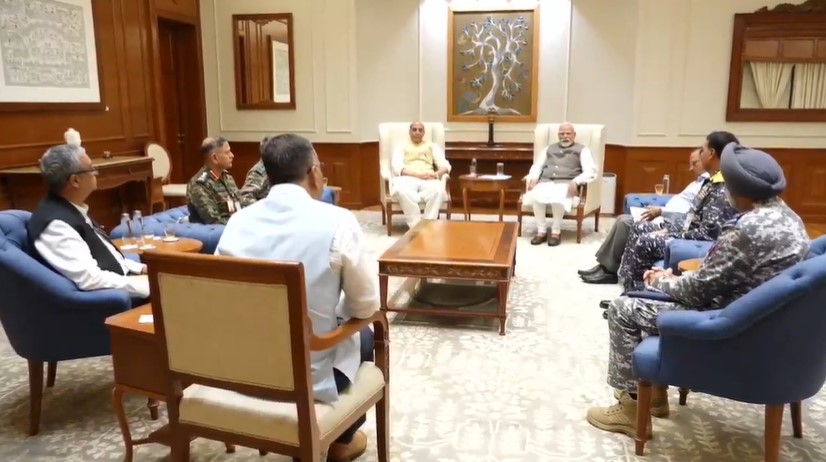
High-Level Meet at PM’s Residence Amid India-Pakistan Tensions

New Delhi – As military tensions between India and Pakistan escalate, a high-level emergency meeting is underway at Prime Minister Narendra Modi’s residence. Defence Minister Rajnath Singh, the Chiefs of the three armed forces, Chief of Defence Staff (CDS) General Anil Chauhan, and National Security Advisor Ajit Doval are participating in the strategic discussions. The meeting comes amid a sharp rise in hostilities following Pakistan’s recent missile and drone attacks on several Indian cities.
On the night of May 8, Pakistan launched a coordinated offensive targeting both civilian and military areas across multiple Indian cities. However, Indian defence systems successfully intercepted and neutralized the attacks. In response, India launched retaliatory strikes on key Pakistani cities including Lahore, Karachi, and Rawalpindi, reportedly inflicting significant damage.
Amidst these developments, a loud explosion was heard in the Pokhran region of Rajasthan earlier today, causing temporary panic among locals. While the exact cause of the explosion has not yet been officially confirmed, security agencies and the local administration suspect it may have been part of a military test or drill, given Pokhran’s history as a defence testing ground. Authorities have confirmed there were no casualties or property damage, and the situation remains under control. An investigation is ongoing, and more details are expected soon.
In Punjab, tensions were high after a Pakistani missile landed in Makhana Windy village in the Amritsar district. The missile, which failed to detonate, was defused by the Indian Army. The defusal process itself triggered a loud explosion, alarming nearby residents. According to sources, this missile was part of Pakistan’s recent offensive but malfunctioned mid-air and fell on Indian soil without causing casualties.
In addition, metallic debris resembling missile components was discovered in several other locations. In Hoshiarpur, parts were found in a field on Thursday evening. SP (Investigation) Mukesh Kumar stated that the police promptly secured the area and notified the Indian Air Force (IAF), which dispatched a team to conduct a preliminary investigation.
In Bathinda, villagers reported hearing loud explosions and seeing bright flashes in the sky on Thursday night. Debris from unidentified flying objects was later found in Tungwali and Burj Mahima villages. One resident claimed that the impact created a three-foot-deep crater and damaged nearby property, including windows, doors, and a cattle shed. The area was cordoned off, and the police have warned locals not to touch any suspicious metallic debris.
In Pathankot, officials also recovered a metallic object resembling a shell, adding to the growing list of suspected missile or drone wreckage found across northern India. Police said that while no injuries were reported, the final identification of the objects would be provided by the Indian military after a detailed inspection.
India has accused Pakistan of launching attacks on more than a dozen cities between Wednesday and Thursday. These included Tangdhar, Keran, Jammu, RS Pura, Arnia, Samba, Karnah, Akhnoor, Pathankot, Jaisalmer, Pokhran, and several cities in Punjab and Jammu & Kashmir, including Avantipora, Srinagar, Amritsar, Kapurthala, Jalandhar, Ludhiana, Adampur, Bathinda, and Chandigarh. Missiles and drones were used in the attacks, most of which were intercepted by Indian defence systems.
In retaliation, the Indian military targeted key Pakistani defence infrastructure. Reports suggest the Indian Air Force used Harpy drones—imported from Israel—to destroy Pakistan’s air defence installations in Lahore, and even caused damage to Rawalpindi’s cricket stadium. India also deployed counter-aircraft systems, PECHORA missiles, and SAMAR missiles along with anti-aircraft guns to counter the aerial threat from Pakistan.
According to defence officials, the counter-aircraft system successfully intercepted drones mid-air, while the PECHORA, a surface-to-air missile, played a key role in neutralizing airborne targets. The SAMAR missile, designed for ground-to-air strikes, shot down a Pakistani missile, and anti-aircraft guns destroyed drones approaching from low altitudes.
Pakistan is reported to have suffered significant losses in the retaliatory action. Sources claim that India destroyed several fighter jets, including American-made F-16s and Chinese-made JF-17s, within a single day. Pakistan’s own official channels have acknowledged some of these losses, indicating the effectiveness of India’s response.
While tensions remain high, authorities have appealed for calm and vigilance. Security forces across the northern and western borders remain on high alert. The Indian government is monitoring the situation closely, and further military or diplomatic steps may be taken based on the decisions emerging from the Prime Minister’s high-level meeting.
As the region watches with bated breath, the conflict marks one of the most intense military standoffs between the two nations in recent years. Civilian safety, infrastructure security, and diplomatic engagement will all be key factors in determining what comes next in this fast-developing crisis.




Prashant Kishor to Contest Bankipur Bypoll, Jan Suraaj Eyes Breakthrough in BJP Stronghold
Patna, July 2026 : Election strategist-turned-politician Prashant Kishor will contest the …
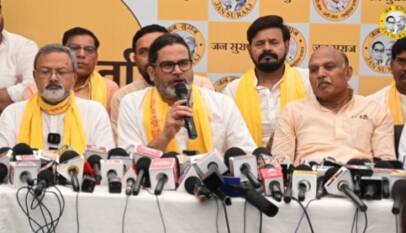
Prashant Kishor to Contest Bankipur Bypoll, Jan Suraaj Eyes Breakthrough in BJP Stronghold
Patna, July 2026 : Election strategist-turned-politician Prashant Kishor will contest the upcoming by-election from …