MGNREGA and Amrit Sarovar Schemes Give New Direction to Rural Development

Multidimensional Gains in Water Conservation, Employment, and Livelihood
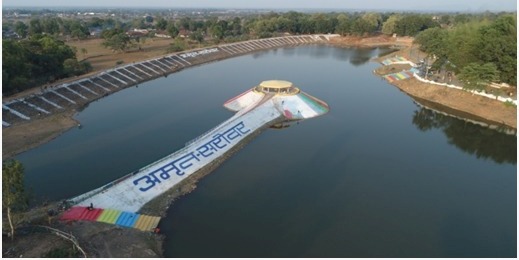
Raipur : The Mahatma Gandhi National Rural Employment Guarantee Act (MGNREGA) and the Amrit Sarovar Scheme have brought significant progress to rural areas in Surajpur district through impactful initiatives focused on water conservation and livelihood enhancement. These efforts have led not only to the creation of sustainable water sources but also to increased opportunities in fish farming, irrigation, agriculture, and rural employment.
In Gram Panchayat Devipur, the Amrit Sarovar built under MGNREGA has become an ideal water body and a central source of livelihood for villagers. With a storage capacity of nearly 10,000 cubic meters, this pond, located in a sloping region, features durable masonry, a silt trap, and scientific design, making it sustainable. The 11-member ‘Kamna Self-Help Group’ has been assigned the responsibility of managing the pond and earns nearly ₹40,000 annually through fish farming. Additionally, 150 acres of land belonging to 80 farmers is irrigated by this water source, enabling cultivation of both Kharif and Rabi crops. With an average income of ₹30,000 per acre, the local rural economy is getting a solid boost.
In Gram Panchayat Bhuvneshwarpur, an old pond has been successfully revived under the Amrit Sarovar scheme. Previously drying up during summers, the pond has now been deepened, widened, and strengthened. The construction of inlet and outlet drains has ensured proper water flow, while small stones have been used to secure the embankments, preventing soil erosion. The pond restoration provided employment to villagers under MGNREGA, offering them both income and financial stability. Fish farming has already begun, and villagers are now generating income by harvesting, nurturing, and selling fish, giving a fresh foundation to their livelihood.
In Gram Panchayat Jagatpur, the construction of an earthen check dam on the Khrauk Jharia stream marks a strong step in water conservation. The project was executed between April 4, 2023, and April 7, 2024, with a total cost of ₹12.88 lakh, of which ₹11.21 lakh was spent on wages and ₹1.67 lakh on materials. Proposed by the panchayat and approved by the gram sabha, the dam has significantly raised the groundwater level, providing year-round irrigation. The stream now flows even in summer, ensuring drinking water for cattle and household use for villagers. Four beneficiaries also received wells and small ponds on their land under the project, allowing them to farm throughout the year.
Despite challenges like clearing encroachments, breaking soft rocks, and managing the labor-intensive bund construction, the joint efforts of the panchayat and local administration ensured the project’s success.
These three projects have empowered villagers with self-reliance in water conservation, agriculture, livelihood, and employment. Today, MGNREGA and Amrit Sarovar are no longer just schemes but have become symbols of rural transformation, economic empowerment, and environmental sustainability.


Spain Stun France 2-0 to Storm into World Cup Final; Oyarzabal, Porro Sink Les Bleus
Score: Spain 2 (Mikel Oyarzabal 20′ pen, Pedro Porro 58′) beat France 0 Arling…

Spain Stun France 2-0 to Storm into World Cup Final; Oyarzabal, Porro Sink Les Bleus
Score: Spain 2 (Mikel Oyarzabal 20′ pen, Pedro Porro 58′) beat France 0 Arlington …