Scientists discoversa way to measure the beauty of coral reefs, which is a key to their survival.

“Why do people care about coral reefs?
Why does their damage cause such concern and outrage?
What drives people to go to great lengths to protect and restore them?”
The ecological importance; economic value; electrifying beauty of the coral reefs, underpinning cultural heritage value, supports tourism industries, encourages ocean stewardship, deepens people’s emotional connections to the sea, oceans and the coral reefs.
Traditionally, many coral reef monitoring and restoration programs overlook their beauty, considering it too subjective to measure, which causes frustrations amongst the scientists. In some ways, it’s an impossible task. But new studies those which have been published in the Scientific Reports grapples with this challenge, delivering a way of quantifying the aesthetic value of a coral reef, as well as measuring its recovery when previously damaged reefs are restored.
An international team of marine scientists working at the Mars coral restoration program (the largest project of its kind) in central Indonesia, have collaborated with the local communities and international businesses for over a decade, rebuilding reefs that were once decimated by dynamite fishing. This illegal fishing method uses explosives to stun and kill fish for easy collection, while shattering coral reefs into rubble—wiping out entire reef communities in seconds. This Indonesian project has already successfully regrown coral reefs. But enhanced explorations were moduled to ascertain whether this program had been able to recreate the visual appeal of a natural reef ecosystem.
To achieve this, Standardised seabed photos were taken using settings that automatically adjust white balance and colour to compensate for underwater light conditions. This enabled capturing accurate colours under consistent shallow-water conditions across healthy, degraded and restored reef sites.
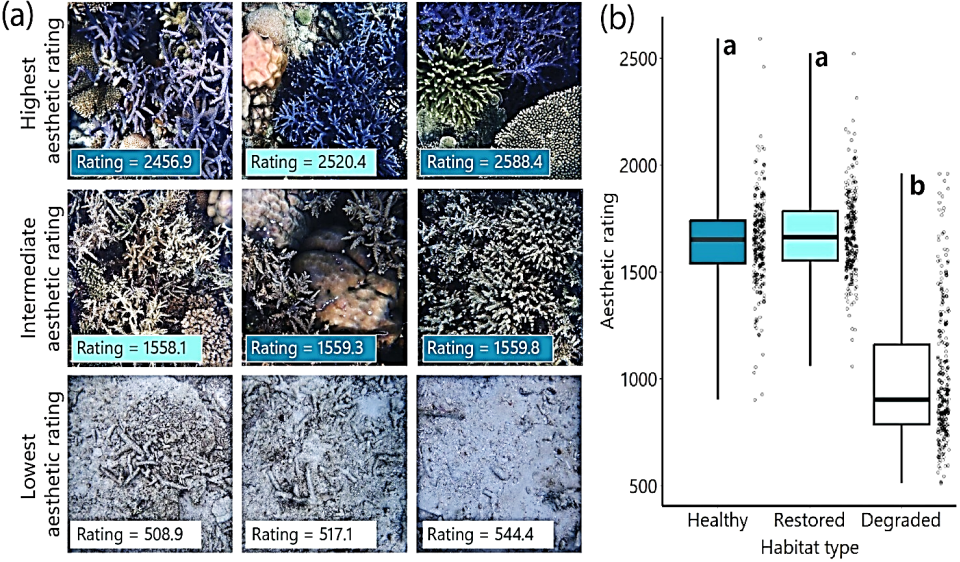
Followed which, extensive surveys were accomplished with more than 3,000 participants, allowing them to compare pairs of photographs and choose which they found more beautiful.
This survey enabled to derive a rating for each photograph, with results demonstrating that people from very different backgrounds consistently shared similar opinions on which reefs were beautiful.
Whether the respondents were young or old, from countries with coral reefs or without, or had different levels of education and familiarity with the ocean, they tended to favour images with high coral cover, vibrant colours and complex coral structures. This suggests there is a shared human appreciation for the beauty of thriving reefs.
These ratings were implemented in the training of a machine-learning algorithm based on AI to reliably predict people’s visual preferences for photographs of different coral habitats. The results of people’s survey responses and the machine learning algorithm were the same. Images of restored reefs were consistently rated just as beautiful as those of healthy reefs, and far more aesthetically pleasing than degraded reefs. This is encouraging, and important. It shows that efforts to rebuild these charismatic ecosystems can recreate the beauty that makes them so highly valued.
Coral reefs need long-term care to help them survive, thrive and maintain their beauty and ecological function. To ensure that initial restoration gains are not quickly lost, such efforts need to be paired with ongoing monitoring and maintenance. Any tourism development around restored reefs also need to be managed carefully and sustainably.
Restoration and sustainable tourism practices can help protect and sustain the ecological and social benefits of beautiful, healthy reefs. Ultimately, restoring beautiful reefs will be crucial for communities that rely on marine tourism, and for inspiring people to care for the ocean.
Team Maverick








Deschamps Admits France Fell Short as Spain End World Cup Dream with 2-0 Semifinal Win
Arlington (Texas), July 2026 : France head coach Didier Deschamps admitted his side was ou…

Deschamps Admits France Fell Short as Spain End World Cup Dream with 2-0 Semifinal Win
Arlington (Texas), July 2026 : France head coach Didier Deschamps admitted his side was …