A small vacuum tube developed by China provided Pakistan the big advantage in the warfare.

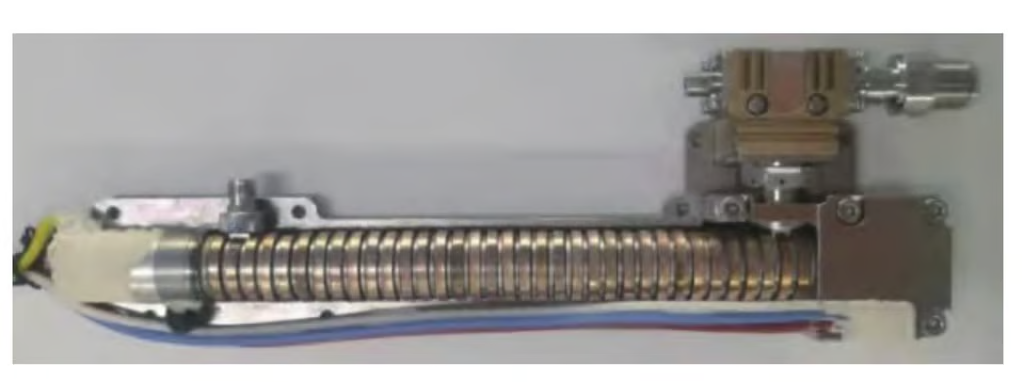
In Beijing – China, researchers have developed a vaccum tube of the size of a revolver, wherein a stream of electrons surges through thin coiled wires, amplifying microwave pulses ranging from 8 to 18 gigahertz with more than 500 watts of output – performance metrics that until recently were only achievable in devices much bigger. It is the new heart of China’s advanced radar and electronic warfare systems – a miniatured travelling-wave tube (TWT), and a symbol of how relentless refinement of microscopic details is propelling the country to the forefront of military electronics.
Earlier, TWTs have powered high-end radar and electronic warfare systems, capable of amplifying broadband microwave signals with efficiency and power that solid-state amplifiers cannot match. But their size, height had long limited their integration into next-generation phased arrays, particularly in aircraft, satellites and stealth platforms where space and weight are at a premium. But Chinese engineers have shrunk a high-power X-Ku band TWT to just 20 millimetres (0.8 inches) in height, less than half the thickness of comparable Western models with a boost in performance.
What has catapulted the trait of this tube, is its use in the Chinese-supplied radars, believed to be relatively new platforms such as the JY-27A and LY-80, in the Indo- Pak encounter in May, reportedly enabled J-10 fighters to down several of India’s French-made Rafales before they could react.
With technological advancements, domestically produced miniatured travelling-wave tubes have seen significant improvements in bandwidth, power output, and efficiency when paired with high-gain broadband phased array antennas, they greatly enhance the detection range and accuracy of air defence and missile defence radar systems, while also boosting the jamming effectiveness and operational reach of multi-beam electronic warfare systems.
At the core of this advance is a design philosophy rooted in precision engineering: optimise everything, trust nothing to chance and extract performance from the margins. The new TWT relies on a monolithic composite housing fabricated through integrated welding, eliminating the need for a transitional shell between the electron gun and the periodic permanent magnet (PPM) focusing system. This single innovation reduced height and improved structural integrity, but it introduced a new challenge – tighter magnetic spacing could distort the electron beam. To solve it, engineers re-engineered the PPM system, reducing magnet thickness and inner diameter, then recalibrated the pole piece geometry to maintain a stable axial magnetic field.
They did not stop there. The electron gun, now compressed to under an inch, required exquisite control of electric fields to prevent vacuum arcing. By refining the vacuum gap between cathode and grid, optimising ceramic insulation surfaces and applying precise “rounding” to sharp electrode edges, they ensured field strength remained below breakdown thresholds – with a safety margin of over 1.5 times the operating voltage.
On the back end, the research team replaced the aluminium sleeves of the collector – which absorbs spent electrons and dissipates heat – with beryllium oxide ceramic. Aluminium and beryllium are “brother metals” with very similar natures, but this small modification makes huge differences, wherein they have managed to obtain the heat transfer efficiency been increased 09 to 10 times.
The resulting TWT measured just 185 by 30 by 20mm (7.2 by 1.2 by 0.7 inches), with over 549 watts of output power, 26dB gain, and a dynamic beam transmission efficiency exceeding 97 per cent across the entire band. When integrated into a microwave power module (MPM), the entire assembly measures 280 by 130 by 22.1mm (11 by 5 by 0.87 inches) – about the size of an iPad.
This miniaturisation is not an isolated achievement. It is part of a broader pattern across China’s military electronics sector – a systematic campaign of incremental optimisation. Engineers have refined beam-forming algorithms, reduced connector reflections, optimised dielectric materials and improved thermal management at the micro-scale.
The payoff is visible. At this year’s World Radar Expo in Hefei, China unveiled over a hundred new radar systems – airborne, naval, space-based and ground-mobile – spanning microwave, millimetre-wave and even terahertz frequencies. Among them were quantum radar and cognitive electronic warfare systems capable of learning and adapting to enemy signals in real time.
Team Maverick








Chabahar Port Remains Unharmed After US Airstrikes on Iran, Confirms MEA
New Delhi, July 2026 : India on Friday confirmed that the Shahid Beheshti terminal at Iran…

Chabahar Port Remains Unharmed After US Airstrikes on Iran, Confirms MEA
New Delhi, July 2026 : India on Friday confirmed that the Shahid Beheshti terminal …