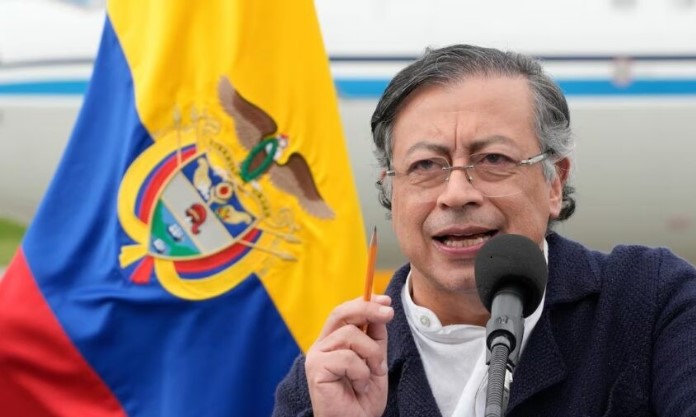
A Drug War Built on Power, Not Powder – Colombian President Gustavo Petro’s thunder at the UN.

Sept 2025 : At the United Nations, Colombian President Gustavo Petro torched drug-war orthodoxy, denounced U.S. Caribbean strikes, and urged remaking global security. His final days as president pose a stark choice: will Latin America accept the status quo, or demand accountability and redesign power?
A Drug War Built on Power, Not Powder –
Gustavo Petro’s last address to the UN General Assembly was not a farewell, bur a reckoning. In a sweeping, accusatory speech, he argued that the “war on drugs” has never truly been about cocaine interdiction. “Prohibition has functioned as a geopolitical instrument, not a public-health strategy, and Latin America has paid the price”.
Petro treated the move as an ‘Exhibit’, in his view, that drug policy is wielded to punish and control rather than to solve. One doesn’t have to share Petro’s politics to recognise the failures he cites. Fifty years of militarised supply side crackdowns have not ended demand; they’ve displaced violence, warped rural economies, and fortified criminal networks with the profit’s prohibition guarantees. When a policy fails on its own terms, power is the missing variable.
Missiles, Migrants, and the Moral Arithmetic of Force –
From the podium, Petro pressed further, linking Washington’s naval operations in the Caribbean to an expanding logic of force. He denounced recent U.S. strikes on suspected drug boats, attacks that left occupants dead, as an attempt “to destroy dialogue” and project control.
Petro’s provocation is twofold. First, he asks whether extraterritorial lethal force in drug interdiction can ever square with due process. Second, he spotlights the asymmetry in global security’s moral math: missiles fix on poverty zones, while the architects and financiers of the drug economy he said. He isn’t wrong to note how the financial superstructure that launders narco-profits rarely faces the urgency, or the violence, that meets a skiff in open water. If the drug trade is a chain, it is telling who breaks first. Three members of the U.S. delegation reportedly walked out. The shock was the point.
His critique of migration follows the same line. Criminalising migrants, Petro argued, papers over deeper drivers, blockades, unsustainable debt, and wars for oil. One can debate proportions, but the underlying point remains: enforcement without a structural remedy is merely theatre.
The Politics of Labels –
Petro’s most combustible claim may have been his dismissal of the U.S. decision to designate the Tren de Aragua as a foreign terrorist organisation. He called it “mentira” that the gang is a terrorist organisation of Venezuela. The provocation is apparent: Washington and several regional governments frame the group’s transnational rackets as a terror-level threat. Petro resists a label that unlocks the extraordinary powers of the terror toolkit, asset freezes, sweeping policing mandates, and narratives that normalise permanent militarisation.
This is not semantics. Across the Americas, the jump from “gang” to “terrorist” has become a policy shortcut with massive consequences, from the carceral overreach to civil-rights erosion. Petro’s scepticism is a reminder that categories are policy launchers, not neutral descriptors. Yet his dismissal also risks minimising the real cross-border predation that communities blame on Tren de Aragua. Precision matters. The region needs evidence-based designations and targeted, transnational enforcement that targets leadership, finances, and logistics—without labelling every crime wave as “terrorism” or every enforcement action as imperial projection.
What Petro Gets Right—and Where the Sword Cuts Both Ways –
Petro’s fiercest rhetoric concerned Gaza and the global order: He urged for a veto-free Palestine and naming Israeli Prime Minister Benjamin Netanyahu alongside U.S. and European allies as complicit in what he called genocide. He demanded that the UN be remade so international court rulings are enforced, not ignored. There is a painful truth in the indictment of selective legality. International law too often acts as a sermon for the weak and a suggestion for the strong. When courts rule and nothing happens, cynicism metastasises.
Demanding that the system work for Palestinians as it would for anyone else is consistent with the universalism the UN claims to embody. And yet Petro’s own words reveal the trap. To declare diplomacy “finished” and summon “the sword” courts the same logic he condemns in the Caribbean: force first, legitimacy later. If the global order is to be remade, it must be remade to constrain, not expand, discretionary violence everywhere whether in Gaza, the Caribbean, or Colombia’s borderlands.
Read generously, Petro’s thunder is a moral clarion, not a martial one: if law and institutions are failing, mend them, and apply them even-handedly. As he exits, his UN speech doubles as a regional manifesto. On drugs, he is right to insist that a militarized supply war cannot mend a demand-driven market. On migration, he is right that enforcement detached from economics and climate is a theatre. On financial impunity, he is right to point at the Manhattan skyscraper before the Caribbean panga. On Gaza, he is right that international law must mean something when it is hardest. Where he falters is the romance of the sword.
Petro’s critics will say his finale was provocation for provocation’s sake. Perhaps. However, provocation has its uses when silence is tantamount to complicity. If his speech forces Washington to defend the legal basis and human consequences of its Caribbean strikes, compels capitals to revisit the theatrics of decertification, and pressures the system to honour its own courts. It did more than exit with applause lines. It put a mirror at the rostrum. Whether the next Colombian president—and the region’s leaders choose to look into it or look away will tell us which myths we keep and which we finally retire.
Team Maverick


FIFA Chief Infantino Hails Messi’s ‘Timeless Brilliance’ After Record-Equalling World Cup Feat
New Delhi, June 2026 : FIFA President Gianni Infantino has showered praise on Lionel Messi…

FIFA Chief Infantino Hails Messi’s ‘Timeless Brilliance’ After Record-Equalling World Cup Feat
New Delhi, June 2026 : FIFA President Gianni Infantino has showered praise on Lionel …