Pakistan PM Shahbaz Sharif Targets India at UNGA, Makes Unsubstantiated Claims on Pahalgam Attack and Operation Sindoor

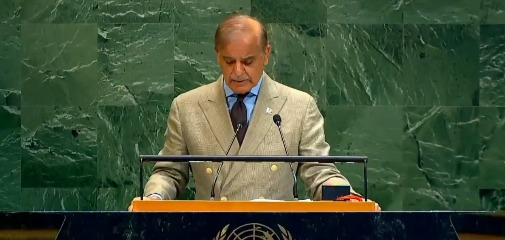
New York, Sept 2025 : Pakistan Prime Minister Shahbaz Sharif on Friday accused India of seeking “political advantage” after the April Pahalgam terror attack, while remaining silent on Islamabad’s role in funding and promoting cross-border terrorism. Addressing the 79th session of the United Nations General Assembly (UNGA), Sharif alleged that India attacked “innocent civilians” in Pakistan, forcing his country’s armed forces to respond in “self-defense.”
Sharif’s Claims at the UNGA
“In May this year, my country faced an unprovoked attack from the eastern front. The enemy came shrouded in arrogance, and we sent them back in humiliation. India tried to gain political mileage from a humanitarian tragedy by rejecting my sincere offer of an independent investigation into the Pahalgam incident. Instead, it attacked our cities and targeted our innocent civilians. When our territorial integrity and national security were violated, our response was in accordance with the right to self-defense under Article 51 of the UN Charter,” Sharif declared in his address.
The Pakistani leader further claimed that his military displayed “amazing professionalism” in thwarting the alleged attack. “Our valiant armed forces conducted an operation with amazing professionalism, thwarting the enemy attack. Our hawks retaliated in the sky, resulting in seven Indian fighter jets being reduced to dust and junk,” Sharif said, repeating earlier claims that Pakistan shot down Indian aircraft.
Silence on Terror Infrastructure
While making these assertions, Sharif avoided any mention of Pakistan’s support to terror outfits operating across the border. He also omitted reference to the fact that India specifically targeted nine terrorist bases in Pakistan and Pakistan-occupied Jammu and Kashmir (PoJK) during Operation Sindoor, launched on May 7 in response to the Pahalgam terror attack of April 22 that killed 26 civilians.
According to Indian authorities, Operation Sindoor destroyed major camps of Lashkar-e-Taiba, Jaish-e-Mohammed, and Hizbul Mujahideen, eliminating over 100 militants. India clarified that the operation was aimed solely at terrorist infrastructure and deliberately avoided targeting Pakistani military assets.
India Counters Pakistan’s Narrative
Sharif’s speech once again lacked concrete evidence, relying instead on sweeping assertions. By contrast, India presented detailed briefings supported by evidence. Indian Air Chief Marshal Amar Preet Singh confirmed that India had shot down a Pakistani aircraft during the escalation, while dismissing Islamabad’s claims of downing multiple Indian jets as “baseless and fabricated.”
From May 7 to 10, senior Indian officials, including Foreign Secretary Vikram Misri, addressed press conferences outlining India’s strategy and presenting satellite imagery of destroyed terror camps. The Indian side repeatedly emphasized that its response was “focused, balanced, and non-aggressive,” warning, however, that any Pakistani strike on Indian military installations would invite a “befitting response.”
The Four-Day Conflict
The flare-up between the two nuclear-armed neighbors lasted four days. Between May 7 and 10, both sides exchanged drone and missile strikes. While Pakistan claimed it was retaliating against Indian “aggression,” New Delhi described its actions as a targeted counter-terror operation following the Pahalgam massacre.
On May 10, both countries agreed to halt hostilities. Analysts noted that while Pakistan claimed “victory” in public statements, India provided verifiable evidence of its military objectives and outcomes.
Continuing Pattern of Denial
Observers at the UN and regional security experts argue that Sharif’s speech was consistent with Pakistan’s long-standing pattern of denial regarding its links to terrorism. “This is an old playbook—portraying Pakistan as a victim while avoiding accountability for sponsoring groups that carry out cross-border terror,” one South Asia analyst told reporters.
India, on its part, has reiterated that lasting peace in the region can only be achieved if Pakistan dismantles terror networks operating from its soil and stops using terrorism as an instrument of state policy.
Conclusion
Sharif’s address at the UNGA drew attention for its combative rhetoric but offered little substance. While Pakistan projected its actions as defensive, India countered with detailed evidence of terrorist camps destroyed under Operation Sindoor. The contrasting narratives once again highlighted the deep mistrust and hostility that continue to define India-Pakistan relations, even as the international community urged both sides to exercise restraint and focus on long-term stability in South Asia.
Team Maverick.


Museums will be named after India’s National Heroes, not invaders: Chief Minister
Grand museum named after Chhatrapati Shivaji Maharaj being constructed at a rapid pace: CM…
Museums will be named after India’s National Heroes, not invaders: Chief Minister
Grand museum named after Chhatrapati Shivaji Maharaj being constructed at a rapid pace: CM …