How Moscow could use an ongoing blackout to switch Europe’s Largest Nuclear Plant from Ukraine’s grid to its own.

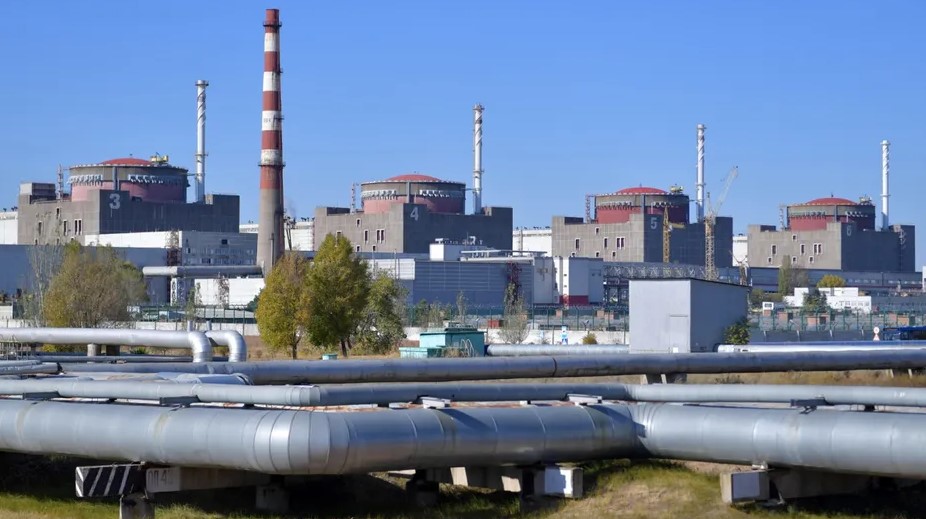
Oct 2025 : According to Ukrainian officials, the Zaporizhzhia Nuclear Power Plant has been without external power since September 23. With no access to the wider grid, backup diesel generators have kicked in to fuel the facility’s critical cooling operations. The Ukrainian authorities have blamed Russian shelling for the outage, while Russian officials claim Ukraine is responsible.
However, a Greenpeace investigation published on October 1 has found “no signs of major damage” to the surrounding power lines, indicating that the disruption may be intentional. The report argues that the outage is “a deliberate act of sabotage by Russia”, whose ultimate aim is to “permanently disconnect the plant from the Ukraine grid and connect the nuclear plant to the grid occupied by Russia”. Russia has seized control of the Zaporizhzhia plant in the early weeks of its full-scale invasion of Ukraine in 2022. According to Ukrainian sources, 07 of the facility’s 18 available generators are currently running the cooling systems. The sources added that European safety regulations introduced after the 2011 nuclear disaster in Fukushima, Japan, stipulate that nuclear plants can operate safely without external power for 72 hours; however, operation beyond that timeframe has never been tested.
Meanwhile, nuclear energy expert Dmitry Gorchakov told Media Houses that the risk of a catastrophic failure at Zaporizhzhia remains low. “Most of the reactors have been shut down for more than two years and are in a state of ‘cold shutdown’”. After shutdown, the reactors still generate heat, but the amount gradually decreases. Now it’s very little, and only a small amount of water is needed for cooling”.
According to Gorchakov, the Fukushima accident occurred because the reactors there had been running at full power and continued to produce high levels of heat after the cooling system shut off. But at Zaporizhzhia, he said, even in the event of a total failure, the reactors would continue cooling naturally for several weeks. The greater risk, he said, lies not in a potential meltdown, but in the possibility that Russia could use the threat of one to justify connecting the plant to its own energy system.
A report submitted by Russia to the International Atomic Energy Agency (IAEA), outlines a procedure for transmitting voltage from Russia’s unified power system if the plant is disconnected from Ukraine’s grid. On the other side, a Ukrainian official, speaking to the Media has voiced: “They’ll portray themselves as saviours”. While the plant has remained linked to Ukraine’s grid since the start of the full-scale war, Gorchakov noted that Moscow has consistently expressed its intention to restart the facility, which would require connecting it to Russia’s power network.
“Russia could use another shutdown as a pretext. It could claim that Ukrainians can’t repair the line, that it’s dangerous, and that to prevent an accident, it has ‘no choice’ but to connect the plant to its own grid. In that way, it could use the outage as a means of information cover. That’s the biggest risk”, as asserted by Gorchakov.
Last week, the plant’s Russian-installed director, Yuriy Chernichuk, announced that reintegrating the facility into Russia’s grid was “in its final stages”. Meanwhile industry experts have voiced their anguish that restarting a nuclear plant in a war zone would be unprecedented.
On September 27, Ukrainian Deputy Foreign Minister Andriy Sybiha accused Russia of preparing to steal the plant, alleging that Moscow was actively attempting to enlist the IAEA in this adventure and justify its theft. Such a scenario would lead to the irreversible collapse of the peaceful nuclear order established by the IAEA. Ukraine demands that the Agency take a principled stance. The Zaporizhzhia Nuclear Power Plant must be returned to Ukraine, who is its rightful owner.
Gorchakov says connecting the plant to Russia’s grid would be technically straightforward. The issue isn’t the technology, but a tactics as a pretext for the international community and the IAEA. Restarting the reactors, he added, would be much more complicated. That’s a far more complex stage that requires powerful networks and careful preparation. Given that the plant is located in an active war zone, Gorchakov warned that risks are high. “If a reactor were brought online and then lost power, the risk of a major accident similar to Fukushima would multiply”.
He has also expressed doubt that the IAEA would be able to prevent Russia from connecting the plant to its grid. Ukraine is capable of revamping the facilities. But if the plant becomes tied into Russia’s network, Moscow would frame any such strike as creating risks for the nuclear plant. The IAEA has no way to verify the situation on the ground. IAEA are not even allowed to inspect the site where the power line was damaged. Russia is manipulating the agency very effectively. Russian representatives at the IAEA will speak about the priority of the plant’s safety. And connecting it to Russia’s grid could even end up being approved.
Lesson from Chornobyl –
The Zaporizhzhia plant isn’t the only nuclear facility in Ukraine where Russia’s ongoing war has caused blackouts in recent days. On Wednesday (01st October, 2025, a Russian strike on energy infrastructure in the city of Slavutych caused a blackout at the Chornobyl Nuclear Power Plant. According to Ukraine’s Energy Ministry, the New Safe Confinement, the structure that seals off the reactor destroyed in the 1986 disaster at the facility, lost power. The outage lasted more than three hours, President Volodymyr Zelensky said. “The Russians could not have been unaware that striking facilities in Slavutych would have such consequences for Chornobyl. It was a deliberate attack in which they used more than 20 drones”, he wrote on Telegram. Late that night, the Energy Ministry reported that power had been fully restored to all facilities at the Chornobyl nuclear plant.
Team Maverick







Australia Calls India a Top-Tier Security Partner, Unveils Landmark Defence and Energy Agreements
Canberra, July 2026 : Australia on Thursday described India as one of its most important s…

Australia Calls India a Top-Tier Security Partner, Unveils Landmark Defence and Energy Agreements
Canberra, July 2026 : Australia on Thursday described India as one of its most …