Indian Origin Nabarun Dasgupta amongst others of 2025 MacArthur Fellowship.

A cartographer, a composer, an archaeologist, a neurobiologist and an astrophysicist are among this year’s MacArthur Fellows, one of the most prestigious cash awards given to “extraordinarily talented and creative individuals as an investment in their potential“, according to the MacArthur Foundation. Each Fellow will receive a no-strings attached award of $ 800,000. In order to get one of this prestigious award, so called “genius grants”, one needs to be nominated and vetted. It’s a selection process that takes “many months and sometimes years“, said Marlies Carruth, director of the MacArthur Fellows Program.
MacArthur Fellows might work in vastly different fields but they share certain attributes like creativity, risk-taking, optimism and perseverance. They are “thinkers and doers and dreamers“, said Carruth.
The 2025 MacArthur Fellows are below; quotes about their work are from the MacArthur Foundation:
- Ángel F. Adames Corraliza of the University of Wisconsin-Madison is an atmospheric scientist whose research “sheds light on tropical atmospheric dynamics that influence global weather patterns and phenomena such as tropical cyclones and monsoons“.
- Matt Black of Exeter, California, is a photographer focused on marginalised communities, from migrant farmworkers to boarded-up towns across the United States. His work shows that “poverty is not an aberration but rather a defining feature of the American landscape“.
- Garrett Bradley of New Orleans is an artist and filmmaker whose work explores “questions of justice, public memory, and cultural visibility”. For the installation “America” (2019), Bradley interspersed footage from Lime Kiln Club Field Day (1915), believed to be the oldest surviving film with an all-Black cast, with vignettes she created of Black figures from the early 20th century.
- Heather Christian of Beacon, New York, is a composer, lyricist, playwright, vocalist and member of The Arbonauts. With works such as Terce: A Practical Breviary (2024), Christian explores “the possibility for the sacred and spiritual in our modern world“.
- Nabarun Dasgupta of the University of North Carolina at Chapel Hill, is an epidemiologist who brings “compassion, collaboration, and creative vision” to his work reducing the harms and deaths from drug use. Dasgupta told media personnel, that he had started analysing overdose death data two decades ago when a close friend of his died of a heroin overdose.
- Kristina Douglass of Columbia University in New York City, is an archaeologist focused on the coastal communities of southwest Madagascar. Douglass involves local residents in her research, which “informs efforts to protect biodiversity hot spots while preserving the lifeways of those who live in them“.
- Kareem El-Badry of the California Institute of Technology in Pasadena, California, is an astrophysicist whose research into all things about stars “has led to many discoveries, ranging from overlooked dormant black holes in our galaxy to new classes of stars and coupled systems”.
- Jeremy Frey of Eddington, Maine, is an artist descended from a long line of Wabanaki basket makers. Using all-natural materials, he harvests himself, Frey is “forging a singular aesthetic that blurs the boundaries between craft, design, and contemporary art“.
- Hahrie Han of Johns Hopkins University in Baltimore is a political scientist whose research “advances scholars’ understanding of what makes certain forms of civic participation more durable and impactful than others.
- Tonika Lewis Johnson of Chicago is a photographer and social justice artist whose work uses “art, storytelling and community organising to help the larger public learn about and confront the history of segregation, housing injustice and the ways in which Black neighbourhoods have been devalued“. Her current project is UnBlocked Englewood, developed in partnership with the Chicago Bungalow Association.
- Ieva Jusionyte of Brown University in Providence, R.I., is a cultural anthropologist who immerses herself in the communities most affected by border security issues. She worked as a volunteer paramedic on both sides of the U.S.- Mexico border.
- Toby Kiers of Vrije Universiteit Amsterdam in the Netherlands is an evolutionary biologist who studies the relationships between plants, fungi and other microbes, “one of the most important and widespread mutualisms on Earth”.
- Jason McLellan of The University of Texas at Austin is a structural biologist who is considered one of the heroes of the pandemic. His work was instrumental in quickly developing COVID-19 vaccines. He and his team are currently focused on “developing a universal vaccine that would be effective against all coronaviruses”.
- Tuan Andrew Nguyen of Ho Chi Minh City, Vietnam, is a multidisciplinary artist whose work explores the traumas of war and displacement as well as resistance and resilience. His feature film The Unburied Sounds of a Troubled Horizon (2022), for example, tells the story of a woman who lives in an area of Vietnam heavily bombarded by the U.S. To help process the pain, she creates Alexander Calder-style sculptures out of bomb remnants. Nguyen exhibits the film next to his own artwork made from Vietnam bomb relics.
- Tommy Orange of Oakland, California, is a fiction writer whose novels, There There and Wandering Stars are centered around the Native American experience, past and present, showing “the many ways historical trauma and dislocation can rupture the fabric of everyday life”.
- Margaret Wickens Pearce of Rockland, Maine, is a cartographer who creates maps in collaboration with Indigenous communities “to resurface their history, knowledge, and presence throughout North America“. Her current project is called Mississippi Dialogues.
- Sébastien Philippe of the University of Wisconsin–Madison is a nuclear security specialist who has studied past harms and potential risks of building, testing and storing nuclear weapons. On The Missiles on Our Land website, “he and collaborators illustrate the widespread destruction that would be caused by a nuclear attack on the missile sites“.
- Gala Porras-Kim of Los Angeles and London is an interdisciplinary artist focused on how cultural artifacts are held in museums and other institutional collections. Porras-Kim’s work “poses powerful questions about the lives of objects, who shapes their preservation, and how their stories are told“.
- Teresa Puthussery of the University of California, Berkeley, is a neurobiologist and optometrist whose research is “laying the foundation for a more complete understanding of human vision and for treatments of debilitating eye diseases“.
- Craig Taborn of Brooklyn, N.Y., is an improvising musician and composer who draws from various musical genres to create a distinct sound using a “fearless and sophisticated approach“.
- William Tarpeh of Stanford University in California is a chemical engineer developing ways to recover valuable chemical resources from wastewater. For example, his electrochemical reactors can convert nitrogen in urine waste into ammonia-based products like fertiliser and house cleaner.
- Lauren K. Williams of Harvard University in Cambridge, Massachusetts, is a mathematician who is “expanding fundamental mathematical theory” and building connections with other scientific fields such as physics “with a curiosity-driven approach to research and willingness to collaborate across disciplines”.
Team Maverick
Solar Defence Showcases Indigenous ‘Bhargavastra’ Counter-Swarm Drone System to Indian Army
New Delhi, July 2026 : Solar Defence and Aerospace Ltd. (SDAL) on Friday showcased its ind…
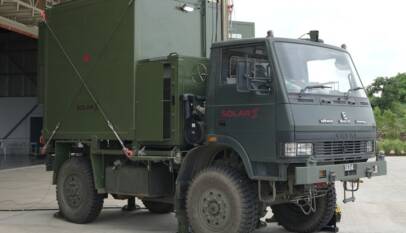
Solar Defence Showcases Indigenous ‘Bhargavastra’ Counter-Swarm Drone System to Indian Army
New Delhi, July 2026 : Solar Defence and Aerospace Ltd. (SDAL) on Friday showcased …