Anyone who wishes to understand democracy must learn from India: Yogi Adityanath

Chief Minister Yogi Adityanath releases the book ‘Early North India and Its Coinage’
Coins bear testimony to India’s unity and democratic heritage: CM Yogi
Book presents facts that decisively counter Western propaganda: Chief Minister
Lucknow, January 2026 : Chief Minister Yogi Adityanath on Thursday said that India has always upheld its Sanatan culture and history through authentic evidence. He described ‘Early North India and Its Coinage’ as a significant scholarly work that firmly establishes India’s democratic consciousness, civilizational unity, and thousands-of-years-old cultural legacy through factual documentation. The book, he said, effectively counters the long-standing Western narrative that has attempted to distort India’s historical and democratic traditions.
The Chief Minister remarked that anyone seeking to understand democracy must look to India. He recalled Prime Minister Narendra Modi’s statement at the G20 Summit that India is not only the world’s largest democracy but also the “Mother of Democracy.” Vaishali, one of the earliest known republics in world history, stands as living proof of this tradition.
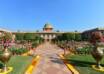
Chief Minister Yogi Adityanath released the book, published by the Hinduja Foundation, from his residence. On the occasion, he also viewed a rare collection of ancient and historical coins preserved by the Foundation. A short film highlighting the philanthropic initiatives of the Hinduja Foundation was also screened.
The Chief Minister said, “India is perhaps the only civilization that has given refuge, dignity, and equal opportunities to people of every caste, creed, and community, enabling them to flourish.”
He cited the timeless Indian philosophy, “Vasudhaiva Kutumbakam,” which teaches that the entire world is one family, reflecting India’s inclusive and humanitarian worldview.
Referring to the ancient saying that being born in India is a rare privilege, and being born as a human being even rarer, he said that India’s civilizational values are unparalleled.
He noted that Western scholars long propagated the false notion that India was never a unified entity, whereas the Partition of 1947 itself was the result of colonial conspiracy. Quoting the ancient verse defining Bharatvarsha, he emphasized that India historically included present-day Pakistan and Bangladesh, and that questioning India’s unity reflects a failure to understand its ancient heritage.
Chief Minister Yogi said that coins discovered from regions such as Ayodhya, Mathura, Kaushambi, Kashi, and Panchal, made of copper, silver, and alloys, serve as irrefutable evidence of the political, economic, geographical, and trade systems of ancient India. These artifacts, documented in the book, reinforce India’s tradition of presenting history through facts and evidence, unlike attempts by Western powers to falsely claim the origins of democracy.
The Chief Minister highlighted that India pioneered scientific systems of weights and measures. Traditional units such as Masha and Tola are still in use today, especially in the trade of precious metals. Ancient coinage followed these precise scientific standards, reflecting India’s advanced intellectual and
economic systems.
Describing the Mauryan era as India’s golden age, he noted that India once contributed nearly 46 percent to the global economy. This share declined to 24 percent by the 15th century and further fell to 1.5–2 percent at the time of independence due to prolonged foreign exploitation. Under the leadership of Prime Minister Narendra Modi, he said, India has now emerged as the world’s fourth-largest economy.
Chief Minister Yogi said that Prime Minister Modi’s Vision 2047 connects every Indian through Panch Pran and eleven resolutions, with pride in heritage as the foremost commitment.
The construction of the Shri Ram Janmabhoomi Temple in Ayodhya, the rejuvenation of Kashi Vishwanath Dham, and sustained efforts to preserve Sanatan heritage are concrete expressions of this vision.
Author of the book, Prof. Devendra Handa, said that a coin preserved in the British Museum bears the inscription “Savitri Putra Janapadas,” providing historical evidence that the story of Savitri and Satyavan is rooted in real events rather than mythology. He also referred to coins from the Madra kingdom and the lineage of King Porus, which challenge prevailing historical assumptions. Ashok Hinduja, Chairman of the Hinduja Group, said that the time has come for India to present its ancient culture to the world through rigorous scientific research and evidence. He described the book as a meaningful step in that direction, praised the leadership of Chief Minister Yogi Adityanath, and expressed confidence in expanding investments in Uttar Pradesh.
Also present at the event were P.P. Hinduja, Trustee of the Hinduja Group; Tourism and Culture Minister Jaiveer Singh; author Prof. Devendra Handa; and senior members and officials of the Hinduja family.


Microsoft Cuts 4,800 Jobs as AI Investments Reshape Business Strategy
New Delhi, July 2026: Microsoft has announced another major round of layoffs, cutting appr…
Recenzja gry zautomatyzowanych w kasynie online Potter Slots Casino: analiza funkcjonalności i rozgrywek hazardowych.
Co to jest Potter Slots Casino? Potter Slots Casino to aplikacja internetowa, która oferuje …