Middle East Christian Demoninations Celebrate Christmas On 07th January, Instead of 25th December, Following The Julian Calendar.

Gaza; January 2026: The reason why some Christians celebrate Christmas on 07th January instead of 25th December is because of their use of the Julian Calendar, rather than the Gregorian Calendar, which is commonly used across the world on 07th January.
Although much older, being introduced by Julius Caesar in 46 BC, the Julian Calendar is less accurate from an astronomical point of view than the Gregorian calendar, losing a day every 128 years instead of the one day every 3,236 years of its counterpart.
Because of the accuracy issue, a split emerged between the Catholic Church and its eastern counterparts, with Pope Gregory XIII mandating the Gregorian Calendar’s adoption in 1582. Therefore, although Christmas in the Julian Calendar is still dated to 25th December, under the Gregorian Calendar, that date now falls on 07th January.
With Christianity emerging originally from the Middle East, there are several Christian denominations in the region that continue to celebrate using the Julian Calendar. This includes Egypt’s Coptic Orthodox Church. Coptic Christians form roughly 10% of Egypt’s population.
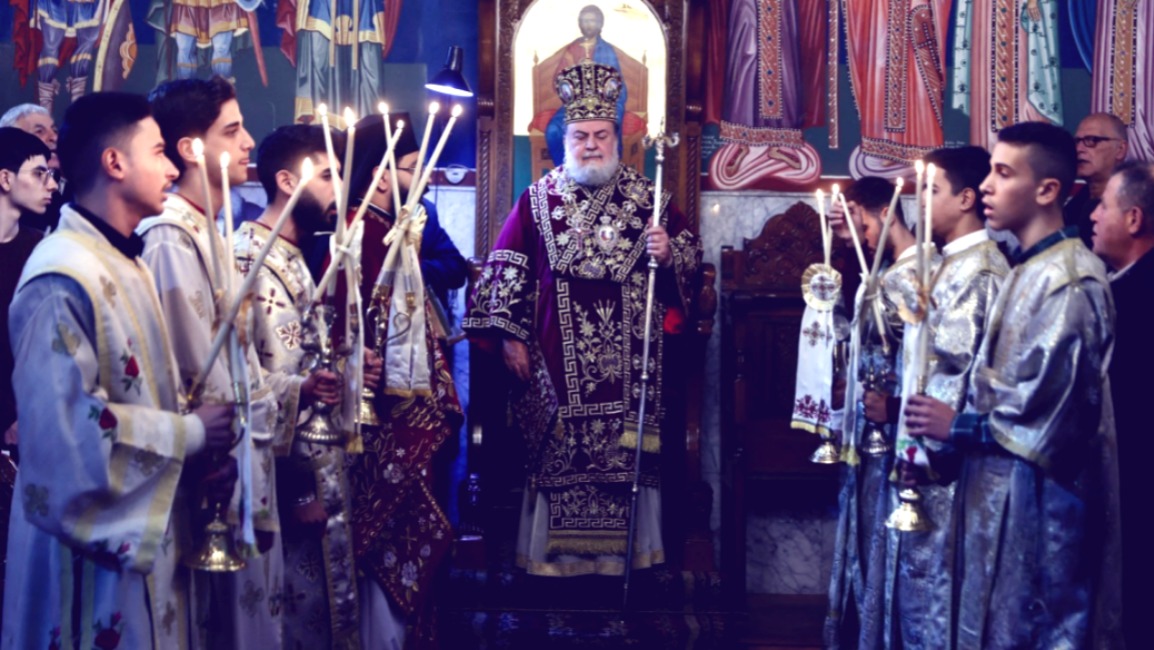
The Church is one of the oldest in Christianity, tracing its roots back to Saint Mark, who is traditionally known as the author of one of the Gospels. Many Greek Orthodox communities in the Middle East, including those in Palestine, Syria and Lebanon, also celebrate on 07th January, with the Church of Saint Prophyrius in Gaza holding mass.
The Armenian Apostolic Church, whose communities exist in Palestine, Syria and Lebanon, also celebrates on Wednesday, as do the region’s Syriac Orthodox Churches, with Syriac Press reporting that Syria’s Syriac Patriarch Mor Ignatius Aphrem II met with his Armenian counterpart Archbishop Armash Nalbandian for the celebrations.
On the 07th January morning, the bells of Saint Porphyrius Church rang softly through Gaza Old City, cutting through the streets that were still buried under rubble and dust. Inside the ancient stone walls of the third-oldest church in the world, Orthodox Christians gathered to mark Christmas with prayers shaped by survival.
Saint Porphyrius, a 05th century church standing as a witness to centuries of wars, faith, and endurance, was itself bombed by Israeli Occupation Forces (IOF) on 19th October 2023, in the early days of the genocide in Gaza, in which 17 Palestinian Christians were killed while sheltering inside its compound. For many here, Christmas now carries the weight of that night and of everything that followed.
This year’s Orthodox Christmas came amid what is being called a ceasefire, fragile, uncertain, and shadowed by two years of devastation, mass displacement, and loss. Yet for Gaza’s small Christian community, simply returning to the church and praying was itself an act of defiance. The past two Orthodox Christmases were marked by absence. In 2024, celebrations were impossible after the church was attacked and Christians were displaced inside churches, shelters, and other houses. Then, in 2025, hunger, bombardment, and an intensifying siege drained any remaining sense of festivity.
According to locals, “the ceasefire gives us a small opening to breathe. We hope it is the beginning of the end, and the beginning of reconstruction”. Inside the church, icons flickered under candlelight. Some families stood silently; others whispered prayers for those who did not survive to see this day.
The locals further reiterated, “our presence protects Palestinian history. Christianity is a pillar of Palestinian identity. By celebrating Christmas here, we assert our existence and our belonging to this land”. Many Christian families in Gaza are still living inside Saint Porphyrius or the Holy Family Church, unable to return to homes that no longer exist.
Adding more, the locals have voiced, “what we miss most are our loved ones. We miss our homes, our memories, our social bonds. I lost friends, neighbours, like Christians and Muslims. Sometimes I feel I am living in a different world, among people who are no longer the same. This Christmas tastes different: part grief, part hope”. That contradiction was present everywhere.
The inability of Gaza’s Christians to reach Bethlehem, the birthplace of Christ, is a recurring wound. “We are the only Christians in the world barred from reaching the city of Christ’s birth. Every Christian can pray there, except us”, the locals lamented. Yet even within confinement, faith persists.
35 years old Montaser Tarazi described this year’s Christmas as a new beginning. “For the first time, the bombing stopped”, he said. “Food entered Gaza. Some prices are still high, but famine has eased. I can walk the streets again without fear of instant death”. The celebrations remain modest. There are no public festivities, no large gatherings. “We celebrate by attending church, by praying”, Montaser said. “That alone is enough”.
Montaser lost close friends in the 19th October church massacre, including Dr Suliman Tarazi. “The occupation did not respect the sanctity of a religious place. That pain follows us into every holiday”, he added. Still, survival itself has become a source of meaning. “We survived two years of genocide. That alone is extraordinary. For Gaza’s Orthodox Christians, Christmas is no longer a moment of unburdened joy. It is an act of memory. An act of faith. An act of presence”.
Other notable Orthodox churches across the world that celebrate Christmas on the 07th January include the Russian Orthodox Church, Serbian and Georgian Orthodox Churches, and the Ethiopian and Eritrean Orthodox Tewahedo Churches.
Team Maverick.





Bye-elections to the Legislative Assemblies of Madhya Pradesh, Gujarat and Bihar Filing of nominations begin
S. No. Election Activity Date / Time 1. Last date for making nominations Monday, July 13, …

Bye-elections to the Legislative Assemblies of Madhya Pradesh, Gujarat and Bihar Filing of nominations begin
S. No. Election Activity Date / Time 1. Last date for making nominations Monday, …