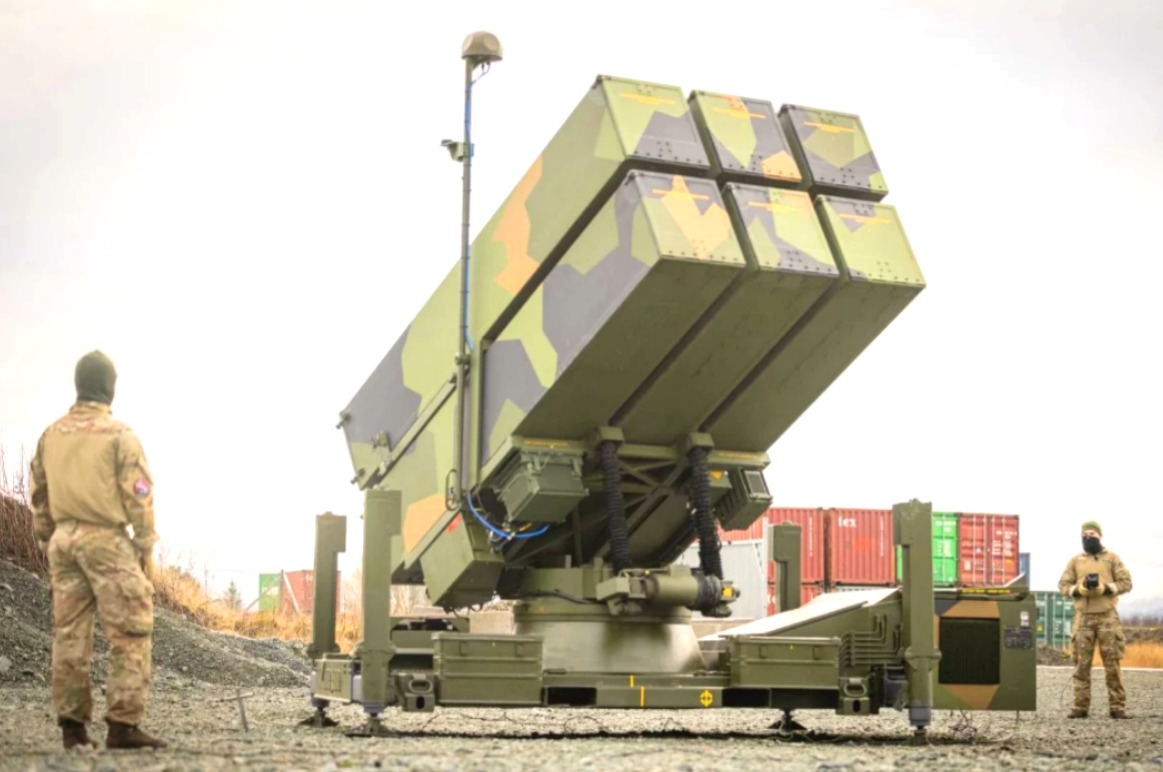
Norway Integrating Ukrainian Missiles With NASAMS Air Defence System In Mitigating Shortages.

Kyiv; January 2026: On January 12th, 2026, Norwegian Foreign Minister Espen Barth Eide has issued a statement reiterating the fact that Norway is working to integrate Ukrainian-made interceptors or effectors into the NASAMS air defence system. The initiative focuses on reducing reliance on expensive missiles by enabling higher-volume production without altering NASAMS command, radar, or launcher architecture.
Speaking in Kyiv, Norwegian Foreign Minister Espen Barth Eide explained that Norway is increasing air defence missile support to Ukraine, alongside deepening industrial ties with Ukrainian defence manufacturers. He stressed that the key problem facing air defence today is that commonly used missiles are expensive and available in limited numbers, which makes sustained defence difficult. To address this, Norway wants weapons that can be produced more cheaply and in larger quantities without changing the existing air defence structure. The initiative follows earlier political statements, as Volodymyr Zelenskyy said in late August 2025 that cooperation with Norway could lead to the joint production of NASAMS systems in Ukraine.
Several Ukrainian weapons could be considered as potential candidates for this NASAMS integration, although no single missile or system has been officially selected. The focus is on whether Ukrainian interceptors or effectors can work smoothly with NASAMS launchers, radars, and command systems, rather than on a single named missile. The potential Ukrainian missile list includes short-range options derived from the R-73, variants of the R-27 medium-range missile with infrared or radar homing guidance, and the UP-277 missile, which has an air-launched range of about 80 kilometres, even though ground-launched use would reduce that figure.
In addition to missiles, Ukrainian interceptor drones are also being considered as effectors that could help counter low-cost aerial threats such as Shahed drones. What matters most is that these solutions can be guided, controlled, and coordinated through NASAMS without disrupting its operation, to widen the choice of usable interceptors and reduce the reliance on a small number of expensive missiles. The idea of integrating Ukrainian interceptors is closely tied to joint production plans between Norway and Ukraine, because scaling interceptor availability depends on manufacturing capacity as much as on technical compatibility.
Eide described the effort as a partnership with Ukrainian defence manufacturers, rather than a simple supply arrangement, which matches Zelensky’s earlier expectation that a broader cooperation could lead to the joint production of NASAMS systems or components in Ukraine. It also allows Ukraine to use its own industrial capacity to support air defence, as these operations consume a large number of interceptors. Independent analysts have estimated that Russian forces have fired more than 24 missiles and drones per day on average against Ukraine since the start of the full-scale war, which would imply that Ukraine’s air defences must try to counter more than 700 targets per month (including cheaper drones and cruise missiles).
At the same time, Norway continues to work on delivering additional missiles to Ukraine in the near term, indicating that near-term supply and longer-term production are being pursued simultaneously.
The NASAMS, short for Norwegian Advanced Surface-to-Air Missile System, is a mobile medium-range air defence system developed by Kongsberg Defence & Aerospace in cooperation with Raytheon. It is designed to counter a wide range of aerial threats, including aircraft, cruise missiles, and unmanned aerial vehicles, through a networked architecture that links sensors, command posts, and launchers.
This modular structure allows the different elements of the NASAMS to be spread out across several sites, while still working together through a centralized fire control. As a result, a NASAMS can protect key locations while remaining flexible and difficult to target, which is particularly relevant where defended assets and threat profiles change frequently. Norway’s current initiative builds on this flexibility, as instead of replacing existing NASAMS missiles, it aims to expand what the system can use as interceptors.
At the unit level, a NASAMS platoon consists of 03 launchers, carrying a total of 18 missiles, supported by a three-coordinate radar station and a fire control console. These components work together to detect targets, decide which threats to engage, and launch interceptors. Launchers and sensors do not have to be placed next to each other, which improves survivability and allows coverage to be adjusted as needed, while remaining connected through the command network. However, during heavy attacks, missiles can be used up quickly, since each launcher carries a limited number of ready rounds.
This operational reality directly reinforces the Norwegian focus on resupply and reload, since sustained defence requires missiles that can be produced in larger numbers. Integrating Ukrainian-made interceptors or effectors would aim to ease this logistical pressure. Compatibility with the platoon-level architecture is therefore central to the integration effort. The performances of the NASAMS place it firmly in the medium-range air defence category, with engagement distances of up to 30 kilometres and engagement altitudes of up to 16 kilometres.
A full battery can fire its available missiles in no more than 12 seconds, which allows rapid reaction against fast-moving threats. This speed is important when facing cruise missiles or coordinated attacks, but it also means interceptor stocks can be depleted very quickly. As a result, cost per missile and production capacity become just as important as technical capability. Norway’s plan directly addresses this issue by seeking cheaper interceptors that can be used in greater numbers. More expensive missiles can then be reserved for the most demanding targets. In this way, the system becomes more sustainable over time, as the NASAMS already successfully intercepted over 900 cruise missiles and drones launched against Ukraine in February 2025.
Team Maverick.






CM Yogi directs action on 2,200 proposals: Budget to be released by July 15, projects to be launched on the ground from August 15
CM takes a tough stand during PWD review, warns of action over delays in pending projects …

CM Yogi directs action on 2,200 proposals: Budget to be released by July 15, projects to be launched on the ground from August 15
CM takes a tough stand during PWD review, warns of action over delays in …