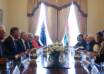
Indian Conglomerates At Davos Exhibits Sustainable Growth And Development.

Davos; January 2026: As reported earlier, the Indian Leaders at the Davos World Summit continues to dominate; however, the conglomerates have also made their presence felt.
Pradeep Kumar, CMD – Indian Renewable Energy Development Agency (IREDA), today have said that a strong clean energy system built by the Indian government over the last decade is now a model for the rest of the world. Speaking at the World Economic Forum, he highlighted that India has created a perfect environment for international companies to invest in green power projects. Explaining the success of the Indian model, the Chairman & Managing Director (CMD) of the Indian Renewable Energy
Development Agency Ltd. (IREDA), Pradeep Kumar, said, “We have come here to share the information, the ecosystem which the government of India has built in the last 10-11 years, in particular. The way renewables have grown in India over the last decade, and more, is an example for any global player to learn from the ecosystem the government of India has built.
The CAGR (Compound Annual Growth Rate) over the last five years is 22.5%. We will not find such a CAGR growth in any industry. Many foreign investors are investing in India, and IREDA is the leading agency for RE financing in the country. We are the largest pure-play green finance company in the country”.
CMD Pradeep Kumar’s assertion was well complemented by the Union Minister Prahlad Joshi, explained how the shift toward green energy is acting as a powerful tool for economic growth. He stated that by focusing on renewable energy sources such as the sun and wind, the country is now able to produce electricity at a much lower cost for its citizens. Connecting the energy shift to national progress, Union Minister Prahlad Joshi said, “India’s agenda at Davos is that transition is not a burden for growth, it is an engine for growth. And because of that, the cost of renewable energy has come down in India.
Because of this renewable movement, which the Prime Minister started almost from 2015-16 and very aggressively from almost 2019, it is bringing down the entire cost of electricity in India. Now, Andhra Pradesh has said that we are going to reduce the cost of electricity. Devendra Fadnavis, the Chief Minister of Maharashtra, has announced that the tariff will come down.
Now we’re pitching for battery storage, pump storage, grid stability, green energy corridor, all these things put together in the coming days, India can showcase itself that we are producing green energy, transition is also happening, and growth is also taking place. Our growth is good, and our renewable energy is also growing well”. The call for bold collective action makes the meeting particularly relevant.
India is Pitched as One of the World’s Fastest-Growing Renewable Energy Markets at Davos. Union Minister Prahlad Joshi urges global investors to partner in India’s rapid clean energy expansion at the World Economic Forum 2026 in Davos.
Ashish Khanna, Director General, International Solar Alliance, have highlighted India’s success in providing cheap solar power to millions of homes and farmers. Speaking at the World Economic Forum, it was explained how programmes like the “Surya Ghar” rooftop scheme and “PM KUSUM” for solar water pumps can be used by other countries to help their citizens get electricity and grow food more easily.
Regarding the scale of these Indian initiatives, Ashish Khanna, said, “The International Solar Alliance is an association of 125 countries based out of India, and we have come to Davos to talk about three things.
First, India’s experience with decentralised solar energy through rooftops, through the Surya Ghar scheme, reaching one crore (10 million) people and households.
Second, on PM KUSUM through the solarisation of agriculture. These are very important lessons for the rest of the world, and we are showcasing how India’s experience with solar at low cost and scale can be replicated across the world. Energy requires a huge amount of money; $2.1 trillion was spent last year. But we need to increase that to 03 trillion to 04 trillion dollars. How can we get more long-term concessional finance invested in renewable energy across all member countries?”
Third, is that the future of energy is linked with AI and digitalisation. We want to work with countries on how AI applications for energy can help bring down costs through innovation, but also improve skills so that people can get jobs in AI. We are having a session on how the AI summit happening in India next month can be used to bring all the countries together to launch a global AI mission for energy, hosted by the ISA.
Bharat Kaushal, Executive Chairman of Hitachi India, highlighted how technology is essential for tackling global disruptions and shaping the future of infrastructure and manufacturing. He noted that Hitachi, with a 90-year history in India, plays a key role in the country’s twin push for both physical and digital infrastructure development.
Over 100 Indian CEOs are in Davos, including Mukesh Ambani (Reliance), N Chandrasekaran (Tata Sons), Sunil Bharti Mittal (Bharti Enterprises), Sanjiv Bajaj (Bajaj Group), and Nandan Nilekani (Infosys). They are meeting with global investors, sovereign funds, and multinational CEOs to secure long-term capital flows.
Suvro Sanyal – Team Maverick.

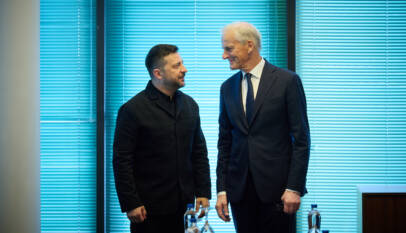

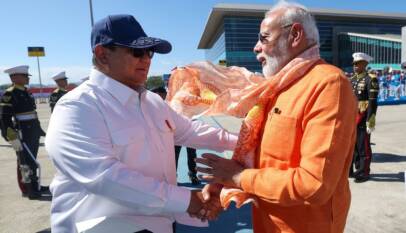




Australia Calls India a Top-Tier Security Partner, Unveils Landmark Defence and Energy Agreements
Canberra, July 2026 : Australia on Thursday described India as one of its most important s…
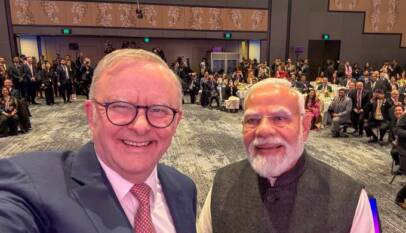
Australia Calls India a Top-Tier Security Partner, Unveils Landmark Defence and Energy Agreements
Canberra, July 2026 : Australia on Thursday described India as one of its most …