A Sense of Accountability among Public Representatives Is the Foundation of a Strong Democracy – Prof. Ram Shinde

86th All India Presiding Officers’ Conference
Accountability is not a process limited only to elections; it is a continuous responsibility at every moment
The legislature should be a forum for thoughtful discussion, not for disorder and chaos
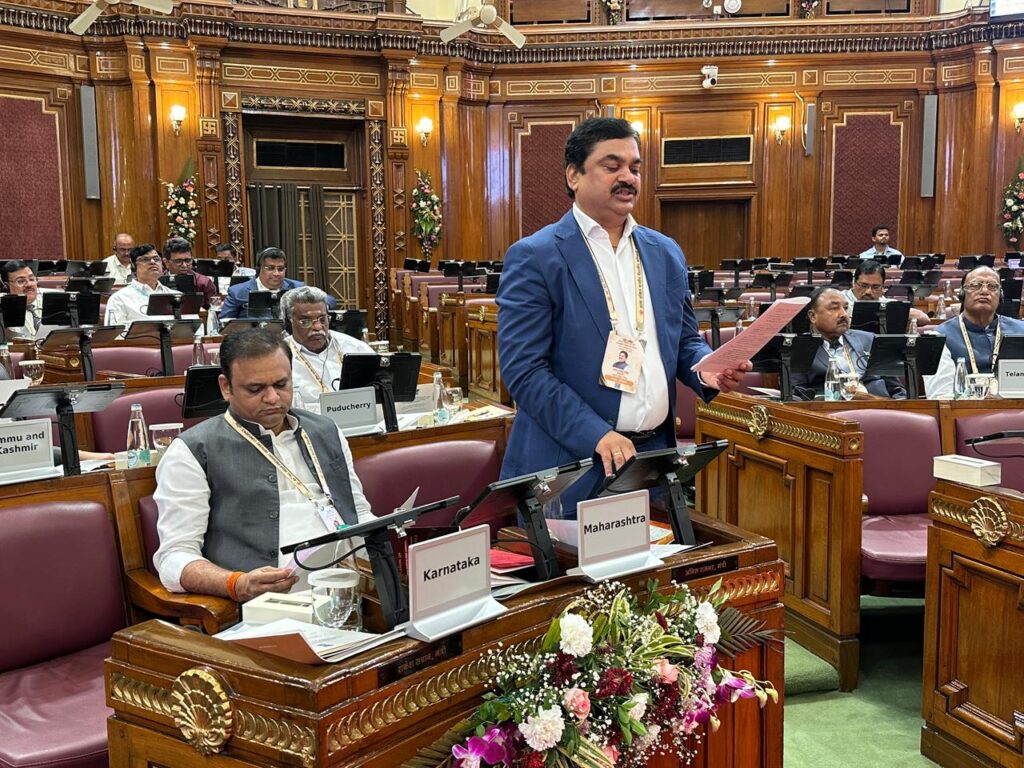
Lucknow, Uttar Pradesh, January 2026 : Accountability of public representatives towards the people is not merely a moral expectation, but an essential functional requirement for a strong and dynamic democracy, stated Chairman of the Maharashtra Legislative Council, Prof. Ram Shinde. He was speaking from the dais of the 86th All India Presiding Officers’ Conference (AIPOC) held in Lucknow.

While expressing his views on the conference theme, “Accountability of Legislatures towards the People,” Chairman Prof. Shinde said that the legitimacy of public representatives and democratic institutions is not obtained only through elections, but is strengthened through continuous transparency, ethical conduct, and sensitivity towards the aspirations of the people.
Referring to this prestigious conference attended by the Speaker of the Lok Sabha, the Deputy Chairman of the Rajya Sabha, and presiding officers from across the country, he described it as an important platform for collective self-introspection in the era of “Amrit Kaal.”
The concept of accountability rooted in Indian constitutional and cultural traditions…
Referring to Maharashtra’s rich tradition, Prof. Shinde mentioned Chhatrapati Shivaji Maharaj’s concept of ‘Hindavi Swarajya’, in which the welfare of the people was at the center of governance (a welfare state). Citing the social thoughts of Mahatma Jyotiba Phule and Dr. Babasaheb Ambedkar, he emphasized that public representatives are not merely elected office-bearers, but trustees of the people’s aspirations.
“Accountability is not a formal process limited to elections that occurs once every five years. It is a continuous responsibility of every hour, every moment,” he said, warning that indiscipline and chaos in legislatures weaken public trust.
Referring to a statement made by Lok Sabha Speaker Om Birla in 2020, Prof. Shinde said that legislatures are “temples of the people’s aspirations,” and the strength of democracy is reflected in the quality of debate and accountability within the House. Platforms such as AIPOC and P20 (G20 Speakers’ Summit) are providing direction to the reform process.
Maharashtra Legislature: A model of accountability…
While mentioning the parliamentary traditions of the Maharashtra Legislature, Prof. Shinde emphasized the role of oversight mechanisms such as the Public Accounts Committee and the Estimates Committee, which exercise strict control over public expenditure. Highlighting Maharashtra’s emphasis on public participation in law-making, he cited the example of the Maharashtra Public Security Bill, where the law was finalized only after examining more than one lakh public suggestions.
“True accountability does not begin unless citizens’ participation in law-making increases,” he said.
Digital transparency and e-Vidhan initiatives…
Stating that technology has fundamentally transformed the relationship between public representatives and citizens, Prof. Shinde referred to e-Vidhan and the digitization of the legislature that Maharashtra initiated nearly two decades ago. He noted that transparency has been strengthened by making House proceedings, questions and answers, attendance, debates, and records available in a timely manner.
He further stated that through Artificial Intelligence (AI) and data analysis, grievance redressal is being monitored, and it is being ensured whether assurances given in the House are actually reaching the grassroots level.
Financial discipline and ethical conduct…
Emphasizing financial accountability, Prof. Shinde referred to the digital monitoring of the MLA Local Area Development Fund (MLA-LAD) and clearly stated that citizens have a complete right to know how public funds are being utilized.
He warned that accountability remains incomplete without ethical conduct and parliamentary discipline, and that frequent adjournments and disorder reduce public confidence.
“The legislature should be a forum for thoughtful discussion; not one of indiscipline and chaos,” he stressed.
The way forward: To further strengthen trust between public representatives and citizens…
- Digital legislative report cards showing attendance, participation in debates, and utilization of funds
- Public representative–citizen interaction days through regular civic dialogue/town hall meetings
- Continuous capacity-building training in policy analysis and public finance
From the AIPOC platform, Prof. Shinde suggested three important measures.
An appeal for collective resolve…
Concluding his speech, Prof. Shinde said that democracy is a living system sustained by everyday acts of accountability. Referring to the line “Jo je vanchhil to te laaho” from Sant Dnyaneshwar Maharaj’s Pasaydan, he appealed for selfless service so that the just aspirations of every citizen may be fulfilled.
“Let us all resolve here in Lucknow that Indian legislatures will set global benchmarks of transparency, accountability, and the finest democratic standards,” he said.





Mumbai Indians Chase Down 221 to Beat KKR in High-Scoring IPL Thriller
Mumbai, March 2026 : In a run-fest at the iconic Wankhede Stadium, Mumbai Indians (MI) pul…

Mumbai Indians Chase Down 221 to Beat KKR in High-Scoring IPL Thriller
Mumbai, March 2026 : In a run-fest at the iconic Wankhede Stadium, Mumbai Indians …