Donald Trump Building Secret White House Bunker To Withstand Nuclear Attack.

Washington DC; January 2026: In the year 1941, Former United States President Franklin D. Roosevelt ordered a secure underground facility under the East Wing of the Presidential Palace – The White House following Japan’s attack on Pearl Harbour, with “no public acknowledgment made of there being a bomb shelter under construction”, as reaffirmed by noted historian Bill Seale.
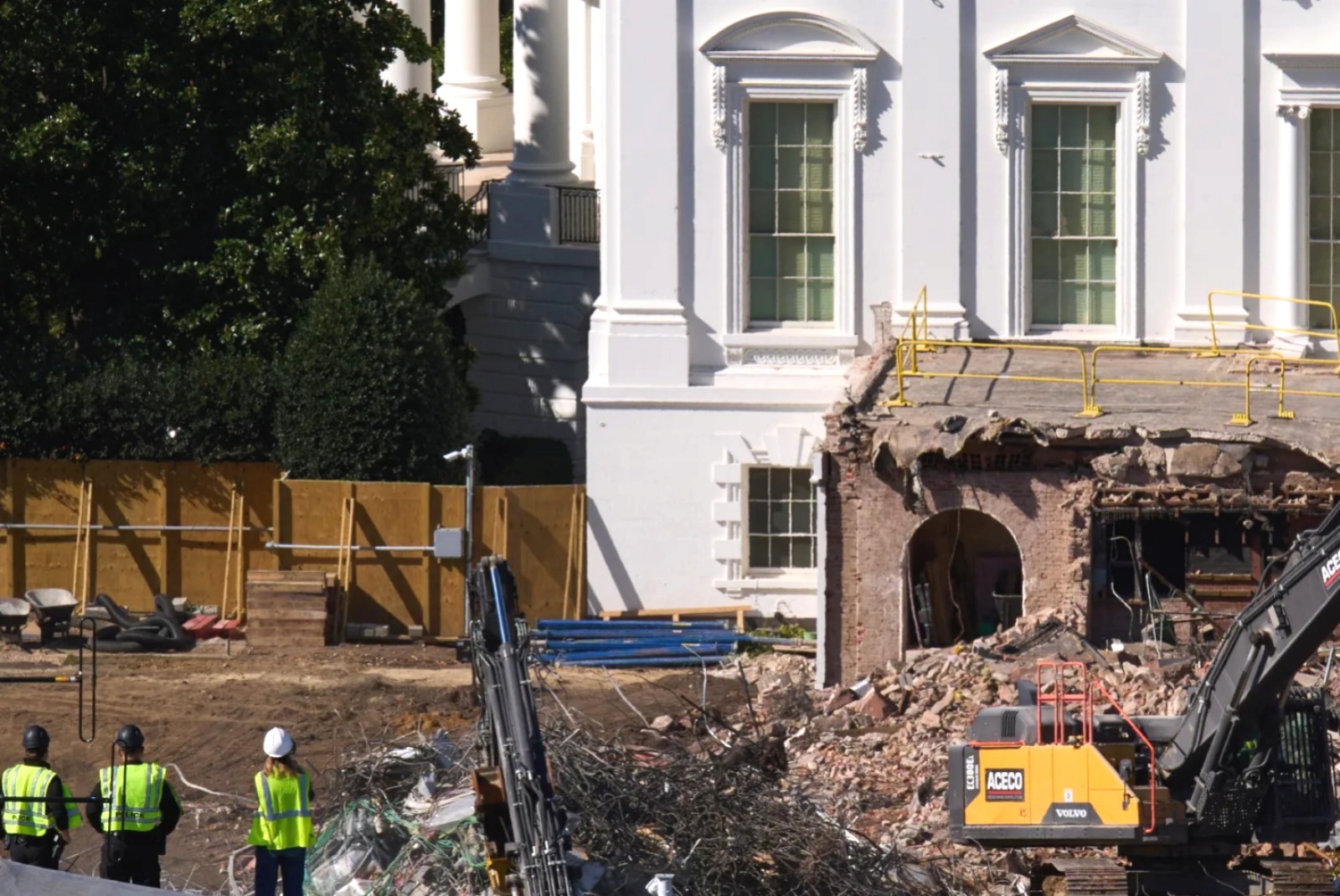
The decades-old underground complex beneath the White House East Wing, which included the Presidential Emergency Operations Center (PEOC), was dismantled during a controversial demolition tied to Trump’s new ballroom project, with plans for a classified replacement using modern technology underway, according to White House sources.
In the first week of January 2026, during a National Capital Planning Commission (NCPC) meeting, a senior White House official referenced “top-secret” work as the reason demolition proceeded before typical approvals, while a recent court filing argued that halting underground construction would “endanger national security”, according to White House sources.
The much discussed underground space included the PEOC, beds, supplies, and secure communications, and was described by sources as a self-contained unit with separate backups for power, water and air filtration. Since then, the PEOC has functioned for decades as a hardened command-and-control space to shelter presidents and senior staff during crises, including the September 11, 2001, terrorist attacks, making any overhaul central to continuity-of-government planning.
And now, more than 80 years on, the East Wing is being reinvented once more. Demolition commenced in October 2025, and with the East Colonnade and office areas removed, sources said that legacy subterranean structures, including the PEOC and related utilities, appeared to be gone. “With a high degree of confidence, I would say that all of the subterranean structures, all of that seems to be gone”, an official source said.
Jonathan Wackrow, a former U.S. Secret Service agent, told media outlets that any successor to the current underground facility would need to anticipate and withstand emerging threats from nuclear blasts and aircraft impacts to chemical, biological, and electromagnetic dangers, while keeping its capabilities hidden from adversaries. “You’re talking about a highly classified site built in total secrecy, designed to endure both today’s threat landscape and whatever comes next”, he said.
At an NCPC meeting, White House Director of Management and Administration Joshua Fisher said the broader ballroom project will enhance mission-critical functionality and security and deliver resilient, adaptive infrastructure aligned with future needs. Meanwhile, President Trump has said the ballroom would be covered by private donations and has cited costs rising to $400 million, while subterranean security infrastructure would ultimately be paid by taxpayers; exact costs for underground work are not public. The assertions were cited on-record remarks by a White House management official and referenced a court filing that asserted national security concerns, establishing a public paper trail for key elements of the project.
Furthermore, White House has defended the East Wing’s reconstruction in a court filing last week over a lawsuit aiming to halt the project, arguing that stopping the underground construction would “endanger national security and therefore impair the public interest”. It added that the justification for this assessment is detailed in a “classified declaration” submitted to the court.
What is evitably important that United States Presidents have multiple secure options beyond the White House, including Mount Weather in Virginia and other Cold War era facilities, including the:
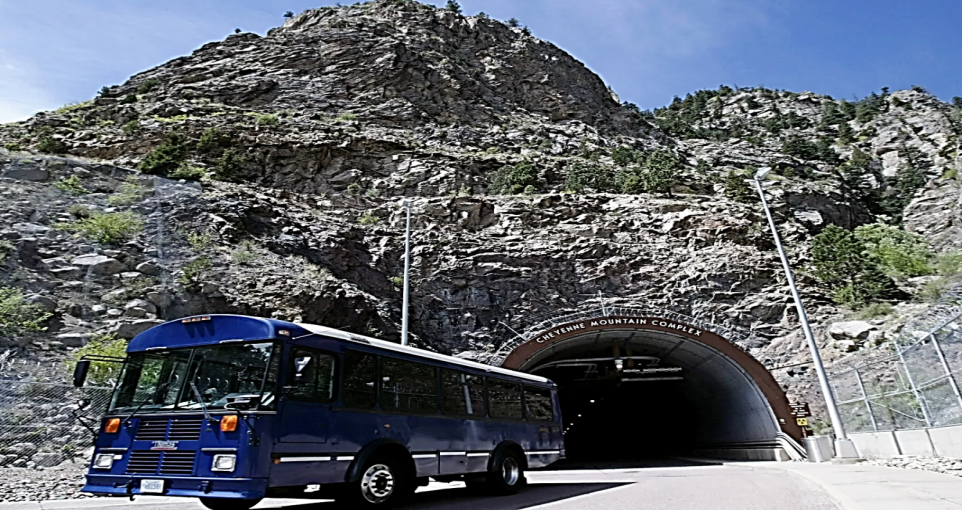
- Cheyenne Mountain Complex, which is among the only publicly known hardened bunkers functioning as a Cold War era continuity‑of‑government site designed to keep the president and top officials alive during a nuclear attack. Built deep inside 2,000 to 2,400 feet of solid granite and engineered to withstand multi‑megaton blasts, it operates as a self‑contained underground city with its own power, water, food supplies, and protected command‑and‑control systems to ensure the government can continue operating even after a catastrophic strike.
- Raven Rock Mountain Complex (also known as Site R, the “Underground Pentagon”, or the Alternate Joint Communications Center), which remains an active, highly classified U.S. military installation. It continues to serve as a major continuity‑of‑government bunker, designed to operate during nuclear, chemical, biological or other catastrophic attacks.
White House director of management and administration Joshua Fisher said during a recent NCPC meeting: “There are some things regarding this project that are, frankly, of top-secret nature that we are currently working on. That does not preclude us from changing the above-grade structure, but that work needed to be considered when doing this project, which was not part of the NCPC process”.
A source told CNN the underground complex was “a very complicated submarine that was built in the 1940’s, a self-contained unit, with separate power backups, separate water backups, separate air filtration”. They added: “But all the infrastructure is 1940s infrastructure”.
Jonathan Wackrow, now a risk‑management executive, has said: “The Situation Room is a much more focused watch centre that will feed information over to the PEOC, but because it is a complex that’s in the West Wing, it is secure to a point, but it’s not a hardened facility. The PEOC is used during emergencies. It’s not something that everybody goes to. The Situation Room is used almost by the whole of government, 24 hours a day”.
He added: “If you think about trying to mitigate the threats today and the threats for tomorrow, you’re really talking about emerging technologies, emerging infrastructure stuff that may not be commercially available. We’re never going to get the line of sight on how much that costs”.
Plans and specifications for any new underground facility are expected to remain classified, and learning the cost of the subterranean work is likely to be difficult, given the national security sensitivities.
Team Maverick.






Deschamps Admits France Fell Short as Spain End World Cup Dream with 2-0 Semifinal Win
Arlington (Texas), July 2026 : France head coach Didier Deschamps admitted his side was ou…

Deschamps Admits France Fell Short as Spain End World Cup Dream with 2-0 Semifinal Win
Arlington (Texas), July 2026 : France head coach Didier Deschamps admitted his side was …