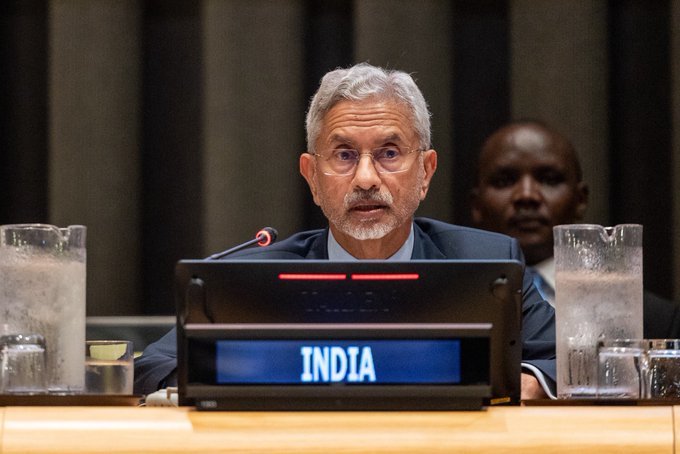
United Nations, September 2026 : External Affairs Minister S. Jaishankar held a series of bilateral meetings with foreign leaders and counterparts on the sidelines of the 81st United Nations General Assembly in New York, discussing India’s development partnerships, economic ties and major global developments.
Jaishankar met Nauru President David Adeang and reaffirmed India’s commitment to supporting the Pacific island nation as a development partner. Following the meeting, he said India valued its strong bilateral and multilateral cooperation with Nauru and remained committed to its development partnership.
The engagement with Adeang was part of Jaishankar’s wider diplomatic outreach during the UN General Assembly’s high-level week, which brings together leaders and senior representatives from UN member states for discussions on international affairs.
Jaishankar also held talks with Moldova’s Deputy Prime Minister and Foreign Minister Mihai Popsoi. The two sides reviewed developments in their bilateral political, economic and educational ties and discussed the Ukraine conflict.
In another meeting, Jaishankar met Switzerland’s Foreign Minister Ignazio Cassis and reviewed the progress of India-Switzerland economic relations following the entry into force of the India-European Free Trade Association (EFTA) Trade and Economic Partnership Agreement. The EFTA grouping comprises Switzerland, Norway, Iceland and Liechtenstein.
The minister also met Ukrainian Foreign Minister Andrii Sybiha, with discussions focusing on developments in Ukraine and the broader situation surrounding the conflict.
Jaishankar’s engagements extended to several European and Indo-Pacific partners. He began the day with a meeting with French Foreign Minister Jean-Noel Barrot, during which the two sides discussed regional and global issues, including the Ukraine and Gulf crises, as well as multilateral matters such as reform of the UN Security Council.
He subsequently met Ecuadorian Foreign Minister Roberto Kury, with talks covering economic cooperation, including energy and pharmaceuticals, mobility, training and development partnerships, besides collaboration in multilateral forums.
Meetings with Slovak Foreign Minister Juraj Blanar and Hungarian Deputy Prime Minister and Foreign Minister Anita Orban also formed part of his diplomatic schedule. Discussions with the two European counterparts focused on strengthening bilateral relations and expanding multilateral cooperation.
Jaishankar also participated in the first India-Visegrad Group foreign ministers’ meeting, bringing together India with Hungary, Poland, Slovakia and the Czech Republic. The discussions covered political and economic cooperation, technology and innovation, defence, space, connectivity, mobility and major international developments.
He later joined a meeting with European Union foreign ministers and Indo-Pacific partners, where discussions included India-EU cooperation, multilateral issues and developments in the Gulf, Ukraine and the Indo-Pacific.
The series of engagements reflects the extensive diplomatic activity surrounding the UN General Assembly high-level week, providing an opportunity for India to discuss bilateral priorities with partners while exchanging views on pressing international issues and multilateral cooperation.