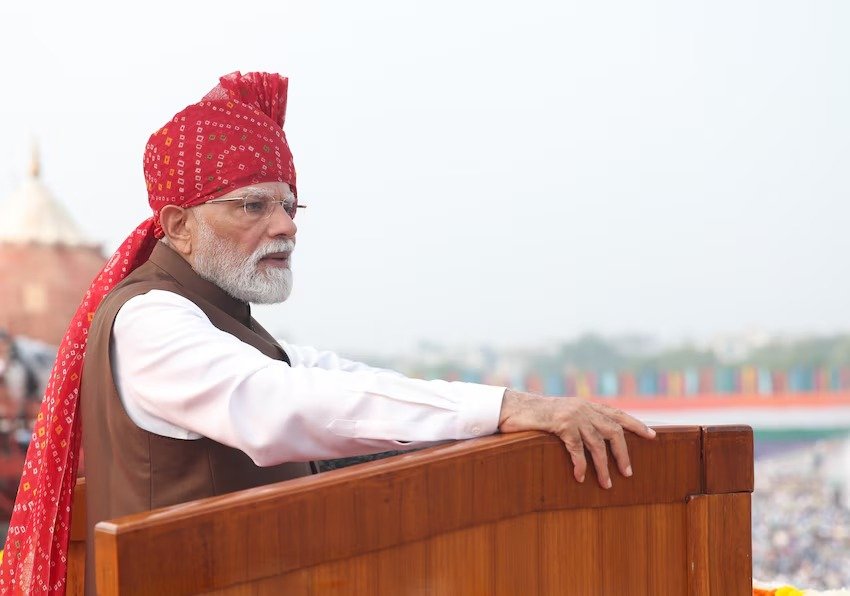
New Delhi, Aug 2026 : Prime Minister Narendra Modi on Saturday used his 80th Independence Day address to highlight India’s transformation over the past 12 years, crediting citizens across social, economic and geographical backgrounds for contributing to the country’s progress while setting an ambitious national goal of building a developed India by 2047.
Addressing the nation from the ramparts of the historic Red Fort, Modi said India had entered a phase where it could no longer afford to pursue limited aspirations. He called upon citizens to think big, remain determined and work collectively to take the country to new heights.
The celebrations also witnessed the rendering of the National Song, ‘Vande Mataram’, at the Red Fort for the first time during the Independence Day programme. Modi said the occasion was particularly significant as the country was marking 150 years of ‘Vande Mataram’, which has long been associated with India’s freedom struggle and national consciousness.
"All of us are celebrating the 80th Independence Day. Today, the heartbeat of every heart is echoing with the chant of ‘Vande Mataram’," the Prime Minister said.
He noted that the Tricolour had become a symbol of pride and unity across the country. "Today, there is a Tricolour at every home, and the Tricolour resides in every mind and heart. And today, filled with enthusiasm and zeal, embracing new resolves, the nation is moving forward," Modi said.
The Prime Minister began his address by paying tribute to the freedom fighters who made immense sacrifices for India’s independence. Remembering Mahatma Gandhi and the revolutionaries who inspired the freedom movement, he said their dedication, penance and martyrdom remained a source of inspiration for the nation.
"Today, the nation reverently remembers those great sons who reached the pinnacle of sacrifice and devotion for the freedom of the nation," he said, adding that the country would always remain indebted to those who devoted their entire lives to the cause of independence.
Modi also expressed solidarity with people affected by floods and landslides in several parts of the country. He said many families had suffered losses and assured them that the entire nation stood with them during the difficult period.
"Many families suffered due to this. We all feel their pain and I want to assure that we and all the people of the country are with them," he said.
Turning to India’s development journey, Modi said a nation achieves greatness when its dreams, resolutions and capabilities move together towards a common goal. He stressed that India must now set larger targets and develop the confidence to achieve them.
"We can no longer proceed with small dreams. We must have big dreams, because big dreams expand our thinking; they broaden our horizon," he said.
The Prime Minister argued that strong resolve becomes particularly important when a nation encounters difficulties. He said steadfast determination provides the strength to overcome challenges, deal with crises and create new pathways even during periods of adversity.
Highlighting the country’s economic and industrial progress, Modi cited substantial growth across several sectors over the past 12 years. According to the figures presented by him, defence production has increased nearly four-fold, while production in the Khadi and Village Industries sector has risen nearly five-fold.
He said electronics manufacturing had expanded nearly seven-fold, modern railway coach manufacturing had grown 21-fold and mobile phone manufacturing had increased 33-fold. Internet users, he said, had risen nearly four-fold, while patents granted had increased four-fold. Digital transactions, meanwhile, had grown 100-fold.
The Prime Minister said the transformation was not limited to industrial production or technology but had also extended to basic amenities and welfare delivery. He highlighted the pace at which tap water connections, cooking gas connections, toilets and houses for the poor had been provided.
According to Modi, tap water connections were delivered at an average pace 15 times faster every year, gas connections at six times the earlier speed, toilets for poor households at four times the pace and houses for the poor at three times the earlier rate.
He also pointed to changes in governance, saying the government had worked to reduce unnecessary compliance requirements and remove outdated laws. Thousands of compliances, he said, had been eliminated, while hundreds of obsolete laws had been repealed.
"The march of the 21st century cannot be driven by laws from the previous century," Modi said, underlining the need to modernise governance in line with the aspirations of a rapidly changing India.
The Prime Minister said these measures were part of a broader effort to strengthen infrastructure, improve public services, expand manufacturing and make governance more efficient and citizen-centric.
Looking ahead, Modi outlined India’s larger national ambition of becoming a developed country by 2047, when the nation will mark 100 years of independence. He said the goal of building a ‘Viksit Bharat’ would require the collective efforts of the country’s 140 crore citizens.
"Today, India has also envisioned a very grand dream. It has envisioned it with great resolve. It has envisioned it to touch new heights," he said.
Modi said India’s resolve to become a developed nation, particularly as the world’s most populous country, would demonstrate its confidence and capacity before the international community. He said the achievement would also compel the world to reassess its perspective towards India.
The Prime Minister concluded by acknowledging the contribution of citizens from every section of society to the country’s development. He said Dalits, deprived communities, tribals, rural and urban residents, the poor and middle class, youth and elderly, women and men, and citizens from every region had contributed to India’s progress.
He said the determination and dedication of citizens over the past 12 years had helped propel the country forward and deserved recognition and respect.
Modi said the collective efforts of citizens had already produced a major social transformation, noting that 25 crore people had emerged from poverty. He described this achievement as the outcome of the determination and hard work of ordinary Indians and said the same spirit would be essential for achieving the larger goal of a developed India by 2047.