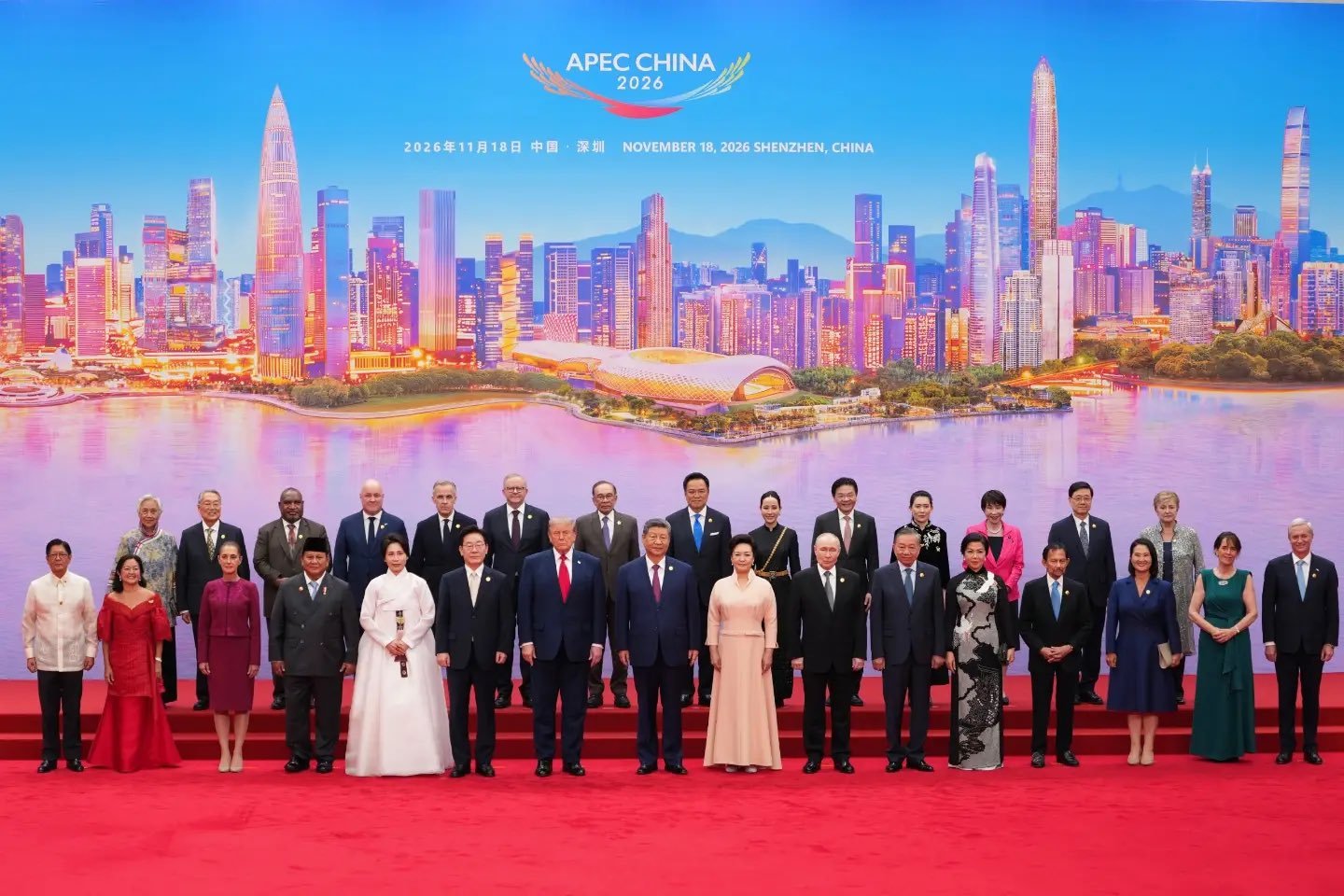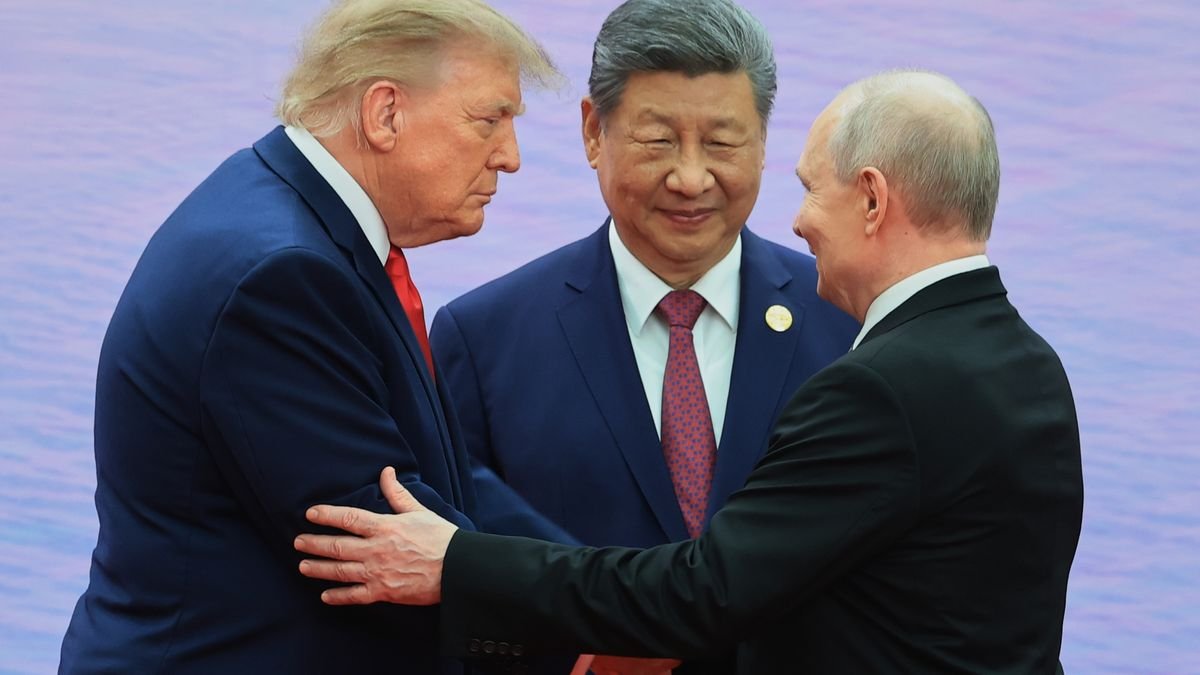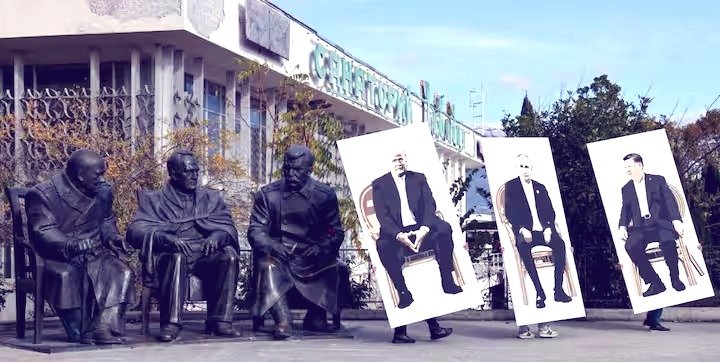
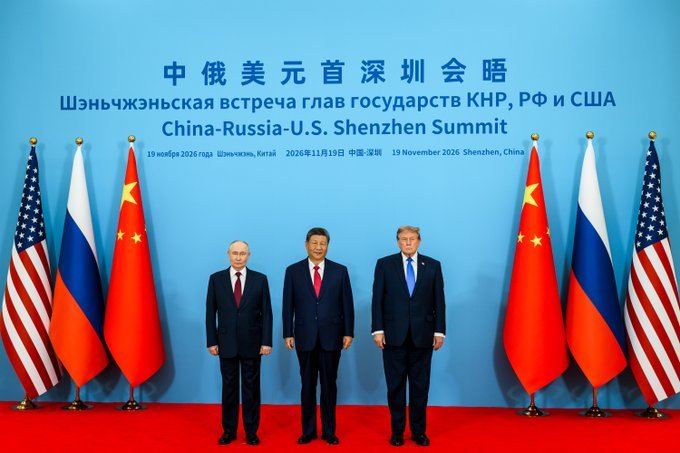
Shenzhen (China), Nov 2026 : US President Donald Trump, Chinese President Xi Jinping and Russian President Vladimir Putin held their first-ever trilateral summit in Shenzhen on Thursday, bringing together the leaders of the three major powers for discussions on nuclear arms reduction, international security, economic relations and energy cooperation.
The meeting took place at Kylin Villa on the sidelines of the Asia-Pacific Economic Cooperation (APEC) summit. Trump had earlier indicated that nuclear arms reductions and other major international issues would feature prominently in the discussions, according to South Korea's Yonhap News Agency.
In his opening remarks, Trump called on the three countries to maintain dialogue and cooperate on issues affecting global peace and security. He said the leaders of the United States, China and Russia had a special responsibility to engage with one another in an open and constructive manner.
"As presidents of three of the world's largest countries, we have a special responsibility to maintain open, respectful and productive dialogue on issues impacting not just our people but the entire planet," Trump said.
Highlighting the nuclear capabilities of the three countries, the US president said Washington, Moscow and Beijing were in a unique position to discuss ways to reduce the global nuclear arsenal and minimise the possibility of nuclear weapons being used.
"As the world's three largest nuclear powers by far, the United States, Russia and China are uniquely positioned to discuss how to reduce the number of nuclear weapons on Earth, and also to lessen the risk that those weapons will ever be used," he said.
Trump also acknowledged the political and strategic challenges involved in nuclear disarmament. He observed that leaders of countries possessing nuclear weapons faced considerable difficulty in deciding to give them up.
"It's very hard to give them up as a leader of a country," he said.
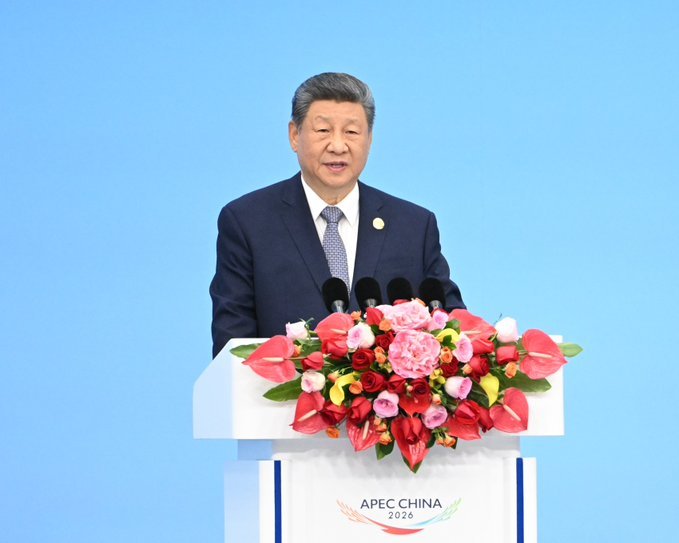
Chinese President Xi Jinping stressed the importance of peaceful relations between major powers, warning that cooperation could contribute to global stability, while confrontation could create uncertainty and chaos. According to China's official Xinhua News Agency, Xi urged the leaders to draw lessons from history while shaping future international relations.
"History is the best textbook," Xi was quoted as saying. "We must remember history, and learn from it to shape the future."
Russian President Vladimir Putin proposed that the discussions also cover global and regional economic relations, food security and energy cooperation. According to Russia's TASS news agency, Putin said these issues were important areas for engagement among the three countries.
"We should certainly discuss global and regional economic ties, and food and energy security," he said.
It remained unclear whether the summit would conclude with a joint statement outlining areas of agreement. In the absence of a common declaration, the three governments could issue separate accounts of the discussions and their outcomes.
Bilateral Meetings Before Trilateral Summit
Before the three-way meeting, Trump held separate bilateral discussions with Putin and Xi.
During his meeting with the Russian president, Trump spoke positively about their longstanding relationship and expressed hope that the discussions could lead to progress on major international issues.
"We've had a great relationship for many years. We know each other for a long time, and I think a lot of wonderful things can come out of this, or at least start," Trump said.
Trump's meeting with Xi was their first in two months, following their discussions in Washington in September. During the talks, the US president highlighted shared interests between Washington and Beijing concerning energy security and developments involving Iran.
He said both countries wanted to ensure the uninterrupted movement of energy supplies through the Strait of Hormuz and prevent Iran from acquiring nuclear weapons.
"Both the United States and China have an interest in ensuring that energy flows through the Strait of Hormuz, and that Iran cannot have a nuclear weapon," Trump said.
The US president also expressed optimism about the possibility of cooperation with China on the Russia-Ukraine war, indicating that the two countries could explore ways to contribute to efforts related to the conflict.
"We're looking to both help with respect to the war with Russia and Ukraine," he said.
North Korea and Possible Trump-Kim Meeting
North Korea's nuclear programme was another issue attracting attention ahead of the summit, although it was not expected to be a major standalone subject. Former US intelligence official Sydney Seiler told Yonhap that the issue could be discussed as part of broader conversations on international security.
Meanwhile, speculation continued over the possibility of a meeting between Trump and North Korean leader Kim Jong Un during the US president's Asia tour.
Trump had raised the prospect of meeting Kim during his visit to the region, which included participation in the Association of Southeast Asian Nations (ASEAN) summit in Manila. He also referred to the possibility during a meeting with Quad leaders in Manila on Tuesday, saying Kim "would like to" attend the APEC summit.
US Secretary of State Marco Rubio said on Wednesday that Trump was serious about engaging with the North Korean leader, but clarified that no meeting had been confirmed.
The White House and the US State Department had not responded to an email inquiry from Yonhap seeking clarification on whether a Trump-Kim meeting had been scheduled.
The Shenzhen summit brought together three countries with significant influence over global security, nuclear policy and economic affairs. Whether the discussions lead to concrete agreements on nuclear arms reduction, regional conflicts and energy security remains to be seen.
(Disclaimer :The content of this article is sourced from a news agency and has not been edited by the Mavericknews30 team.)