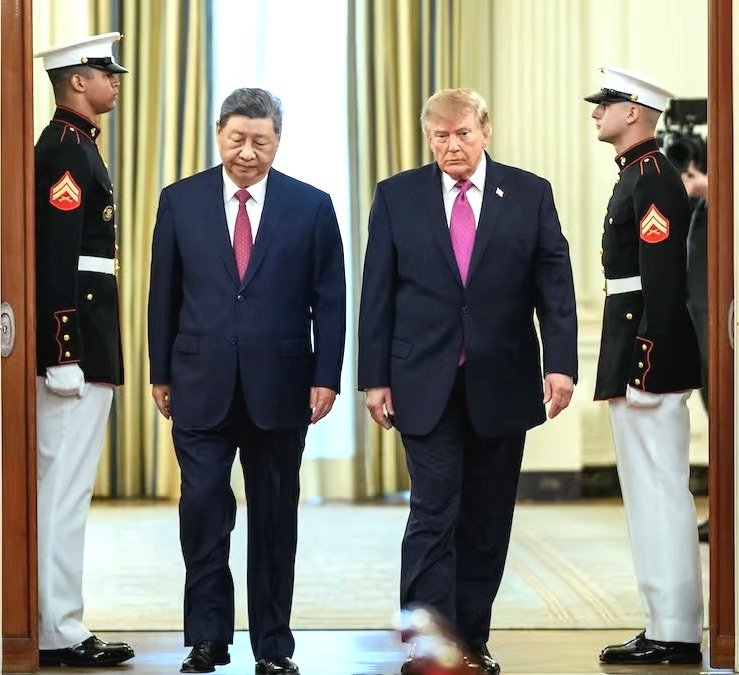
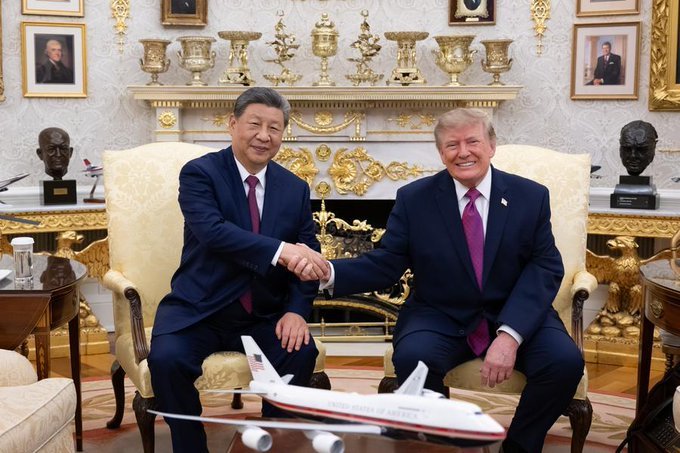
US President Donald Trump and Chinese President Xi Jinping agree on more favourable tariff treatment for $30 billion of non-sensitive goods in each direction and establish a new bilateral dialogue on advanced AI technologies.
Washington, Sept 2026 : US President Donald Trump and Chinese President Xi Jinping have agreed on measures to ease trade tensions and establish a new dialogue on advanced artificial intelligence, producing several economic and technology-related outcomes during the Chinese leader’s state visit to Washington.
The two sides reached consensus on recommendations for more favourable tariff treatment covering $30 billion of non-sensitive goods in each direction, meaning goods worth a combined $60 billion would be covered by the proposed arrangements. The White House said the agreement was reached through the newly operational US-China Board of Trade.
The announcements followed Xi’s three-day visit to Washington, during which he held talks with Trump as the two countries sought to maintain stability in a relationship marked by prolonged disputes over tariffs, technology, critical minerals and other strategic issues.
Neither government immediately disclosed the precise tariff rates that would apply to the covered goods, the size of individual reductions or the date on which the changes would take effect. China described the outcome as an arrangement for reciprocal tariff reductions, while the US account referred to recommendations for more favourable treatment.
The products covered include a range of non-sensitive goods. US exports include agricultural products, fish and seafood, logs and wood products, cosmetics and medical devices. Chinese products covered by the arrangement include small appliances, toys, holiday decorations and children’s car seats.
The Board of Trade also launched a working group focused on addressing market-access barriers in agricultural trade. Separately, the US-China Board of Investment was operationalised to provide a government-to-government channel for discussing investment projects and obstacles facing commercially significant investments. Both mechanisms were established following the leaders’ May summit in Beijing.
The White House also said China would import at least 10 million metric tonnes of US coal in 2027 and another 10 million tonnes in 2028. The coal commitment was included in the US account of the summit outcomes but was not highlighted in China’s published summary.
Critical minerals remained an area requiring further discussions. Washington said the two countries would continue working on concerns related to supplies of rare earths and other critical minerals, with the objective of restoring shipments to appropriate levels.
Xi stressed the importance of maintaining stable economic relations with Washington. According to China’s Foreign Ministry, he said cooperation should be expanded while the number of outstanding issues should be reduced, reflecting Beijing’s emphasis on maintaining communication alongside competition.
Technology emerged as another significant area of the discussions. The two governments agreed to use the term “super intelligence” for the emerging technologies covered by their talks and established a US-China Super Intelligence Dialogue to exchange views on the potential benefits and risks.
The next round of discussions is expected by November. The two sides will also establish a bilateral communication channel for incidents involving advanced AI systems, creating a mechanism for exchanging information when such incidents occur.
China referred to the mechanism as the China-US AI Dialogue and said both countries should increase exchanges as AI technology develops. Xi also stressed that AI should remain under human control.
The leaders agreed to pursue what the White House described as a “constructive relationship of strategic stability” based on respect, fairness and reciprocity. They are expected to meet again at the Asia-Pacific Economic Cooperation summit in Shenzhen in November and the G20 summit in Miami in December.
Trump and Xi also discussed international issues including Iran, Russia and North Korea. The White House said both leaders agreed that Iran must not acquire a nuclear weapon and that no country or institution should be allowed to impose tolls on international waterways.
The latest agreements mark an effort by Washington and Beijing to establish regular channels for managing economic, technological and strategic differences, even as major areas of competition between the two countries remain unresolved.
(Disclaimer :The content of this article is sourced from a news agency and has not been edited by the Mavericknews30 team.)