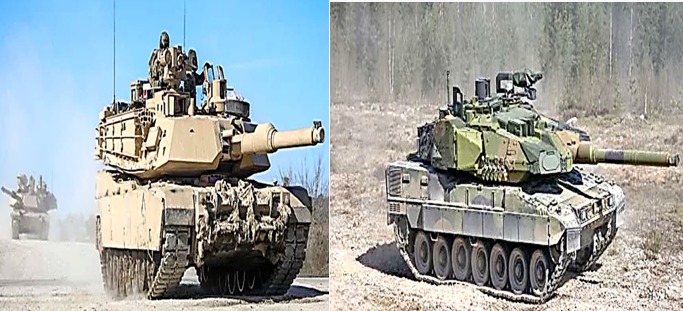
How The United States And NATO Tanks Differ In Modern Warfare.

May 2026: The U.S. M1A2 SEPv3 Abrams and Germany’s Leopard 2A8, recently introduced within Norway armed forces, are being directly compared as two of the most advanced main battle tanks designed for high-intensity warfare. This comparison highlights how the United States and its allies are prioritising survivability, firepower, and mobility to counter advanced anti-armour threats and maintain battlefield superiority against near-peer adversaries.
Both tanks reflect key lessons drawn from recent conflicts, such as Ukraine, where precision-guided munitions, drones, and layered defences have significantly increased the risks to armoured formations. Their evolving capabilities demonstrate how NATO is adapting its heavy forces to operate effectively in contested environments where protection, mobility, and sustained combat performance are critical to survival.
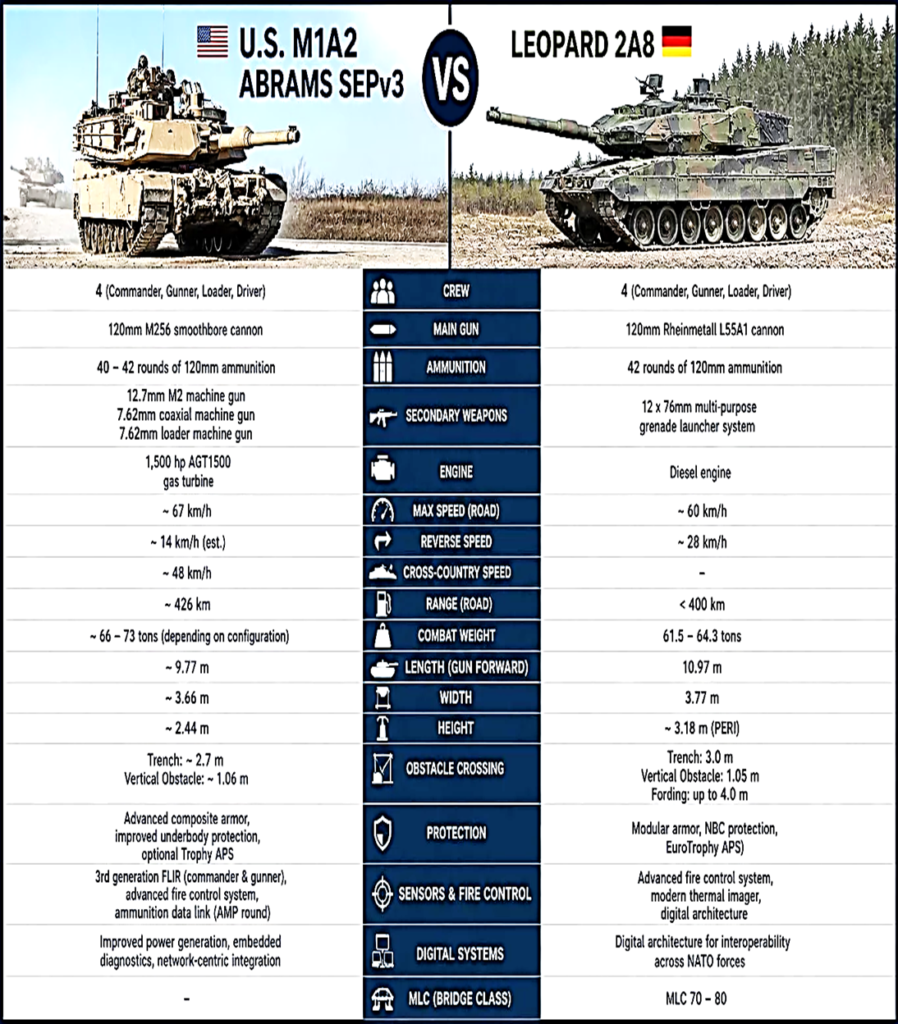
The M1A2 SEPv3 Abrams emphasises layered protection and combat endurance. It integrates advanced composite armour, explosive reactive armour options, and the Trophy active protection system, which can intercept incoming anti-tank guided missiles before impact, giving it a clear advantage in direct engagements against guided threats. The Leopard 2A8 adopts a modular protection concept, combining enhanced passive armour with the Euro Trophy system and an NBC protection suite, allowing rapid adaptation to evolving threats including loitering munitions and top-attack weapons, which provides a long-term advantage in scalability and future upgrades. In technical terms, the Abrams operates with a crew of four and is powered by a 1,500 horsepower AGT1500 gas turbine engine, delivering superior acceleration and sustained power under combat conditions.
A critical distinction lies in how each tank approaches active protection. The Trophy system used on the Abrams is a combat-proven hard-kill system that detects incoming missiles using radar and launches countermeasures to destroy them before impact. Euro Trophy, selected for the Leopard 2A8, is based on the same core Israeli technology but adapted for European integration and future growth. Its main value is not only the interception of anti-tank guided missiles and rocket-propelled grenades, but also its open architecture, which allows upgrades to address emerging threats such as top-attack munitions and potentially loitering drones. This gives the Leopard 2A8 a structural advantage in long-term threat evolution, even if the Abrams currently benefits from broader operational experience with its protection system.
Firepower between the two main battle tanks remains closely matched but reflects different optimisation paths. The Abrams is equipped with the 120mm M256 smoothbore cannon, supported by advanced fire control systems, third-generation FLIR thermal sights for both commander and gunner, and a digital ammunition data link that improves first-round hit probability and engagement flexibility. It carries between 40 and 42 rounds and is supported by secondary armament, including a 12.7 mm M2 heavy machine gun and multiple 7.62 mm machine guns, giving it strong multi-target engagement capability. The Leopard 2A8 fields the Rheinmetall L55A1 120mm cannon, designed for higher chamber pressure and compatibility with next-generation kinetic energy rounds, offering a potential advantage in raw armour penetration and future ammunition growth potential.
Mobility reveals a clearer divergence in design philosophy. The Leopard 2A8, weighing between 61.5 and 64.3 tons, is powered by a diesel engine that enables a road speed of up to 60 km/h and a reverse speed reaching 28 km/h, a critical advantage for rapid disengagement under fire and tactical repositioning. Its operational range remains below 400 km on roads, with strong obstacle-crossing capability, including 3.0 m trench crossing, 1.05 m vertical obstacles, and fording up to 4.0 m with preparation. The M1A2 SEPv3, with a combat weight ranging from approximately 66 to over 70 tons depending on configuration, reaches speeds of about 67 km/h on roads and around 48 km/h cross-country, with an operational range near 426 km. Its gas turbine engine provides superior acceleration and power-to-weight performance, offering an advantage in offensive manoeuvre and rapid assault operations despite higher fuel consumption.
The Leopard 2A8’s mobility characteristics highlight a focus on survivability through manoeuvre. Its ability to rapidly reverse at high speed improves crew survivability in ambush scenarios and under drone observation, reflecting recent battlefield lessons. This specific capability is increasingly relevant in Ukraine, where tanks that cannot quickly disengage after firing are highly vulnerable to precision strikes. The Abrams, while highly mobile, prioritises forward offensive momentum supported by robust logistics and recovery systems within U.S. doctrine, giving it an advantage in breakthrough operations where sustained forward pressure is essential.
In terms of dimensions, the Leopard 2A8 measures nearly 11 metres in length with the gun forward, 3.77 metres in width, and approximately 3.18 metres in height, placing it within the standard envelope for European infrastructure and transport constraints. Its Military Load Classification of 70-80 reflects compatibility with NATO bridging systems, offering an advantage in infrastructure flexibility across Europe. The Abrams operates within a similar dimensional range but places greater strain on infrastructure due to its higher weight and fuel requirements, reinforcing reliance on U.S. engineering assets while benefiting from superior protection levels.
Crew configuration remains identical, with four personnel including commander, gunner, loader, and driver, ensuring redundancy and sustained operational tempo. Both tanks are equipped with multi-purpose smoke grenade launchers, with the Leopard 2A8 featuring a 12-tube 76 mm system for rapid concealment and countermeasure deployment, enhancing its defensive reaction capability.
Digital integration is where the Abrams maintains a decisive edge. The M1A2 SEPv3 features improved onboard power generation, embedded diagnostics, and full integration into U.S. Army network-centric warfare systems. This enables real-time data exchange with unmanned aerial vehicles, reconnaissance units, and artillery, significantly accelerating sensor-to-shooter cycles and giving it a major advantage in coordinated, multi-domain operations. The Leopard 2A8 incorporates modern digital architecture but is optimised for interoperability across multinational NATO formations, providing flexibility and ease of integration across different armies, which is a key advantage in coalition operations.
Operational experience continues to shape both systems. The Abrams has been extensively deployed in combat, giving it a proven track record in survivability, reliability, and crew protection under real battlefield conditions. The Leopard 2A8 reflects a forward-looking approach, integrating lessons from recent conflicts and emphasising adaptability to emerging threats, particularly the growing importance of drones and top-attack attack profiles.
The core value of the Leopard 2A8 compared to the M1A2 SEPv3 lies in its adaptability and battlefield survivability model. It is designed not just to resist current threats, but to evolve rapidly as those threats change, with modular armour, scalable active protection, high reverse mobility, and lower logistical burden. In contrast, the Abrams delivers maximum combat power through superior integration, acceleration, and proven protection systems, making it dominant in structured, high-intensity offensive operations.
As NATO prepares for future large-scale conflict scenarios, the combination of these two advanced main battle tanks enhances overall alliance resilience. The M1A2 SEP V3 Abrams provides unmatched integration, offensive power, and battlefield dominance in coordinated operations, while the German Leopard 2A8 ensures flexible, sustainable armoured capability across Europe, complicating adversary targeting and reinforcing deterrence across multiple operational theatres.
Team Maverick.






Hockey Junior Men’s Nationals: Rajasthan, Telangana, Puducherry Shine in Coimbatore
Coimbatore, July 2026 : Hockey Rajasthan, Telangana Hockey and Le Puducherry Hockey regist…

Hockey Junior Men’s Nationals: Rajasthan, Telangana, Puducherry Shine in Coimbatore
Coimbatore, July 2026 : Hockey Rajasthan, Telangana Hockey and Le Puducherry Hockey registered impressive …