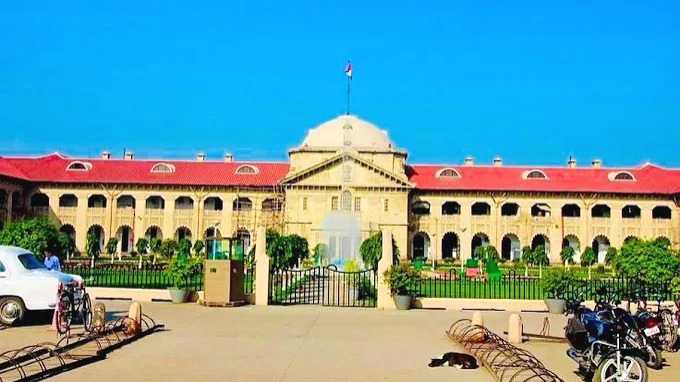
Allahabad High Court Refuses Registration Of FIR Against Rahul Gandhi for “Fight Against Indian State” Remark.

Prayagraj; May 2026: In a petition filed against the rejection of the applicant’s plea for registration of an FIR against Rahul Gandhi for the “fight against Indian State” remark, the Single Judge Bench of Vikram D. Chauhan, J., has dismissed the petition and held that the applicant presented no circumstances and material particulars to indicate that the speech had resulted in the aforesaid excitement, encouragement, or endangerment as provided under Section 152, Nyaya Sanhita, 2023 (BNS).
BACKGROUND –
The applicant filed an application under Section 173(4), Nagarik Suraksha Sanhita, 2023 (BNSS), before the trial court seeking registration of an FIR against Rahul Gandhi, Member of Parliament and Leader of Opposition, under Section 152 BNS. She alleged that Rahul Gandhi made a statement saying, “Our fight is with an organisation, a political party as well as the Indian State”.
She contended that this statement threatened the sovereignty, integrity, and unity of India, and it would create instability and a sense of rebellion in society. She further contended that Rahul Gandhi, who holds a constitutional position, made the statement, which was against the basic spirit of the Constitution, and thus, a cognizable offence.
The trial court rejected the application, holding that the applicant failed to explain how the said statement was a threat to the sovereignty, integrity, and unity of the Indian State. The Court further held that the allegation of instability and sense of rebellion was only a suspicion/imagination of the petitioner, and no material in this respect had been produced. The Court also noted that both parties were residents of Delhi and not Uttar Pradesh.
Aggrieved, the applicant filed a revision petition before the appellate court, but that was also rejected. Hence, the present petition.
ANALYSIS –
At the outset, the Court reiterated that Article 19(1)(a) of the Constitution grants all citizens the right to freedom of speech and expression, but it is restricted by Article 19(2). Article 19(2) provides that this right is subject to reasonable restriction in the interest of sovereignty and integrity of India, security of the State, public order, decency or morality, in relation to contempt of court, defamation or incitement of offence.
“The advancement of democracy is based on the exchange of views, free from retribution. Restricting freedom of speech reduces an individual to an approved narrative, undermining the moral polity of an individual”.
Regarding freedom of speech, the Court referred to several landmark decisions, such as Imran Pratapgadhi v. State of Gujarat, (2026) 1 SCC 721, and Shreya Singhal v. Union of India, (2015) 5 SCC 1, and remarked that courts play a very important role regarding any challenge to freedom of speech and expression, as they are required to protect it.
In Imran Pratapgadhi, the Supreme Court mandated that it was the bounden duty of courts to protect freedom of speech and expression and thwart any attempt to undermine it. This mandate, therefore, required each Court to examine whether an objection to any speech or expression would violate the right of an individual to freedom of speech and expression.
“Whenever an issue is raised objecting to a particular speech or expression, the courts are required to be vigilant to ensure that the fundamental right of an individual is not taken away lightly or restrictions on the speech and expression are reasonable”.
The Court reiterated that while examining whether a particular speech and expression is in violation of law or is included within the exceptions of Article 19(2), the courts are required to apply the prudent person test, i.e., think in a reasonable, just, and fair manner. Furthermore, a strict interpretation shall be made against taking away such a right, and the burden of proving restrictions under Article 19(2) shall be placed on the person making the accusations.
The Court further added that lodging an FIR is a serious act which may curtail the liberty of an individual and therefore courts are required to be very cautious while considering an application for lodging it, particularly, when the alleged offence is in respect of speech or expression, which is protected by the Constitution.
DECISION –
On the merits of the case, the Court stated that Rahul Gandhi is an elected representative and elected representatives may voice their concerns through various media. Even otherwise, such an elected representative has the individual right to freedom of speech and expression. Regarding the allegedly anti-national statement, the Court stated that the word “fight” could have different meanings based on context, and such context was required to be seen when examining the offensive speech. In the context of an elected representative, in the natural course of events and conduct, the word “fight” may signify intense advocacy, persistence, or opposition against a policy, thought, or ideology of an opponent or a particular person. There may be a distinction between an elected representative declaring commitment to fight against a particular policy or ideology and a person inciting rebellion. Noting that, admittedly, Rahul Gandhi made that statement in an interview, the Court held that it would be included in the aforesaid normal course of events.
The Court remarked that in a parliamentary democracy, criticism of government action or policies is not only permitted but is essential. Therefore, criticism or ideological difference may not by itself be an offence. The said exception also arises from the explanation provided under Section 152 BNS.
The Court further noted that, as per the applicant, the offending speech was broadcast on national television. The complete extracts of the alleged speech had neither been brought before this Court nor before the other two courts. Merely, a particular line of the speech was quoted in her application before the trial court, claiming that the words “fight against Indian State” were objectionable. The said expression was preceded by two words mentioning an independent organisation and a political party.
Noting the aforesaid, the Court held that the applicant had not shown how the said speech excites or attempts to excite secession, armed rebellion, or subversive activities, or encourages feelings of separatist activities, or endangers the sovereignty, unity, and integrity of India. The Court further held that no circumstances and material particulars had been shown to indicate that the aforesaid speech had resulted in the aforesaid excitement, encouragement, or endangerment, despite the speech being made more than a year ago in January 2025.
Reiterating that a suspicion cannot be a foundation for criminal prosecution, the Court stated that the applicant ought to have brought forth the material particulars, circumstances, and context which would have made the allegedly offensive speech of Rahul Gandhi an offence. However, the speech does not explicitly call for any offences provided under Section 152 BNS.
Considering that the trial and appellate courts recorded concurrent findings, the Court held that it would not convert itself into a court of appeal as it had not been demonstrated that the two courts had exercised their jurisdiction in grave dereliction of duty or gross abuse of power.
Accordingly, the petition was dismissed.
Team Maverick.




Hockey Junior Men’s Nationals: Rajasthan, Telangana, Puducherry Shine in Coimbatore
Coimbatore, July 2026 : Hockey Rajasthan, Telangana Hockey and Le Puducherry Hockey regist…

Hockey Junior Men’s Nationals: Rajasthan, Telangana, Puducherry Shine in Coimbatore
Coimbatore, July 2026 : Hockey Rajasthan, Telangana Hockey and Le Puducherry Hockey registered impressive …