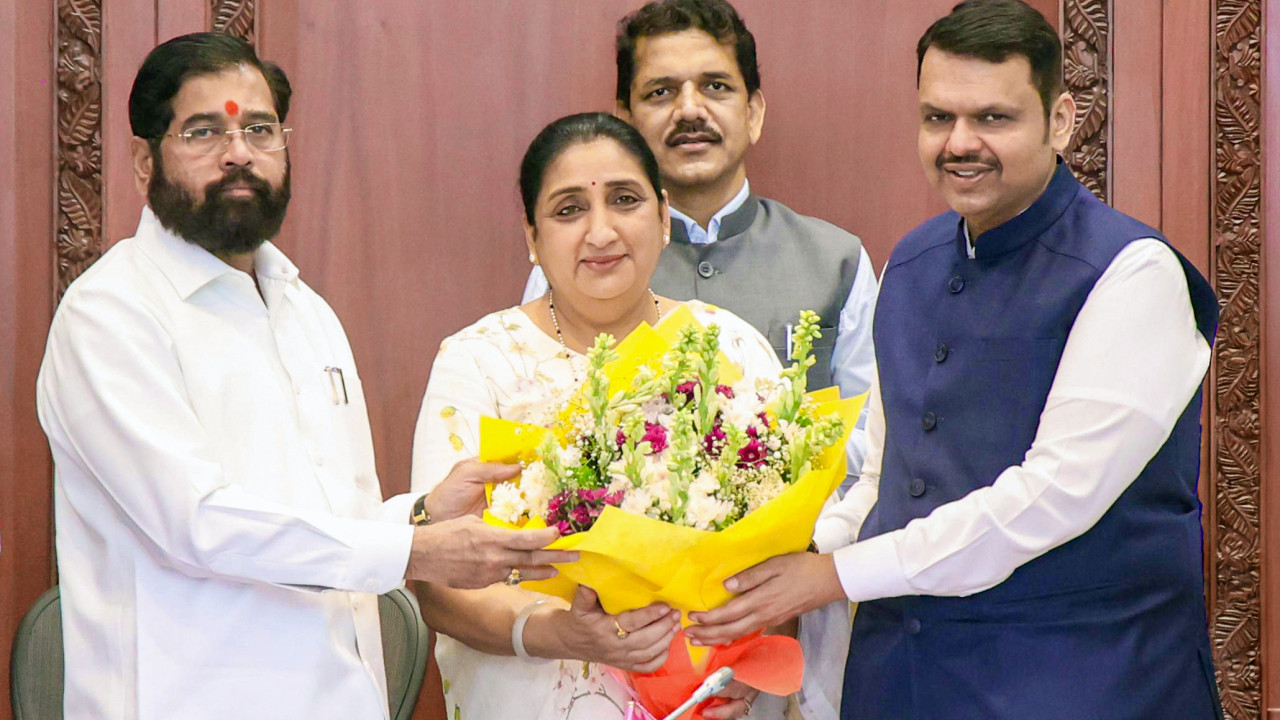
Mahayuti Seat-Sharing Battle Intensifies Ahead of Maharashtra MLC Polls Amid Internal Bargaining

Mumbai, May 2026 : With the June 1 deadline for filing nominations fast approaching, Maharashtra’s ruling Mahayuti alliance is witnessing intense closed-door negotiations over seat-sharing for the upcoming Legislative Council (MLC) elections scheduled for June 18. The elections will decide 17 crucial seats elected by local body representatives, and despite the alliance’s strong numerical advantage, internal bargaining has exposed underlying tensions among partners.
The Mahayuti coalition, comprising the Bharatiya Janata Party (BJP), Shiv Sena (Eknath Shinde faction), and Nationalist Congress Party (NCP – Ajit Pawar faction), enters the contest buoyed by its recent dominance in local body elections. Together, the three parties secured over 67 per cent of seats, placing them in a strong position to potentially sweep the Upper House polls. However, this very dominance has triggered a complex and increasingly competitive internal debate over seat allocation.
At the centre of the discussions is the BJP, the senior partner in the alliance under Chief Minister Devendra Fadnavis, which has proposed a formula largely reflecting its numerical superiority in local bodies. According to sources, the BJP is seeking between 11 and 12 of the 17 seats, asserting that its organisational strength and electoral performance justify a larger share.
The Eknath Shinde-led Shiv Sena faction, meanwhile, is pushing for 3 to 4 seats but has reportedly demanded as many as seven at the initial stage of negotiations. The party has been particularly assertive about retaining influence in traditional strongholds such as Thane, Pune, Chhatrapati Sambhaji Nagar–Jalna, and Parbhani–Hingoli regions.
The Ajit Pawar-led NCP faction is also seeking 2 to 3 seats, but its leadership has argued that seat allocation should not be determined solely by statewide numbers. Instead, it has emphasised concentrated voter strength in districts such as Pune, Raigad, and parts of Marathwada.
Tensions within the alliance have escalated as each partner insists on protecting its regional influence. In Raigad, for instance, a politically sensitive arrangement is reportedly under discussion in which Shiv Sena may consider supporting NCP leader Aniket Tatkare in exchange for the long-pending Raigad Guardian Minister post. However, no final consensus has been reached.
Pune has emerged as the most contested battleground, with all three partners staking competing claims. The NCP argues it has a demographic and organisational edge in the region, while the BJP counters this by highlighting its superior numerical strength in local governing bodies. Shiv Sena, meanwhile, is also seeking representation, making the seat one of the most tightly contested in the negotiation process.
Similarly, Thane and Raigad remain sensitive flashpoints. The Shiv Sena has firmly resisted what it perceives as attempts by allies to impose a “purely numerical formula” that could dilute its traditional influence in these regions. Party leaders have maintained that historical presence and grassroots loyalty must be factored into the final distribution.
Amid growing speculation of friction within the alliance, Maharashtra BJP president Chandrashekhar Bawankule has been holding a series of late-night meetings with coalition partners to ease tensions and build consensus.
Chief Minister Devendra Fadnavis has, however, publicly sought to downplay any perception of discord, projecting unity within the Mahayuti. Speaking on the ongoing negotiations, he emphasised that coalition stability remains the top priority despite competing ambitions.
“In a robust three-party alliance, it is natural for each partner to seek maximum representation based on its strength. We are carefully analysing ground realities, past performance, and current numbers in each constituency. Leaders from all three parties are engaged in discussions, and I can confidently say that nearly 99 per cent of the formula has already been aligned. The Mahayuti is fighting these 17 seats as a united front, and we are confident of winning all of them,” he said.
However, tensions reportedly escalated over the weekend when Eknath Shinde made an unannounced visit to Delhi to meet senior BJP leadership. His move was seen as an attempt to assert his party’s bargaining position directly with the central leadership.
Returning from Delhi, Shinde strongly defended his party’s claims, rejecting the idea that seat-sharing should be decided purely on numerical calculations. He stressed that political legacy, ground organisation, and regional identity must also be respected.
“An alliance must be built on mutual respect. One cannot ignore decades of organisational work in regions like Thane, Konkan, and Marathwada. These areas are deeply connected to the legacy of Balasaheb Thackeray. Our workers are prepared, and we have claimed seven seats on legitimate grounds. Discussions are ongoing, and we are confident of reaching a respectful solution,” he said.
On the NCP side, Ajit Pawar’s faction has also pushed for a merit-based approach rather than a rigid formula. Party leaders argue that in districts such as Pune, Raigad, and Nanded, the NCP’s concentrated voter base makes it a decisive factor in electoral outcomes.
The NCP has maintained that it is not interested in public confrontation but insists that seat distribution should reflect ground realities rather than arithmetic alone.
“Our focus is on strengthening the Mahayuti alliance and ensuring maximum success. We are advocating a seat-by-seat evaluation based on local strength and strike rate. Internal discussions are progressing in a constructive manner,” a senior NCP leader said.
As the June 1 nomination deadline nears, the three leaders—Devendra Fadnavis, Eknath Shinde, and Ajit Pawar—are expected to hold a final round of talks over the weekend to finalise the seat-sharing formula and approve candidate lists.
While the BJP is unlikely to significantly dilute its dominant position in the alliance, sources indicate that strategic concessions, including future Cabinet adjustments or assurances in upcoming Assembly elections, may be considered to maintain unity.
Despite the underlying tensions, all three partners continue to publicly project confidence, insisting that the Mahayuti remains cohesive and committed to a clean sweep in the MLC elections. However, political observers believe that the outcome of these negotiations will test the durability of the alliance ahead of future electoral battles in Maharashtra.
(The content of this article is sourced from a news agency and has not been edited by the Mavericknews30 team.)

ISRO Successfully Tests Indigenous Ship-Borne Tracking System for Gaganyaan Mission
New Delhi, July 2026 : The Indian Space Research Organisation (ISRO) has successfully vali…

ISRO Successfully Tests Indigenous Ship-Borne Tracking System for Gaganyaan Mission
New Delhi, July 2026 : The Indian Space Research Organisation (ISRO) has successfully validated …