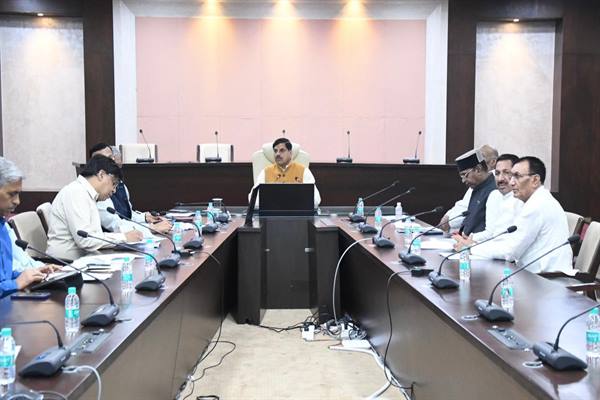
All Departments Must Make Coordinated Preparations to Tackle Possible Deficient Rainfall: Chief Minister Dr. Yadav

Chief Minister Dr. Mohan Yadav has said that the possibility of deficient rainfall should be viewed not as a challenge but as an opportunity for better planning, scientific farming and timely preparedness. He directed all concerned departments to work in close coordination and provide timely guidance to farmers so that agricultural production and farmers’ incomes remain protected from any adverse impact.
Chief Minister Dr Yadav, reviewing the State’s preparedness for a possible deficient monsoon at the Mantralaya on Thursday, held a comprehensive meeting with the departments of Farmers’ Welfare and Agriculture Development, Water Resources, Horticulture, Animal Husbandry, Fisheries, Cooperation, Public Health Engineering and other related departments. The Chief Minister said that the government’s priority is to ensure that every farmer is equipped to deal with weather-related challenges through scientific approaches and proper planning. He said that timely decisions and effective inter-departmental coordination can substantially mitigate the impact of deficient rainfall.
Chief Minister Dr. Yadav directed officials to launch a large-scale awareness campaign encouraging farmers to cultivate short-duration, low-water-requirement crops. He said, emphasising the cultivation of millets and pulses such as sorghum (jowar), pearl millet (bajra), black gram (urad), green gram (moong), pigeon pea (tur) and kodo-kutki, that these crops require less water, provide better resilience under adverse conditions and can offer higher returns to farmers. The Chief Minister also advised that farmers should not rush into sowing operations. Sowing should be undertaken only after adequate soil moisture is available, while moisture conservation practices should be actively promoted.
Chief Minister Dr. Yadav directed officials to ensure wider adoption of improved short-duration crop varieties and modern agricultural technologies. Suggestions from agricultural scientists and subject experts should be effectively disseminated to farmers so they can select crops best suited to local conditions. He further instructed that the agricultural extension system be strengthened and made more proactive.
Chief Minister Dr. Yadav said that the State Government is continuously monitoring the evolving rainfall situation. He directed all concerned departments to implement their pre-planned action plans in a coordinated manner and provide every possible technical and administrative support to farmers. He assured, emphasising that farmers’ welfare remains the government’s highest priority, that all necessary measures would be taken to safeguard agricultural production and ensure farmers’ prosperity.
Two-Year Preparedness Plan
To strengthen long-term resilience, the State Government has prepared a comprehensive two-year strategy. All urban local bodies will identify alternative water sources, prepare contingency plans for tanker-based water supply and ensure timely completion of water supply projects under AMRUT 2.0. In rural areas, village-wise reviews under the Jal Jeevan Mission will be conducted, while a 90-day campaign will be launched to repair non-functional and incomplete piped water supply schemes. Under Jalabhishek 2.0, old ponds, stepwells, wells and other traditional water bodies across the State will be surveyed and restored. Through convergence with various development programmes, at least 100 water structures in every development block will be rejuvenated over the next two years. A mission-mode groundwater recharge programme will be implemented in all development blocks through recharge shafts, check dams, stop dams and farm ponds, following the principle of ‘Water of the field should remain in the field, and water of the village should remain in the village’. Cleaning and repair of canals will be completed before the Rabi season, with accountability measures in place to ensure water reaches tail-end farmers. The cultivation of low-water-demand crops such as pulses, oilseeds and Shree Anna (millets) will be promoted, and procurement of these crops at the Minimum Support Price (MSP) will also be encouraged. Water availability-based advisories will be issued for summer paddy and moong cultivation. Direct seeding of paddy and alternate wetting and drying (AWD) techniques will be encouraged, while district-specific contingency crop plans are being prepared. Under hydropower and reservoir management, the prescribed rule curves for major reservoirs, including Indira Sagar, Omkareshwar, Bansagar and Gandhi Sagar, will be strictly adhered to. A clear protocol for water allocation will be followed, giving top priority to drinking water, followed by irrigation and then hydropower generation. State-level water dashboards will be developed for real-time monitoring and early warning. A sustained public awareness campaign on the lines of the Jal Ganga Samvardhan Abhiyan will be launched with active public participation. Every district will prepare a Water Crisis Contingency Plan under the chairmanship of the District Collector. Joint training of Revenue, Agriculture and Panchayat officials for damage assessment under RBC 6(4) will be completed in advance. Digital crop surveys and satellite image-based damage assessment systems will be validated to enable completion of surveys within 15 days. Crop insurance coverage will be expanded, and measures will be taken to ensure prompt settlement of insurance claims.
State Preparedness for Contingency Situations
The State Government has already initiated several preparedness measures. A model State-level contingency action plan has been prepared and uploaded on departmental portals. District-wise targets have been issued for crop demonstrations and distribution of improved seed varieties under various schemes. Targets have been assigned to districts under the Balram Talab Scheme to promote rainwater harvesting. Social media platforms are being extensively used to raise awareness among farmers. Weather forecasts, crop advisories and seasonal agricultural recommendations are being sent directly to farmers through mobile messages. District Collectors have been directed to regularly review irrigation arrangements, water logging conditions, the availability of electricity for life-saving irrigation, and drought monitoring in coordination with all concerned departments. Contingency action plans were discussed during Gram Sabha meetings held between June 26 and 30.
The meeting was attended by Revenue Minister Shri Karan Singh Verma, Cooperation Minister Shri Vishvas Kailash Sarang, Farmers’ Welfare and Agriculture Development Minister Shri Edal Singh Kansana, Minister of State for Fisheries Shri Narayan Singh Panwar, Chief Secretary Shri Anurag Jain, Additional Chief Secretaries Dr. Rajesh Rajora, Shri Neeraj Mandloi, Shri Sanjay Dubey and Shri Manish Rastogi, along with other senior secretaries, secretaries and departmental officials.




Solar Defence Showcases Indigenous ‘Bhargavastra’ Counter-Swarm Drone System to Indian Army
New Delhi, July 2026 : Solar Defence and Aerospace Ltd. (SDAL) on Friday showcased its ind…

Solar Defence Showcases Indigenous ‘Bhargavastra’ Counter-Swarm Drone System to Indian Army
New Delhi, July 2026 : Solar Defence and Aerospace Ltd. (SDAL) on Friday showcased …