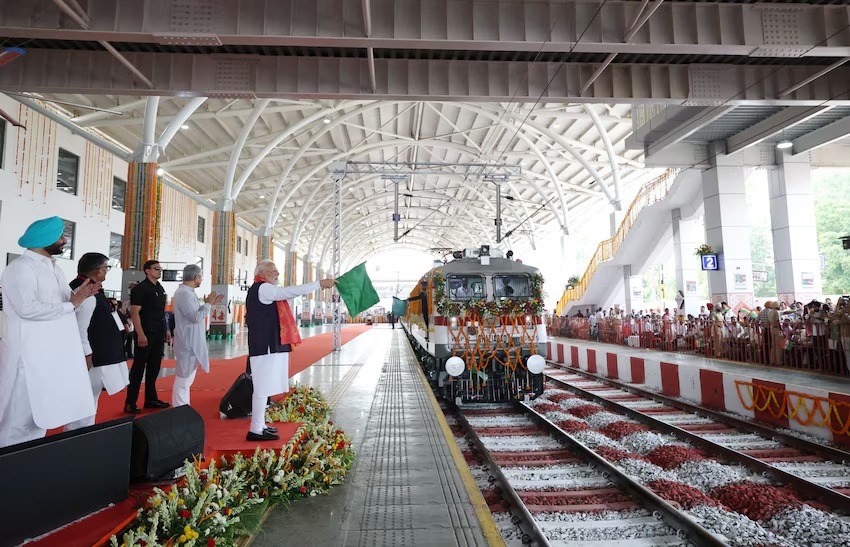
India Becomes World’s Largest Electrified Railway Network, Achieves 99.6% Broad Gauge Electrification

New Delhi, July 2026 : India has emerged as the country with the world’s largest electrified railway network, achieving an impressive 99.6 per cent electrification of its broad gauge rail network, Union Railway Minister Ashwini Vaishnaw informed the Lok Sabha on Wednesday. The achievement places India ahead of all major railway nations and marks a significant milestone in the country’s push towards sustainable and energy-efficient transportation.
Replying to a question in the Lower House, the Railway Minister said that India now ranks second only to Switzerland in terms of the percentage of railway electrification. While Switzerland has achieved 100 per cent electrification, its railway network is considerably smaller than India’s. In terms of the scale of electrified railway infrastructure, India has now emerged as the global leader.
The minister highlighted that India has surpassed several major economies in railway electrification. China has electrified about 82 per cent of its railway network, followed by Spain at 67 per cent, Japan at 64 per cent, France at 60 per cent and the United Kingdom at 39 per cent.
Vaishnaw said Indian Railways has undertaken one of the fastest railway electrification drives anywhere in the world. Unlike many countries that focus on electrifying only high-density passenger or freight corridors, India adopted the ambitious goal of electrifying its entire broad gauge network.
The pace of electrification has accelerated dramatically over the past decade. Between 2014 and 2026, Indian Railways electrified 48,072 route kilometres, more than double the 21,801 route kilometres electrified during the preceding six decades. The minister said this reflects the government’s mission-mode approach to modernising railway infrastructure and reducing dependence on imported fossil fuels.
Electrification has also delivered substantial economic and environmental benefits. According to the minister, Indian Railways’ diesel consumption for traction purposes has fallen sharply from 293 crore litres in 2015-16 to 108 crore litres in 2024-25, representing a reduction of 185 crore litres. The decline has significantly lowered fuel import requirements, resulting in considerable savings in foreign exchange while also reducing greenhouse gas emissions.
Apart from lowering fuel costs, electrification has improved the operational efficiency of Indian Railways. Electric locomotives offer greater hauling capacity, higher speeds and better reliability than diesel-powered engines, enabling faster train operations, reduced travel times and improved freight movement across the country.
The Railway Minister also pointed out that Indian Railways has made significant progress in integrating renewable energy into its operations. More than 1,260 MW of solar and wind energy capacity has already been commissioned to support railway operations, reinforcing the organisation’s commitment to clean energy and sustainable transportation.
He noted that rail transport remains one of the most environmentally friendly modes of travel, emitting approximately 89 per cent less carbon dioxide than road transport. The continued expansion and electrification of the railway network will therefore play a crucial role in reducing India’s overall carbon footprint while promoting cleaner mobility.
Vaishnaw said electrified railway systems are ideally suited for integrating renewable energy sources such as solar and wind into traction power systems. This makes rail transport one of the most efficient and sustainable modes of mass transportation available today.
Reaffirming the government’s commitment to green infrastructure, the minister said Indian Railways will continue pursuing near-total electrification, supported by renewable energy generation and strategic power procurement. These initiatives, he added, are aligned with India’s broader climate commitments and long-term objective of building a low-carbon, energy-efficient transportation network capable of supporting the country’s future economic growth.






HAL Set to Increase TEJAS MK-1A Production to 30 Jets Annually as GE Commits Higher Engine Deliveries
New Delhi, July 2026 : Hindustan Aeronautics Limited (HAL) is preparing to significantly r…
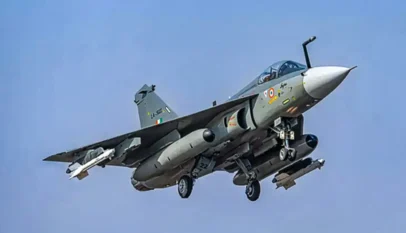
HAL Set to Increase TEJAS MK-1A Production to 30 Jets Annually as GE Commits Higher Engine Deliveries
New Delhi, July 2026 : Hindustan Aeronautics Limited (HAL) is preparing to significantly ramp …