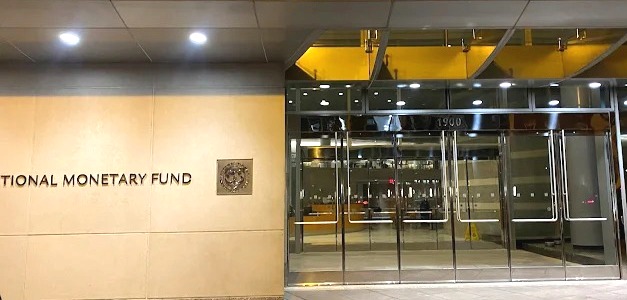
IMF Executive Board Concludes 2025 Article IV Consultation With Bangladesh.

Washington DC; January 2026: The Executive Board of the International Monetary Fund (IMF) have completed the Article IV Consultation for Bangladesh on January 26, 2026. The authorities have consented to the publication of the Staff Report prepared for this consultation. Under the IMF’s Articles of Agreement, publication of documents that pertain to member countries is voluntary and requires the member consent.
Bangladesh’s economic growth has slowed recently, while inflation has remained elevated. GDP growth decelerated to 3.7% in FY25 from 4.2% in FY24 and 5.8% in FY23, reflecting production delays during the popular uprising, a tighter policy mix, and sluggish investment. Headline inflation fell from double-digit levels in early FY25 but remained elevated at 8.2% (y-o-y) in October. Tax revenue to GDP ratio fell sharply in FY25, although the fiscal deficit was contained due to under-execution of capital and social spending. Foreign exchange reserves have begun to rebuild, supported by improvements in the current account.
The economy is expected to recover gradually over the medium term. With implementation of policies to mobilize tax revenue and address financial sector vulnerabilities, growth is projected to rebound to 4.7% in FY26 and gradually accelerate to around 06% over the medium term. Inflation is projected to remain elevated at 8.9% in FY26 before subsiding to around 06% in FY27. Risks to the outlook are tilted to the downside, mainly from delayed or inadequate policy action and reversals of exchange rate reform and fiscal discipline.
Executive Board Assessment:
Executive Directors acknowledged the interim authorities’ efforts to stabilise the economy following the 2024 uprising and, till the outcome of the national elections. They, however, noted that Bangladesh faces mounting macroeconomic and financial challenges. Weak revenue mobilisation, banking sector vulnerabilities, incomplete implementation of the new exchange rate framework, and elevated inflation are weighing on macroeconomic stability and growth prospects.
Furthermore, the Directors have also observed an uneven program performance and emphasised that decisive and sustained policy actions and bold reforms are needed to restore macroeconomic and financial stability and support the country’s long-term development goals. The new administration’s full ownership of the program will be critical, supported by early and active engagement with staff and efforts to secure stakeholder buy-in.
Directors stressed the need for ambitious fiscal reforms. They encouraged the authorities to undertake bold tax policy reforms, simplify the tax system, and strengthen tax administration and compliance to mobilise revenue. Directors also underscored the importance of rationalising subsidies, prioritising growth-enhancing investments, enhancing social safety nets, and improving public financial and investment management to support inclusive development and growth. Strengthening the financial viability of energy SOEs will also be important.
The Directors highlighted the urgent need for a credible banking sector reform strategy consistent with international standards to restore banking sector stability. Such a strategy should include estimates of undercapitalisation, define fiscal support, and outline legally robust restructuring and resolution plans. They encouraged the authorities to conduct asset quality reviews for all systemic and state-owned banks, advance risk-based supervision, and strengthen governance and balance sheet transparency.
Directors concurred that maintaining a tight policy mix is necessary to keep rebuilding foreign reserves and reducing inflation. They stressed the importance of full and consistent implementation of the exchange rate reform and greater exchange rate flexibility and cautioned against unsecured liquidity injections into weak banks. Monetary policy should remain appropriately tight until inflation is firmly on a downward path. Modernisation of the monetary policy framework should continue.
Directors underscored that comprehensive structural reforms are essential to unlock Bangladesh’s economic potential and promote inclusive growth as Bangladesh is graduating from LDC status. They emphasized enhancing governance and transparency, strengthening anti-corruption and AML/CFT frameworks, and ensuring central bank autonomy. Directors supported policies for job creation, particularly for the youth, and export diversification and agreed that capacity development and improvements in macroeconomic statistics remain essential. Continued implementation of reforms under the RSF arrangement can help build climate resilience and mobilize climate finance.
Bangladesh: Selected Economic Indicators, FY: 2025–27 (Fiscal year calculated: July 01 to June 30) –
| FY 25 Actual | FY 26 Projected | FY 27 Projected | |
| Real GDP | 3.7 | 4.7 | 4.7 |
| Consumption: | |||
| Private | 10.2 | 2.9 | 4.5 |
| Public | -6.8 | 15.0 | 12.3 |
| Gross Capital Formation | -8.0 | 8.2 | 4.9 |
| Private | 0.9 | 2.3 | 5.3 |
| Public | -39.3 | 42.5 | 3.3 |
| Trade: | |||
| Exports of goods and services | 5.6 | 12.3 | 13.6 |
| Imports of goods and services | 3.3 | 11.7 | 13.2 |
| Prices: | |||
| GDP deflator | 6.1 | 8.7 | 6.1 |
| CPI inflation (annual average) | 10.0 | 8.9 | 6.0 |
| CPI inflation (end of period) | 8.5 | 8.7 | 5.5 |
| Central government operations (in percent of GDP): | |||
| Total revenue and grants | 8.0 | 8.2 | 10.3 |
| Of which: Tax revenue | 6.9 | 7.2 | 9.3 |
| Total expenditure | 10.9 | 12.6 | 15.0 |
| Of which: Annual Development Program (ADP) | 2.3 | 3.4 | 3.4 |
| Overall balance (including grants) | -2.9 | -4.3 | -4.7 |
| (excluding grants) | -3.0 | -4.4 | -4.7 |
| Primary balance (including grants) | -0.7 | -2.0 | -2.2 |
| Public sector total debt | 42.1 | 42.4 | 43.4 |
| Of which: External debt | 19.5 | 19.2 | 18.8 |
| Balance of Payments (in percent of GDP): | |||
| Current account balance | 0.0 | -0.3 | -0.6 |
| Trade balance | -5.6 | -5.5 | -5.8 |
| Capital account balance | 0.1 | 0.1 | 0.1 |
| Financial account balance | 0.8 | 0.7 | 1.3 |
| Foreign direct investment, net | 0.4 | 0.3 | 0.5 |
| Gross international reserves (billions of U.S. dollars) | 26.8 | 30.9 | 35.8 |
| in months of next year’s imports | 3.8 | 3.9 | 4.0 |
| Monetary and Credit (in percent of GDP): | |||
| Reserve money | 7.5 | 7.7 | 8.1 |
| Broad money (M2) | 46.5 | 45.6 | 45.8 |
| Credit to private sector | 33.2 | 31.0 | 30.1 |
| Credit to private sector (percent change) | 5.6 | 6.1 | 7.9 |
| Savings and Investment (in percent of GDP): | |||
| Gross national savings | 28.2 | 28.2 | 27.9 |
| Public | -0.1 | -0.1 | 1.6 |
| Private | 28.4 | 28.3 | 26.2 |
| Gross investment | 28.2 | 28.5 | 28.5 |
| Public | 4.1 | 5.5 | 5.4 |
| Private | 24.1 | 23.0 | 23.1 |
| Memorandum item: | |||
| Nominal GDP (in billions of taka) | 55,029 | 62,637 | 69,533 |
Team Maverick.




Andhra Pradesh Announces Cash Incentive for Higher Births as CM Naidu Pushes Population Growth Agenda
Amaravati, May 2026: In a significant policy shift aimed at addressing declining birth rat…
Andhra Pradesh Announces Cash Incentive for Higher Births as CM Naidu Pushes Population Growth Agenda
Amaravati, May 2026: In a significant policy shift aimed at addressing declining birth rates, …