Work in Coordination with Centre under ‘Dalhan Aatmanirbharta’ Mission: CM Dr. Yadav

Chief Minister Dr. Mohan Yadav stated that Madhya Pradesh’s fertile land, abundant water resources, and favourable climate are its greatest strengths. The strengthening presence of an international research institution like ICARDA in the state is a matter of pride. He said that in India, foodgrain is not merely an agricultural produce, but the very foundation of life, culture and values. ‘Ann Devo Bhava’ is the core mantra of the country’s agricultural tradition.
 Madhya Pradesh is observing the ‘Krishak Kalyan Varsh’, under the leadership of Prime Minister Shri Narendra Modi, the government, which stands firmly with farmers from seed to market, has launched the ‘Dalhan Aatmanirbharta’ Mission. The mission aims to increase pulses production to 35 million tonnes by 2030–31, reduce import dependence, and enhance farmers’ incomes. Under this mission, farmers will receive better-quality seeds, modern storage facilities, and assured marketing support.
Chief Minister Dr. Yadav said that India is the world’s largest producer and consumer of pulses. Madhya Pradesh ranks first in pulses production in the country. As a result, farmers of the state will derive the maximum benefit from this mission. Chief Minister Dr. yadav addressed the ‘Rashtriya Paramarsh evam Ranneeti Sammelan’ organised under the National ‘Dalhan Aatmanirbharta’ Mission at the Food Pulses Research Centre, Amlaha (Sehore district) on Saturday.
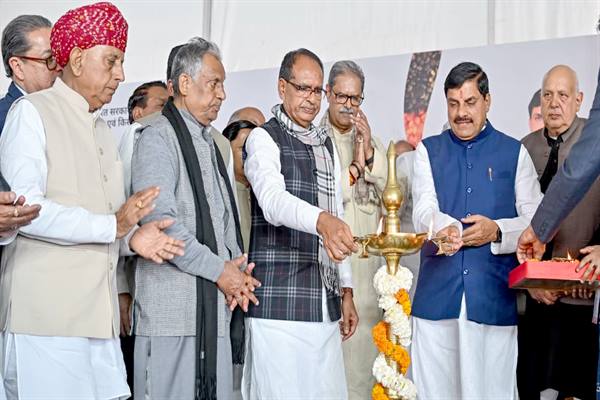
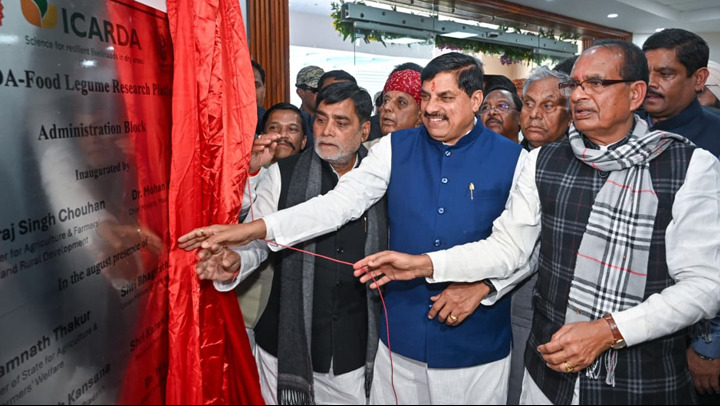
Chief Minister Dr. Yadav and Union Minister for Agriculture & Farmers’ Welfare and Panchayati Raj & Rural Development Shri Shivraj Singh Chouhan inaugurated the conference by lighting the ceremonial lamp. On this occasion, the newly constructed Administrative Building, Training Centre and Advanced Plant Tissue Culture Laboratory of ICARDA, Sehore, were also inaugurated.
Chief Minister Dr. Yadav stated that this new ICARDA facility would open new avenues of hope and opportunity for the state’s farmers. The centre will play a historic role in connecting farmers with scientific farming practices, advanced technology and global agricultural experience.
 Emphasising irrigation expansion and water conservation, Chief Minister Dr. Yadav said that the scientific models developed by ICARDA would provide a strong foundation for state schemes. The joint efforts of the Union Ministry of Agriculture and ICARDA can make Madhya Pradesh a national and global model of sustainable and prosperous agriculture as well. He stated that the national conference in Sehore would serve as a strong platform for in-depth deliberations on current challenges, core concerns and future possibilities in the pulses sector, proving to be a milestone in policymaking and research. He congratulated the Union Ministry of Agriculture and the entire ICARDA team, stating that the centre would give a new direction to agriculture in the state and bring positive change in farmers’ lives.
Chief Minister Dr. Yadav said that Madhya Pradesh is the food basket of India. In Indian culture, society flourishes through reverence for food as Ann Devta. Prime Minister Shri Narendra Modi has identified four pillars of national development and welfare—the poor, farmers, youth, and women. Indian civilisation evolved around an agriculture-based lifestyle. In modern times, several distortions have entered farming, including the excessive use of chemical fertilisers, which affects lifestyles. The Prime Minister has consistently prioritised farmers’ interests above all else, and even countries like the United States have acknowledged India’s stance.
Chief Minister Dr. Yadav said that pulses are a daily staple in every Indian household and are essential across all seasons. The levels of production and consumption indicate that much more work needs to be 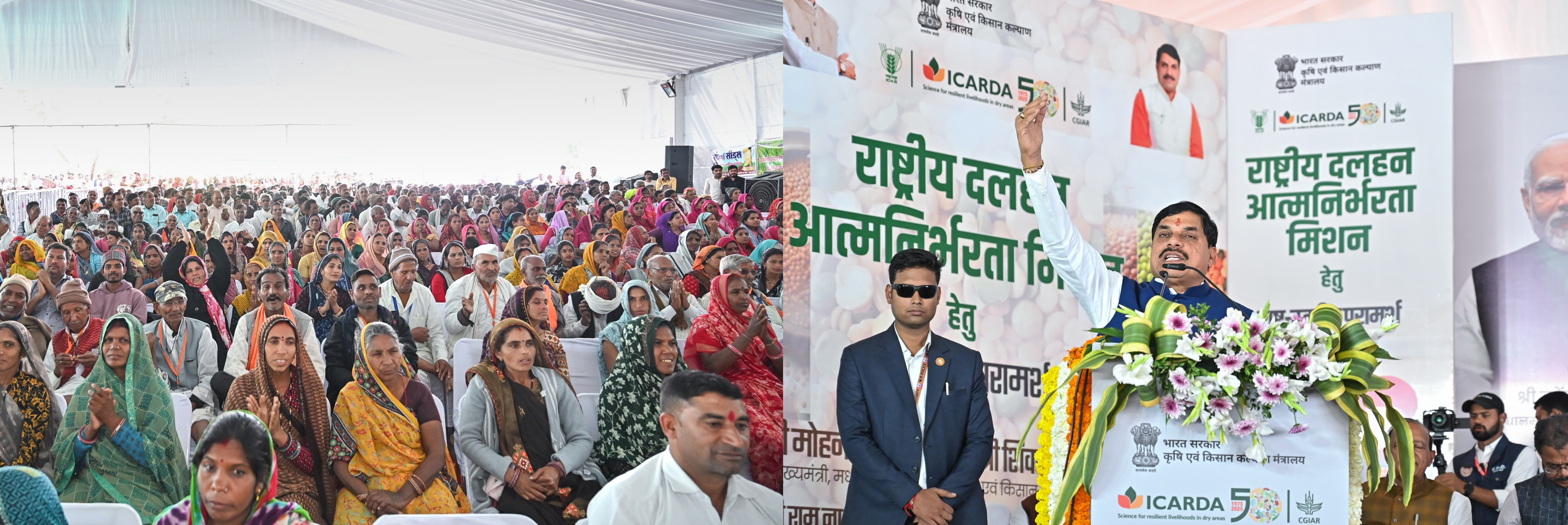 done in the pulses sector. Therefore, Madhya Pradesh will rapidly increase pulse production, working in close coordination with the Central Government. The state government will extend all necessary support to fulfil every mission and resolve of the Centre to make the country self-reliant in pulses. Together, India will achieve the goal of pulses prosperity. The Chief Minister further said that under the Bhavantar Payment Scheme, more than ₹1,500 crore for soybean produce has been transferred directly to farmers’ accounts. He noted that although Madhya Pradesh is the birthplace of many rivers, a large part of the state earlier lacked irrigation due to the absence of proper direction. After the formation of the present government, the irrigated area has increased by 44 lakh hectares. With the Ken–Betwa National River Linking Project and the Parvati–Kalisindh–Chambal River Linking Project, irrigation coverage will expand further. The government has set a target of increasing irrigation coverage to 100 lakh hectares in the coming years.
Madhya Pradesh Leads in Pulses Production: Union Minister Shri Chouhan
Union Minister for Agriculture & Farmers’ Welfare Shri Shivraj Singh Chouhan said that agreements have been reached with the United States and 27 European countries. Prime Minister Shri Narendra Modi 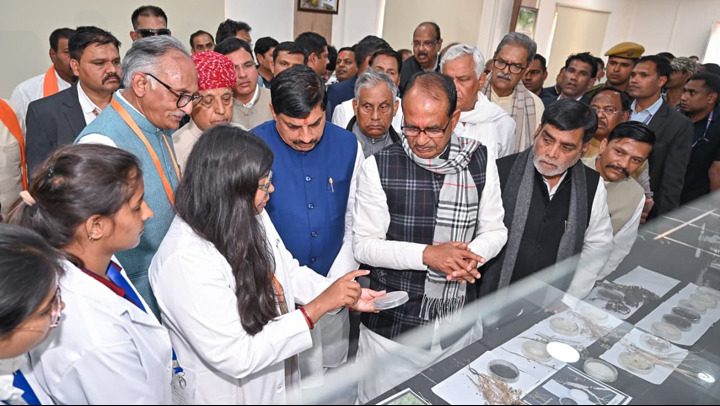 ensured that India did not bow under pressure and protected farmers’ interests in agricultural agreements with the US. Sehore’s Sharbati wheat will gain global recognition. Indian basmati rice and spices will benefit from an 18% tariff advantage, and increased textile exports will benefit cotton farmers. He said that India must become self-reliant in pulses. Except for moong, production of other pulses has declined, and importing pulses from abroad is not in the national interest. He congratulated the state government, noting that Madhya Pradesh continues to lead the country in pulses production. Farmers should not restrict themselves to wheat, soybean, and paddy alone but should adopt crop rotation. Production of gram, lentil, urad and tibbada needs to be increased. Through ICARDA, improved seeds of pulses will be developed.
Union Minister Shri Chouhan said that the Ministry of Agriculture is no longer run from Delhi alone but from villages and fields. Through plant tissue culture, new and improved varieties of lentils and other pulses are being developed. Farmers will be provided with high-yielding, disease-free seeds. Under the ‘Dalhan Aatmanirbharta’ Mission, pulse clusters will be created, and with ICARDA’s support, seed villages and seed hubs will be established. Model farmers will receive an incentive of ₹10,000 per hectare for pulse cultivation. The Ministry will take care of farmers from seed to market. In these clusters, anyone wishing to set up a dal mill will receive a ₹25 lakh grant from the Government of India. To ensure fair prices for farmers, 1,000 dal mills will be set up across the country, 55 of them in Madhya Pradesh. The Madhya Pradesh Government has declared 2026 as the Farmer Welfare Year, and the Union Agriculture Ministry stands firmly with the state government.
Union Minister Shri Chauhan said that the Central Government will procure pulses at ₹8,000 per quintal for tur, ₹7,800 per quintal for urad, ₹5,875 per quintal for gram, and ₹7,000 per quintal for lentil, with 100% procurement of all pulses. He noted that Madhya Pradesh pioneered the Bhavantar Payment Scheme and reiterated that the government is addressing farmers’ concerns from seed to market. For vegetarians, pulses are the main source of protein, and farmers are not only food providers but also life providers. He informed that Madhya Pradesh will receive ₹354 crore under the Pulses Self-Reliance Mission and presented budget sanction letters of the mission to the agriculture ministers of various states present at the conference.
State Minister for Agriculture & Farmers’ Welfare Shri Edal Singh Kansana said that India is an agriculture-based country and that Prime Minister Shri Modi has set the goal of doubling farmers’ income. The state government is working continuously for farmer welfare, as a prosperous farmer leads to a prosperous state and nation. He emphasised the need to shift from traditional farming methods to technology-driven modern agriculture.
 Joint Secretary, Union Ministry of Agriculture, Shri Sanjeev Kumar Agrawal, said that the Government of India has allocated ₹11,440 crore for the National Pulses Self-Reliance Mission. The Centre and states are working together in mission mode to promote pulse cultivation. Farmers are being provided with improved seeds, training in new technologies and modern machinery. Madhya Pradesh is a leading pulses-producing state, and technologies and seeds developed on its soil will reach farmers across the country.
Director General of ICARDA, Shri Ali Abur Saba, said that the Government of India is committed to promoting agriculture, farmers, and food processing. The Union Ministry of Agriculture has selected ICARDA for the Pulses Production Development Consultation. India is the world’s largest consumer of pulses, where they are the primary source of protein. ICARDA has developed 41 new varieties of different pulses through its research centres.
Director General of the Indian Council of Agricultural Research (ICAR) Dr. M.L. Jat said that with the cooperation of the Union Agriculture Minister, Chief Minister Dr. Yadav, and ICARDA, this pulses research centre has been established in Sehore. The national average productivity of pulses is 926 kg per hectare, while in Madhya Pradesh it is 1,200 kg per hectare. If Madhya Pradesh’s model is adopted nationwide, India’s pulses production could increase by 8 million tonnes, enabling the country to achieve self-reliance in pulses. ICAR will work in close coordination with the Ministry, ICARDA and farmers to achieve this goal.
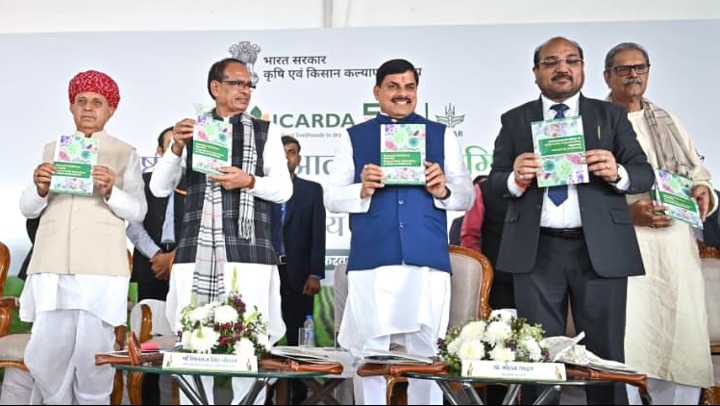
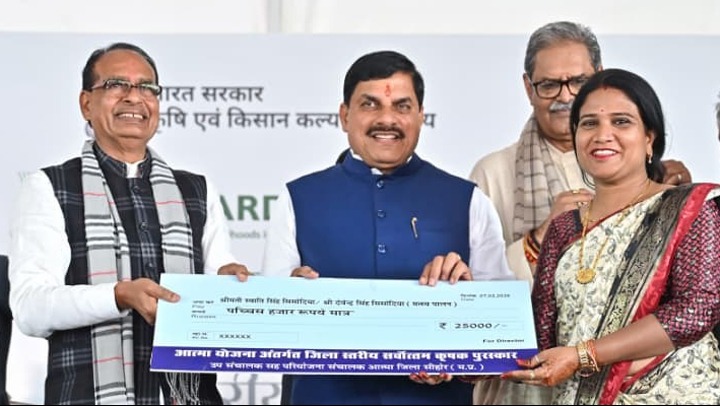
At the conclusion of the event, Agriculture Minister Shri Kansana presented ‘One District–One Best Product’ items from various districts of Madhya Pradesh to the guests. The Pulses Mission Portal was launched, and publications of ICAR and ICARDA were released. An agricultural development exhibition was organised at the venue, and plantation activities were carried out in the ICARDA परिसर.
The national conference was attended by Union Ministers of State for Agriculture & Farmers’ Welfare, Shri Ramnath Thakur and Shri Bhagirath Choudhary, State Revenue Minister Shri Karan Singh Verma, Minister of State (Independent Charge) for Backward Classes and Minority Welfare and In-charge Minister of Sehore district Smt. Krishna Gaur, Agriculture Ministers from several states, senior officials, representatives of agricultural institutions, progressive farmers, agricultural scientists, experts, and a large number of farmers.






PM Modi Begins Three-Nation Tour to Indonesia, Australia and New Zealand, Focus on Indo-Pacific Cooperation
New Delhi, July 2026: Prime Minister Narendra Modi on Monday embarked on a significant thr…

PM Modi Begins Three-Nation Tour to Indonesia, Australia and New Zealand, Focus on Indo-Pacific Cooperation
New Delhi, July 2026: Prime Minister Narendra Modi on Monday embarked on a significant …