Bangladesh Goes To People’s Mandate Tommorow, 12th February 2026:

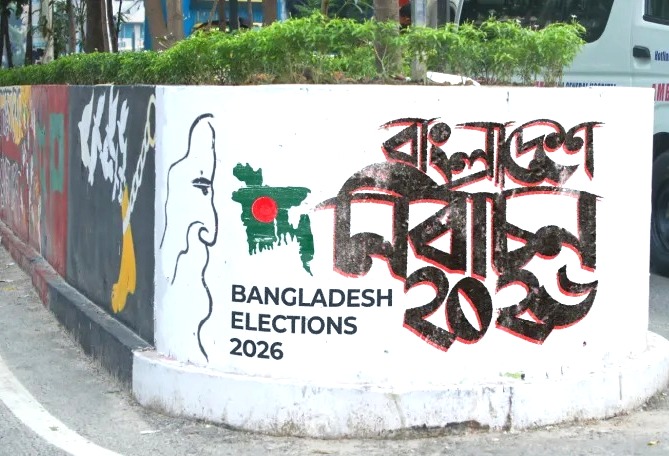
Dhaka; February 2026: General elections are scheduled to be held in Bangladesh tommorow, 12th February 2026 to elect members of the Jatiya Sangsad. This election will determine the next Government of Bangladesh. The vote will take place under the interim government led by Muhammad Yunus, which has governed the country since August 2024. The salient features of this schedule people’s mandate are:
- A constitutional referendum on the July Charter will be held alongside the election.
- More than 127 million people are eligible to vote in the election, making it the “biggest democratic exercise of the year”.
- 1,981 candidates will contest for the 300 seats in the election.
- The 350 members of the Jatiya Sangsad consist of 300 directly elected seats using first-past-the-post voting (FPTP) in single-member constituencies, and an additional 50 seats reserved for women. The reserved seats are elected proportionally by the elected members. Each parliament sits for a five-year term.
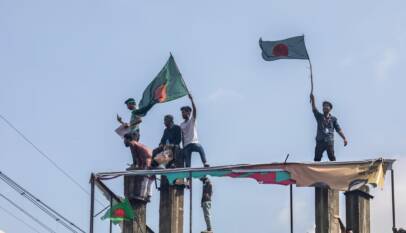
This is the first electoral test since the seismic uprising of 2024, a year defined by the blood of student protesters and the ignominious flight of an ousted Prime Minister. It is a moment of profound, terrifying reckoning.
Most importantly, this election apparently turns out to a bipolar contest between the Bangladesh Nationalist Party (BNP) and the 11 Party Alliance led by the Jamaat-e-Islami. Another National Citizen Party (NCP) is also aspiring to take the advantage of the Hasina absentia. For the first time in nearly two decades, Awami League, the juggernaut that Sheikh Hasina steered with an increasingly iron fist is nowhere to be found. The party that boasted of historic GDP growth while systematically dismantling the machinery of dissent has been effectively scrubbed from the political map, its leaders either in exile, behind bars, or barred from the contest.
In the wake of Hasina’s departure, a vacuum has opened, and the scramble to fill it is proving that the end of a dictatorship is often just the beginning of a different kind of chaos. Key campaign issues and agendas include unemployment, corruption, extortion, proportional representation (PR), and promises to the youth and the minority voters. Tomorrow’s election will be decided “less by ideology and more by promises of governance”.
For a decade, the BNP was a hollowed-out shell, its leadership decimated by arrests and its relevance stifled by boycotted elections. But the return of acting chairman Tarique Rahman from 17 years of exile has acted like a shot of adrenaline to the party’s heart. His return was a mobilisation masterstroke that has consolidated the party’s fractured base and signaled to the establishment that the old lineage was back to claim its inheritance. The BNP’s pitch is a masterclass in survivalist pragmatism, pivoting away from the lofty ideological battles of the past to focus on the empty stomachs of the present.
However, the BNP’s coronation is far from guaranteed, largely because of a quiet, disciplined surge from the religious right. Jamaat-e-Islami, once a political pariah relegated to the fringes due to its dark history during the 1971 liberation war, has pulled off a rebranding effort that should terrify secularists.
By positioning itself as the only “clean” alternative to the dynastic bickering and endemic corruption of both the Awami League and the BNP, Jamaat is successfully courting a new generation. They aren’t just preaching; they are organising, offering a potent cocktail of moral governance and social justice wrapped in the flag of Islamic values.
Popular votes will be taken at 247,499 booths in 42,766 polling stations countrywide.[6] For the votes of expatriates, polling officers and detainees, postal ballots will be used for the first time in the country. Accompanied by the referendum, postal voting, technological support and observer’s accreditation, this will be the “most procedurally complex” election in the country’s history. It’s considered to be the world’s first “Gen Z-inspired” election after the series of Gen Z protests around the world.
The true wild card, however, is the youth. A staggering one-third of the electorate is under 35, a demographic that views the political establishment with profound suspicion. These are the voters who stood in front of armored vehicles in 2024, and they have little patience for the “business as usual” politics of the BNP or the moralising of Jamaat.
The specter of 2024 violence looms over this fragile democratic experiment. The campaign has already been marred by targeted killings and street-level thuggery, reminding the world that in Bangladesh, the transition from the street to the ballot box is often paved with broken glass. The world is watching, and the neighborhood is nervous. New Delhi, which spent years tethered to Hasina’s stability, is now forced into a panicked recalibration, while Beijing and Islamabad look for openings in the new disorder.
Before the election, the government issued 3 days general holiday for the workers starting from 10th February, and 02 days general holiday for the service holders and government employees starting from 11th February, accompanied by the weekends of Friday-Saturday on 13th and 14th February respectively.

Team Maverick.


Shivakumar Says Congress United, Assures Women Will Get Cabinet Berth
Bengaluru, Aug 2026 : Karnataka Chief Minister D.K. Shivakumar on Monday sought to dismiss…
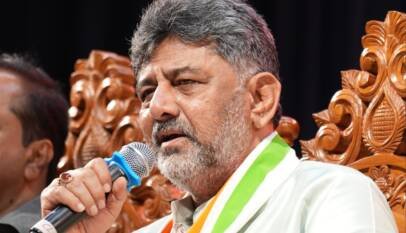
Shivakumar Says Congress United, Assures Women Will Get Cabinet Berth
Bengaluru, Aug 2026 : Karnataka Chief Minister D.K. Shivakumar on Monday sought to dismiss …