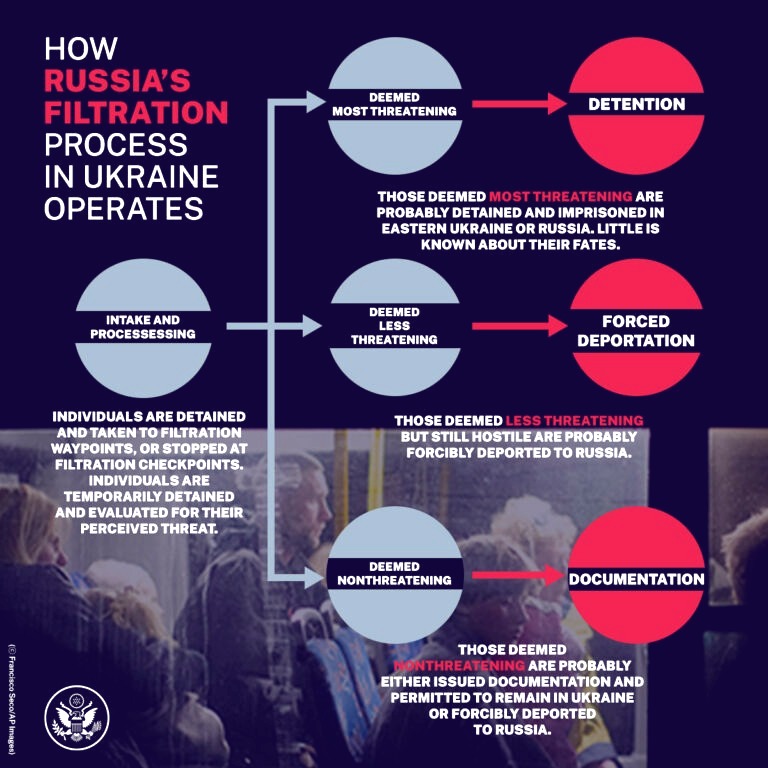
Russia Deporting Forcibly Ukrainian Citizens, Including Children.

Kyiv; February 2026: An approaching Russian administrative deadline is likely to enable the systematic removal of vulnerable Ukrainian children from their homes and families in occupied areas.
The Kherson Oblast occupation Ministry of Labour reported on 05th February that individuals who hold Ukrainian guardianship, trusteeship, or adoption documents for children issued before September 30, 2022 will expire on March 1, 2026. Several municipal occupation administrations, including the Hola Prystan and Oleshky (occupied Kherson Oblast) and the Melitopol (occupied Zaporizhia Oblast) administrations, issued warnings on February 05th reminding guardians and adoptive parents of the 01st March 2026 deadline and calling for such individuals to re-register their adoption, guardianship, or trusteeship under Russian law.
The March 01st deadline was codified in the Russian federal laws on the “admission” of occupied Ukraine into the Russian Federation in October 2022, following Russia’s illegal annexation of Kherson, Zaporizhia, Donetsk, and Luhansk oblasts on September 30, 2022. The March 01st deadline triggers a mechanism that may be harmful to Ukrainian children in several ways:
First, it pertains to a particularly vulnerable class of children, those living with adoptive parents or under specific legal guardianship or trusteeship arrangements.
Second, the relevant Russian federal law requires those guardians or adoptive parents to re-register their relationship with their child with the occupation administration, therefore providing personally identifying information to occupation officials.
While the specifics of this re-registration process are unclear, it is very likely that in order to re-register adoption or guardianship documents the guardian must present a Russian passport. International media outlets have observed similar passport requirements for document re-registration in different contexts.
Those who do not re-register their children in accordance with the Russian law risk having their children removed from their care and placed into the care of the occupation administration or the Russian state. Guardians who do not re-register their documents are also likely to be perceived as undertaking anti-Russian actions and may therefore risk punishment. The media outlets have further noted instances of parents or guardians losing rights to their child if they engage in perceived anti-Russian behavior.
A Ukrainian partisan source warned that this Russian law will lead to the forced removal of Ukrainian children to Russian orphanages and boarding schools, or their adoption into Russian families.
Russia is building physical military infrastructure in occupied Ukraine to support Russian military operations on the frontline. The “Atesh” Crimea-based Ukrainian partisan group reported on February 11th that its agents are surveilling a large-scale construction site near occupied Myrne, Zaporizhia Oblast, where Russian forces are building a base for the 291st Motorised Rifle Regiment (42nd Motorised Rifle Division, 58th Combined Arms Army, Southern Military District).
Atesh reported that construction is underway for a field training camp and training grounds for drone operators. The 291st Motorised Rifle Regiment is currently operating in western Zaporizhia Oblast, about 75 kilometers from the reported site of the new military base.
The Sevastopol occupation administration is preparing to install a cadre of loyal Russian veterans in the municipal government. The Sevastopol occupation administration began the second training module of the “Sevastopol — City of Heroes” program in early February.
The “Sevastopol — City of Heroes” program is modeled on Russian President Vladimir Putin’s federal “Time of Heroes” program, which seeks to install veterans of the war in Ukraine into government positions throughout occupied Ukraine and in the Russian Federation. The “Time of Heroes” program and its occupied Ukraine-based municipal and regional offshoots serve the dual purpose of militarising the governance of occupied areas by installing pro-Russian veterans in government positions while also consolidating the Kremlin’s control over occupied areas, using Russian regime loyalists.
On the otherside, the Kherson Oblast occupation administration has drastically shortened the deadline for residents to re-register ownership of real estate according to Russian law, leaving potentially thousands of residents at risk of losing their property to Russian nationalisation efforts.
Occupied Kherson Oblast-based media reported on February 11th that the Kherson Oblast occupation administration shortened the deadline for Ukrainian-style property documents to be re-registered with the Russian Federal Service for State Registration, Cadaster, and Cartography (Rosreestr) from 2028 to 01st July, 2026. If properties are not re-registered according to Russian law by 01st July, they will be considered “abandoned” and transferred to state and municipal ownership. Property owners can only re-register their rights to property if they hold Russian citizenship. The occupation administration may transfer “ownerless” property to medical workers, teachers, and government officials, many of whom relocate to occupied Ukraine from Russia in exchange for cheap housing and other financial benefits.
Occupied Kherson Oblast-based media warned that the deadline reduction may leave many occupied Kherson Oblast residents homeless.
Russian occupation officials have recently intensified efforts to seize property in occupied Ukraine. Luhansk People’s Republic (LNR) Senator to the Russian Federation Olga Bass reported on February 02 that the Luhansk Oblast occupation administration plans to develop new regional legislation on the transfer of “abandoned” agricultural land to state ownership and that Luhansk residents must re-register and claim ownership of land plots by July 01st, 2026.
Bass’ statement and recent developments in occupied Kherson Oblast are likely in part a response to Russian President Vladimir Putin’s recent signing of a law on December 15, 2025, codifying occupation officials’ ability to seize and nationalize any property deemed as “ownerless” in occupied regions through 2030.
Team Maverick.







Punjab Kings Beat Gujarat Titans by 3 Wickets in Last-Over Thriller
Delhi, March 2026 : In an exciting match of the Indian Premier League 2026, Punjab Kings d…

Punjab Kings Beat Gujarat Titans by 3 Wickets in Last-Over Thriller
Delhi, March 2026 : In an exciting match of the Indian Premier League 2026, …