Bangladesh Votes for Change as BNP Surges Ahead in Post-Hasina Election

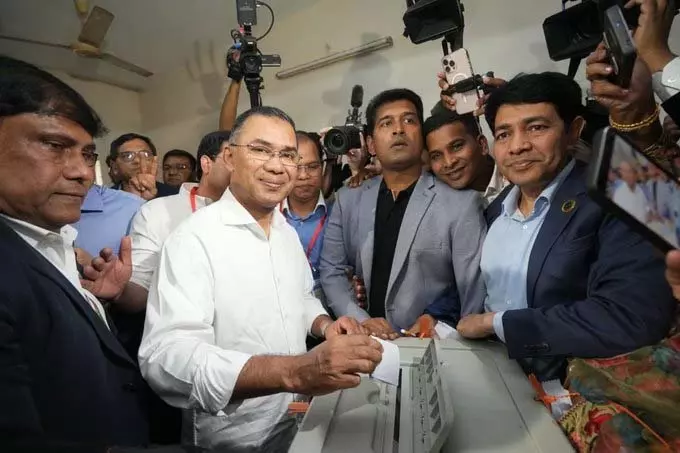
Dhaka, Feb 2026 :Vote counting began in Bangladesh late Thursday after polling concluded for the country’s 13th parliamentary elections, an exercise widely seen as a turning point in national politics following the dramatic fall of the Awami League government in August 2024. These are the first general elections held since the political upheaval that led to the formation of an interim administration, making the outcome critical for the future direction of the country.
Polling officially ended at 4:30 pm local time, though voting continued at centres where queues were still present. The Election Commission indicated that early trends would emerge by night, while full results were expected by Friday. Alongside the parliamentary polls, voters also participated in a nationwide referendum on an 84-point reform agenda known as the “July National Charter,” adding another layer of significance to the electoral process.
The contest was largely viewed as a direct face-off between the centre-right Bangladesh Nationalist Party (BNP) and its former ally, Jamaat-e-Islami, after the Awami League was barred from contesting. Interim chief adviser Mohammed Yunus had last year dissolved the Awami League and prohibited its participation, fundamentally reshaping the political landscape.
Bangladesh, with a population of over 300 million, had approximately 127 million eligible voters this time, including around five million first-time voters. Elections were conducted across 42,779 polling stations covering 299 of the 300 constituencies; voting in one constituency was cancelled due to the death of a candidate. By 2 pm, turnout stood at about 48 per cent, according to Election Commission data, though some local media later estimated overall participation at close to 60 per cent. While lower than the 86 per cent turnout recorded in the 2008 caretaker-government polls, the voting process was largely peaceful, backed by extensive security arrangements.
Early projections from Bangladeshi television channels and newspapers suggested a sweeping victory for the BNP, led by Tarique Rahman, with the party reportedly leading in over 200 of the 300 parliamentary seats. If confirmed by official results, this would give the BNP a decisive two-thirds majority, enabling it to form the government independently and push through constitutional amendments without relying on smaller allies.
Jamaat-e-Islami, meanwhile, was projected to be leading in more than 60 seats, positioning it as the second-largest party and the principal Opposition force. This marks a remarkable resurgence for a party that had long remained on the fringes of mainstream politics. Analysts point to its improved performance in university elections over the past year—particularly in Dhaka and other government-run institutions—as an early indicator of its revival.
Media projections on Friday morning also showed the “Yes” vote leading in the referendum on constitutional reforms, though the Election Commission had yet to formally announce the outcome. The reforms seek to cap the Prime Minister’s tenure at 10 years, restore the caretaker government system, introduce a bicameral legislature, and enhance judicial independence. Each voter cast two ballots—one for a parliamentary candidate and another for the referendum—making the process complex in a country of Bangladesh’s scale.
As counting continued overnight into Friday, it became evident that voters favoured established political forces over newly formed parties, including those floated by student protest groups. Although Jamaat had allied with the National Citizens Party, the partnership appeared to yield limited electoral dividends.
The absence of the Awami League meant the race unfolded without the party that had dominated Bangladeshi politics for years under Sheikh Hasina. Its exclusion effectively cleared the field for the BNP and Jamaat, making the results less surprising to many observers.
Speaking after casting his vote, Tarique Rahman said the election represented a chance for citizens to reclaim democratic rights and thwart conspiracies through participation. Prof Yunus, for his part, urged voters to treat polling day as the “birthday of a new Bangladesh.”
With final results awaited, the election is expected to determine not only the next government but also the fate of sweeping institutional reforms. Should current trends hold, Bangladesh may soon witness the formation of a strong, stable administration—and a significant reordering of its political future.





US Says Naval Blockade on Iran Remains in Force, Multiple Commercial Vessels Intercepted
Washington, July 2026: The United States has reaffirmed that its naval blockade against Ir…

US Says Naval Blockade on Iran Remains in Force, Multiple Commercial Vessels Intercepted
Washington, July 2026: The United States has reaffirmed that its naval blockade against Iran …