Bangladesh Heads to Crucial Parliamentary Polls After 18 Months of Political Upheaval

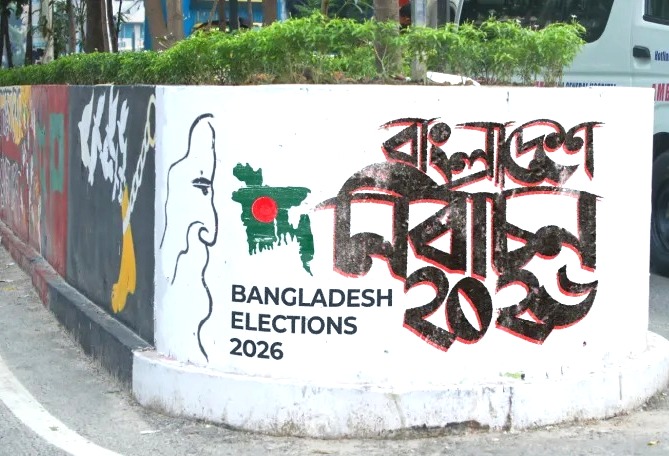
Dhaka, Feb 12 : Bangladesh is set to hold its much-anticipated parliamentary elections on Thursday, marking a decisive moment nearly 18 months after the dramatic collapse of former Prime Minister Sheikh Hasina’s 15-year rule following widespread nationwide protests. The polls are widely viewed as a turning point for the country, which has been governed by an interim administration amid prolonged political uncertainty, social unrest, and deep divisions.
Since Sheikh Hasina was forced out of office in August 2024, Bangladesh has witnessed repeated protests, the growing influence of hardline Islamic groups, and sporadic incidents of violence targeting religious minorities. Against this backdrop, the formation of a democratically elected government is expected to reshape the nation’s political landscape and determine its future direction.
Political analysts largely project the Bangladesh National Party (BNP) as the frontrunner in the elections. The party has regained momentum following years of marginalisation and is now poised to return to power. The BNP is currently led by Tarique Rahman, son of former Prime Minister Khaleda Zia, who passed away recently. Rahman is widely seen as the leading contender for the post of prime minister should his party secure a majority.
The BNP’s principal challenger is the Bangladesh Jamaat-e-Islami, a hardline Islamic party that once shared an alliance with the BNP. While most observers expect the BNP to emerge victorious, many believe Jamaat-e-Islami could register its strongest electoral performance to date, reflecting shifts in voter sentiment during the prolonged period of instability.
Following Sheikh Hasina’s removal from power, interim government Chief Advisor Muhammad Yunus dissolved the Awami League and barred it from contesting the election. The decision has been one of the most controversial aspects of the transition period. The Awami League has strongly criticised the move, describing the polls as a “staged election” and alleging that BNP, Jamaat, and their allies are exerting continuous pressure and issuing threats against party workers and ordinary citizens to compel participation in the voting process.
Despite these allegations, voter enthusiasm appears high, particularly among younger citizens. A significant portion of the electorate, especially those in their 20s and 30s, will be voting for the first time since Sheikh Hasina’s long tenure came to an end. Voters aged between 18 and 37 now account for around 44 per cent of Bangladesh’s total electorate, underscoring the growing political influence of younger generations.
Polling for the 13th National Parliament elections, along with a nationwide referendum scheduled for 2026, will take place across 299 parliamentary constituencies. Voting will be held from 7:30 a.m. to 4:30 p.m., with the counting of votes set to begin immediately after polling concludes.
According to a report by leading Bangladeshi daily The Dhaka Tribune, more than 127 million registered voters are expected to cast their ballots. The parliamentary election is being conducted simultaneously with a landmark referendum that could significantly alter Bangladesh’s constitutional framework.
The proposed July National Charter outlines sweeping constitutional reforms, including the introduction of a two-term limit for the prime minister, the restoration of a neutral caretaker government system to oversee future elections, and the creation of an upper house of parliament. The proposed upper chamber would include 100 nominated members, complementing the existing 350 elected lawmakers in the lower house.
Women voters are emerging as a decisive force in this election. Out of the 127.7 million registered voters, 62.88 million are women. Notably, around 2.7 million women have registered as first-time voters, significantly outnumbering the 1.87 million newly registered male voters. In several constituencies, particularly in parts of the Khulna division, female voters outnumber men, prompting political parties to place greater emphasis on women-centric issues in their campaign pledges and manifestos.
However, despite rising female participation at the ballot box, women remain underrepresented among candidates. Only 83 women are contesting the election — 63 nominated by political parties and 20 running as independents — accounting for just about four per cent of the total candidate pool.
To ensure a peaceful and orderly electoral process, authorities have undertaken extensive security arrangements. Around 958,000 security personnel have been deployed nationwide, with enhanced presence in sensitive and high-risk areas. In addition, more than 100,000 army personnel have been stationed across the country to maintain law and order and ensure the smooth conduct of polling.
As Bangladesh prepares to vote, the elections are being closely watched both domestically and internationally, seen as a critical test of the country’s democratic resilience after one of the most turbulent periods in its political history.
Team Maverick



Australia Calls India a Top-Tier Security Partner, Unveils Landmark Defence and Energy Agreements
Canberra, July 2026 : Australia on Thursday described India as one of its most important s…
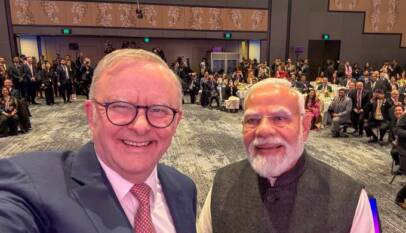
Australia Calls India a Top-Tier Security Partner, Unveils Landmark Defence and Energy Agreements
Canberra, July 2026 : Australia on Thursday described India as one of its most …