EU Announces Over €81 Million In Humanitarian Aid As Conflict In Eastern DRC Pushes Great Lakes Crisis To New Extremes.

Brussels; February 2026: The escalation of conflict in eastern Democratic Republic of the Congo (DRC) is driving mass displacement. The resources of food, water and shelter are stretched to breaking point and women and children increasingly left exposed to violence and exploitation. As the Commissioner for Crisis Management Hadja Lahbib visits the region, the European Union is mobilising €81.2 million in humanitarian aid across the Great Lakes.
With this new humanitarian funding, the EU will provide life-saving services to the most vulnerable in the eastern DRC, but also to Congolese refugees forced to flee the country. The funding will also support aid projects in Burundi, where a fragile humanitarian situation continues to leave vulnerable communities at risk, as well as in Rwanda and in Tanzania.
Commissioner Lahbib is currently visiting the DRC, Burundi and Rwanda to assess the most pressing humanitarian needs on the ground and to advocate for humanitarian access with all parties to the conflict in eastern DRC.
This follows the Foreign Affairs Council discussion on 29 January, where the Commissioner received full support from Member States for her mission, with a view to developing tangible humanitarian diplomacy initiatives. During her visit, she will be meeting with government representatives in the three countries, humanitarian partners and visit EU-funded humanitarian aid projects.
Of the €81.2 million, €68 million will fund humanitarian aid inside the DRC, where conflict and displacement are driving the most urgent needs. The funding will provide food assistance and emergency health and nutrition care, restore access to water, sanitation and basic shelter for displaced families, and support protection services, including care for survivors of violence and child protection.
€13.2 million will support the regional refugee response and strengthen disaster preparedness across the Great Lakes region, helping partners respond quickly to new displacement and emergencies linked to the crisis.
Background –
The DRC is facing one of the world’s most severe humanitarian crises, driven by persistent armed conflict, mass displacement, disease outbreaks and deep poverty. More than 21 million people require humanitarian assistance, while violence in the eastern provinces continues to force families to flee repeatedly, often into overcrowded shelters or temporary camps. The crisis is compounded by widespread human rights violations, conflict-related sexual violence, and alarming food insecurity affecting nearly 28 million people.
Burundi’s humanitarian situation remains fragile, with hundreds of thousands of Burundian refugees still displaced across neighbouring countries and many more internally displaced by natural hazards such as floods and landslides, while returnees face challenges rebuilding their lives and accessing basic services like food, healthcare, water, sanitation and protection. Recent escalations in neighbouring eastern DRC have triggered large cross-border movements, with tens of thousands of Congolese refugees arriving in Burundi since late 2025, putting additional pressure on already stretched resources, including camps, health services and water systems.
The European Union remains a major humanitarian donor to the region, allocating €129.5 million in 2025, most of which to the response in the DRC, to deliver life-saving assistance in the DRC, as well as to refugees across neighbouring countries.
Letter dated 30 December 2025 from the Group of Experts on the Democratic Republic of the Congo:
The members of the Group of Experts on the Democratic Republic of the Congo namely: Krisztina Varga, Coordinator, Group of Experts on the Democratic Republic of the Congo; David Zounmenou,
Expert; Fadhel Bouzidi, Expert; Oumar Cissé, Expert; Yannick Weyns, Expert, have transmitted, in accordance with paragraph 6 of that resolution, the midterm report on their work.
The letter envisaged: In North and South Kivu, despite progress in ongoing mediation efforts, the security situation deteriorated, marked by heavy armed clashes. The humanitarian situation further deteriorated, with an alarming surge in widespread and systematic attacks against civilians, and in conflict-related sexual violence.
Following the signing of the Peace Agreement between the Democratic Republic of the Congo and the Republic of Rwanda and the Doha Declaration of Principles, negotiations continued between the Governments of the Democratic Republic of Congo and Rwanda, as well as between the Government of the Democratic Republic of the Congo and Alliance Fleuve Congo/Mouvement du 23 mars (AFC/M23), in an effort to resolve outstanding points of contention. Some progress was achieved, including the establishment of confidence-building and verification mechanisms to support the implementation of operational plans to neutralize the Forces démocratiques de libération du Rwanda (FDLR). However, divergent interpretations of key provisions continued to impede implementation of the agreements. All parties simultaneously pursued mobilization and offensive operations, in violation of ceasefire agreements, undermining the peace process. AFC/M23 sought to position itself as an alternative governance authority to the Congolese State, establishing administrative, judicial, fiscal and security structures and assuming core State functions. AFC/M23 leaders have expressed a long-term objective of governing an autonomous region in the eastern Democratic Republic of the Congo.
AFC/M23 expanded its military campaign in North and South Kivu, with sustained support from and operational coordination with the Rwanda Defence Force (RDF), combining coordinated offensives, strategic deployments and preparations for further operations. Spoofing and jamming technologies continued to be employed by RDF, disrupting navigation systems and communications. After consolidating control around Goma, AFC/M23 and RDF focused on neutralizing FDLR, conducting
operations marked by heavy clashes and widespread, systematic targeting of civilians, in particular in Hutu-inhabited areas of Bwito and Bwisha.
In Masisi and Walikale, AFC/M23 and RDF sought to secure control over key logistical corridors and population centres, with the objective of taking Walikale town. Simultaneously, AFC/M23 deepened its territorial entrenchment in South Kivu, securing strategic axes and mining zones. Coordinated deployments across multiple front lines, notably in Masisi, Walikale and Lubero, positioned AFC/M23 and RDF to pursue further territorial expansion.
AFC/M23 also consolidated its access to mineral resources in South Kivu, seizing the strategic mining locality of Nzibira and the Twangiza industrial gold mine in Luhwindja. As a result, AFC/M23 came to control nearly half of South Kivu’s cassiterite and coltan production and over two thirds of its wolframite output.
The Armed Forces of the Democratic Republic of the Congo (FARDC) and Wazalendo groups continued to contain AFC/M23 and RDF advances, undertaking joint operations to mitigate further territorial losses and preserve key supply routes. Despite diplomatic commitments to address the presence of FDLR, FARDC continued to rely on operational support from FDLR and FDLR-aligned groups.
Hadja Lahbib, Commissioner for Equality, Preparedness and Crisis Management has expressed her profound anguish stating, “civilians in eastern DR Congo are trapped between bullets and hunger. Families are fleeing, and survivors of violence are struggling to find even basic care. The EU is mobilising €81.2 million in humanitarian assistance to ease the suffering of those most at risk. But money alone will not stop suffering. Aid workers must be able to reach people safely, quickly and without obstacles. International humanitarian law is not a buffet table. You don’t pick and choose. It is a duty for all parties, and it must be fully respected”.
Team Maverick.
Rahul Gandhi, INDIA Bloc Hold Candlelight Vigil at Gandhi Smriti Over NEET Paper Leak Row
New Delhi, July 2026 : The Opposition intensified its campaign over the alleged NEET exami…
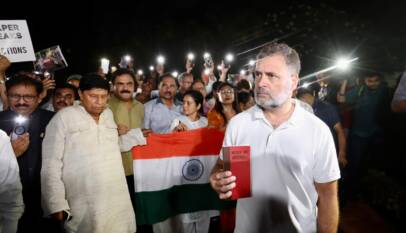
Rahul Gandhi, INDIA Bloc Hold Candlelight Vigil at Gandhi Smriti Over NEET Paper Leak Row
New Delhi, July 2026 : The Opposition intensified its campaign over the alleged NEET …