Has The Ukraine Peace Talks Turning To Be A Financial Deal.

Washington DC; February 2026: The four years long Ukraine-Russia conflict is not any snag – a transient one that corrects itself, making it difficult to troubleshoot. Moreover, the peace initiative by United States Of America is evitably a characteristic feature. For it opens rather, a path for ‘Business’ to be done, for ‘stakeholder’ deals to be cut, and for billions to be shared out in payoffs. This is Trump’s geo-political transactional model: Business displaces traditional negotiation (at least while the money flows); Money is the politics.
The hyped peace monger – Steve Witkoff alongwith his negotiation head honchos are swaying Russia from its security imperatives. The head honchos namely Trump, Witkoff and Kushner are said to be confident that they can construct a financial reward system for western debt-holders, investors and politicians (and the Zelensky entourage, in the case of Ukraine) that succeeds in “retaining the financial rewards of war, without the ancillary ingredient of bloodshed”.
Pragmatic people have long predicted the ultimate solution to the bloodshed will only be determined once western interests get to the point where negotiators propose a long-term plan for continued financial benefit. Too many people, “stakeholders” are making money from the conflict. From a western perspective, support for the Ukraine conflict is based on money. Therefore, the solution to the conflict requires a system where the western opportunity for financial benefit continues. Written in polite diplomatic terms, the continued payments are identified as “the prosperity agenda which aims to support Ukraine’s post-war reconstruction, joint U.S.–Ukraine economic initiatives, and long-term recovery projects”. This is codespeak for the U.S. Senate and EU will retain a financial mechanism to exploit for personal benefit.
A readout of meeting between Special Envoy for Peace Steven Witkoff, Jared Kushner, Ukrainian Secretary of National Security and Defense Council Rustem Umerov, and Chief of General Staff General Andriy Hnatov demonstrates:
“Over two days, Special Envoy for Peace Steven Witkoff and Jared Kushner met with Ukrainian Secretary of National Security and Defense Council Rustem Umerov and Chief of General Staff General Andriy Hnatov for constructive discussions on advancing a credible pathway toward a durable and just peace in Ukraine.
Today, on 05th December 2025, the group had their sixth meeting over the past two weeks. Secretary Umerov reaffirmed that Ukraine’s priority is securing a settlement that protects its independence and sovereignty, ensures the safety of Ukrainians, and provides a stable foundation for a prosperous democratic future.
The participants discussed the results of recent meeting of the American side with the Russians and steps that could lead to ending this war. The American and Ukrainians also agreed on the framework of security arrangements and discussed necessary deterrence capabilities to sustain a lasting peace.
Both parties agreed that real progress toward any agreement depends on Russia’s readiness to show serious commitment to long-term peace, including steps toward de-escalation and cessation of killings.
Parties also separately reviewed the future prosperity agenda which aims to support Ukraine’s post-war reconstruction, joint U.S.–Ukraine economic initiatives, and long-term recovery projects.
American and Ukrainian parties underscored that an end to the war and credible steps toward ceasefire and de-escalation are necessary to prevent renewed aggression and to enable Ukraine’s comprehensive redevelopment plan, designed to make the nation stronger and more prosperous than before the war. Parties will reconvene tomorrow (06th December 2025) to continue advancing the discussions”.
Once payments are apportioned, from the Trump-Witkoff perspective, the “territorial issues, security guarantees, EU membership status and the position of NATO are downstream details once the larger payment system is organized. Put another way, they are down to the stuff that really matters, the money”.
With this worldview, negotiations between the U.S. and Russia are being pursued by two New York real-estate doyens i.e., (Witkoff and Kushner, together with Josh Gruenbaum, who has also been appointed as secretary to Trump’s ‘Gaza Peace Board’. Gruenbaum’s previous work experience has been with the KKR fund, which, although not strictly a ‘vulture fund’, is specialist in aggressive distressed-debt investing. Where are the experienced professionals from Russia’s foreign service in these talks? They are notably absent. Foreign Minister Lavrov does not attend.
The Witkoff team stemming from the head honchos comprises Blackrock Company and its CEO Larry Fink, who are commissioned by Witkoff to raise the reconstruction funds for Ukraine. Larry Fink also liaises closely with the Witkoff team on divvying out the potential re-construction ‘opportunities’ (but is not directly involved in the Moscow talks with President Putin).
Then there are the Rothschilds who are the principal advisers to Kiev’s Ministry of Finance and who are responsible for managing the huge Ukrainian bond debt of more than $216 billion. There are also sovereign creditors who have guaranteed loans to Ukraine from financial institutions, such as the IMF and World Bank. The EU alone has guaranteed €193 billion.
These ‘stakeholders’ in the Witkoff framework: the creditors of Ukraine, the interests of Blackrock and possibly KKR, stand to do well out of a reconstruction package, in the case of a political settlement agreed between the U.S. and Moscow.
As of February 2026, Ukraine’s sovereign dollar bonds are trading in the 60 to 76 cents on the dollar range, reflecting intense market sensitivity to potential peace proposals. Prices have rallied significantly from lows in the 19 cent to 20 cent range seen in late 2024 and early 2025 as diplomatic momentum builds”.
Rothschilds may, or may not, have a direct interest in the Ukraine debt package, but as a ‘firm’ they have a bitter history in their dealings with President Putin over what happened to Yukos. The latter was the largest oil and gas enterprise in Russia in the 1990s.
In 2003, Mikhail Khodorkovsky, then head of the Russian oil giant Yukos, appointed Lord Jacob Rothschild as the “guarantor” or “protector” of his controlling stake in the company. The transfer of control of Yukos (which consisted of much of Russia’s oil and gas resources) to Lord Rothschild was triggered automatically in 2003 by Khodorkovsky’s arrest by Russian authorities. The intent was to put these resources beyond President Putin’s reach. However, Yukos subsequently was nationalised and wiped out by tax impositions which effectively voided its assets of any value.
On the new ‘money-in’ side to the Witkoff ‘balance sheet’, the EU and the U.S. are pitching for an $800 billion post-settlement rebuilding fund for Ukraine war damage. All of Witkoff’s identified stakeholders have an interest in getting a slice of this cake; Zelensky needs a slice to share around his ‘stakeholders’ and the EU is lining up its defence contractors to claim their portion of the $800 billion action, too.
And on the Russian side, there is Kirill Dmitriev, the Wall Street-trained Head of Russia’s National Wealth Fund, who initiated efforts to offer investment opportunities to the United States as part of the stakeholder strategy to restore economic ties and foster negotiations. These included joint projects on rare earth minerals and Arctic development.
From Russia’s perspective, and with a clear understanding of the Trump’s mercantilist and transactional psyche, perhaps having Washington pulled by ‘deal’ opportunities into talking with Russia (after a long period of severed communications) and when the U.S. leadership is inconstant and capricious engagement with Witkoff and Kushner may have been seen as the better side to valour.
However, this ‘business first’ methodology has a major flaw: The ‘negotiations’ with the Witkoff team are not working. Matters are moving in the wrong direction, as Foreign Minister Lavrov has underlined in frank language in two recent interviews (last week with Rick Sanchez on Russia Today, and on Tuesday with Russia’s NTV television channel).
FM Lavrov emphasised that the understandings reached at Anchorage are stuck, and in fact are being rowed back, “moving in the wrong direction”, Lavrov warned. Not only are relations cooling; asymmetrical actions are increasing and the risk of escalation growing, Lavrov suggested.
Trump’s approach to his ‘business strategy’ are several distinct parameters, the principal one being the deal-making culture centred on a ‘financial rewards system’. This approach ignores reality. The issue of Russia’s relations with Ukraine and the US are not centred on the notional cutting up of a billion dollar re-construction cake.
But matters are moving in the opposite direction: Lavrov’s frustration is very evident in these interviews. Trump is becoming more and more focussed on American domination (driven in no small part by the US dollar and debt crisis).
Trump’s debt-driven focus on domination lies in diametric contradiction to a multi-polarity of powers based on respect for each other’s national security interests. It is simply that conflicts and wars are not all susceptible to monetary buy-offs. There is ‘history’ and lives sacrificed. Only a resolution that encompasses an understanding of the full context which brought the conflict into being in the first place is likely to succeed. And it is the root causes to the dispute that are precisely what is excluded under the Witkoff framing.
Separately, the legacy culture of European and U.S. banking and financial interests provides the predisposition to preserving the Ukrainian status quo as parcel to their historic stance. The ‘taking care of stakeholders’ approach then automatically devolves into seeking a continuation of existing structures of power and authority in Kiev, without which the monetary worth of Ukrainian bonds, many of which are held by European governments will fall to zero.
It is a widely acclaimed de-facto that European nations, including the UK, are in a catastrophic fiscal position, partly because they have lent or guaranteed hundreds of billions to Ukraine that are likely to become “bad debts”.
Russia on the otherside has been very clear that there must be a transformation made to the leadership culture in Ukraine for any stable coexistence between Russia and Kiev to be viable. For them, the continuation of the Zelensky regime culture of radical hostility would be viewed as setting up Russia to face a future of regular bouts of repeated conflict as Ukraine is periodically rearmed and re-grouped by European states.
Any mooted change of Ukrainian leadership style however, would pull the rug from under Witkoff’s carefully arranged ‘financial reward system’. An outcome to the conflict brought about by military facts on the ground leading to a transformed culture in Kiev would be anathema to the stakeholder benefit scheme.
The ‘stakeholders’ are united in opposing such eventuality. The Witkoff plan effectively fuels their opposition to any change in the status quo. It is not surprising then that Foreign Minister Lavrov is signalling a backing off from the Witkoff negotiation enterprise. It is not working. It is distancing Russia from its security imperatives. Rather, it paves the path for a continuation of war against Russia.
Suvro Sanyal – Team Maverick.




Shivakumar Meets Sonia, Rahul and Priyanka Gandhi Amid Karnataka Cabinet Discontent
New Delhi, June 2026 : Karnataka Chief Minister D.K. Shivakumar on Wednesday met senior Co…
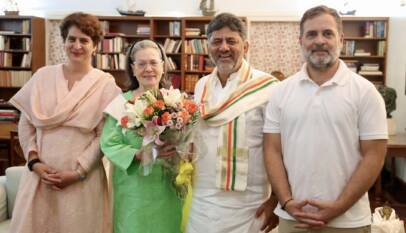
Shivakumar Meets Sonia, Rahul and Priyanka Gandhi Amid Karnataka Cabinet Discontent
New Delhi, June 2026 : Karnataka Chief Minister D.K. Shivakumar on Wednesday met senior …