Government Deploys Multi-Tier Mechanism to Curb Fake News; FCU, IT Rules and Media Regulations Aimed to Improve Information Credibility

PIB’s Fact Check Unit (FCU) Ensures Timely and Accurate Public Communication
A Fact Check Unit (FCU) functions under Press Information Bureau, Ministry of Information and Broadcasting. FCU identifies misinformation and fake news relating to the Central Government. After verifying the authenticity of news from authorized sources, FCU publishes correct information on its social media platforms for wide dissemination including in border districts.
During Operation Sindoor, the FCU actively identified misinformation and fake news circulating online. It promptly fact-checked false claims, providing authentic information, and ensuring accurate public communication. Ministry also issued directions for blocking of over 1,400 URLs on digital media during Operation Sindoor. The content of these URLs included false, misleading, anti-India news content, communally sensitive content primarily from Pakistan based social media accounts and inciteful content against Indian Armed Forces.
Under Section 69A of the Information Technology Act, 2000, Government issues necessary orders to block websites, social media handles and posts in the interest of sovereignty and integrity of India, defence of India, security of the State, and public order.
Apart from above, the Government takes all possible steps to curb fake news with the available statutory and institutional mechanisms on various media platforms, which include:
- Print media: Newspapers have to adhere to “Norms of Journalistic Conduct” brought out by the Press Council of India (PCI). These norms, inter-alia, restrain publication of fake/ defamatory/ misleading news. The Council holds inquiry into alleged violations of the norms, as per section 14 of the PCI Act, and may warn, admonish or censure the newspaper, editors, journalists, etc. as the case may be.
- Television: TV channels are required to adhere to the Programme Code under the Cable Television Networks (Regulation) Act, 1995, which, inter alia, provides that content which contains anything obscene, defamatory, deliberate false and suggestive innuendos and half-truths is not broadcast. Cable Television Network (Amendment) Rules 2021, provides for a three-tier grievance redressal mechanism to look into the complaints relating to the violation of the Code by the TV channels. Appropriate action is taken where violation of Programme Code is found.
- Digital media: For the publishers of news and current affairs on digital media and publishers of online curated content, the Information Technology (Intermediary Guidelines and Digital Media Ethics Code) Rules, 2021 (IT Rules, 2021) provides for a Code of Ethics along with a three-level institutional mechanism for redressal of grievance relating to violation of Code of Ethics by such publishers.
The I&B Ministry also issues advisories from time to time to private satellite TV channels for adherence of the Programme Code and Advertising Code under the Cable Television Networks (Regulation) Act, 1995.
Community Radio Stations (CRSs) play an important role in dissemination of authentic, timely and locally relevant information including in border districts. Programmes should be of immediate relevance to the local community thereby addressing local concerns and countering misinformation effectively. CRSs are required to constitute an Advisory and Content Committee comprising members from the local community, to decide upon the content being broadcast on the community radio. Programmes are preferably broadcast in local languages and dialects to ensure better outreach and comprehension among the target audience.
This Information was submitted by the Minister of State for Information and Broadcasting Dr. L. Murugan in a written reply in Lok Sabha in response of questions asked by Shri Ummeda Ram Beniwal.



Shivakumar Says Congress United, Assures Women Will Get Cabinet Berth
Bengaluru, Aug 2026 : Karnataka Chief Minister D.K. Shivakumar on Monday sought to dismiss…
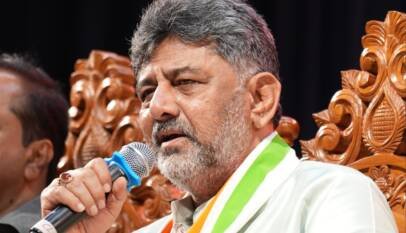
Shivakumar Says Congress United, Assures Women Will Get Cabinet Berth
Bengaluru, Aug 2026 : Karnataka Chief Minister D.K. Shivakumar on Monday sought to dismiss …