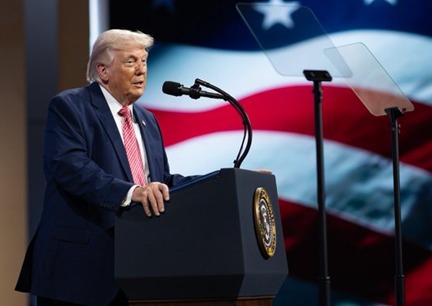
Trump Warns of Massive Strikes on Iran as Strait of Hormuz Tensions Escalate

Washington, April 2026 : Donald Trump has signalled the possibility of sweeping military strikes on Iran’s critical infrastructure if Tehran fails to comply with American demands, marking a sharp escalation in rhetoric amid rising tensions over the strategically vital Strait of Hormuz.
In an interview with The Wall Street Journal, Trump warned that Iran could face widespread destruction of key national assets, including power plants and bridges, if it does not act within a specified timeline. “If they don’t do something by Tuesday evening, they won’t have any power plants and they won’t have any bridges standing,” he said, underlining the scale of potential action.
The remarks come at a time when tensions between Washington and Tehran are intensifying over control and access to the Strait of Hormuz, a critical maritime route through which nearly 20 percent of the world’s oil supply passes. Any disruption in this corridor has immediate and far-reaching implications for global energy markets and trade.
Trump’s statements reflect a dual-track strategy—combining aggressive pressure with the possibility of negotiations. While maintaining a hardline stance, he indicated that Iranian leadership may still be open to dialogue. “We have it under control, seriously under control,” he said, projecting confidence in the U.S. approach even as the situation remains volatile.
However, the rhetoric has sparked widespread concern both domestically and internationally. Legal experts and analysts have warned that targeting civilian infrastructure such as power plants and transport systems could violate international humanitarian law. According to reports by The New York Times and The Washington Post, such facilities are essential for civilian life, and deliberate attacks on them could be classified as war crimes unless justified by clear military necessity.
The White House has attempted to temper the fallout. Press Secretary Karoline Leavitt stated that the United States would act “within the confines of the law,” even as Trump’s remarks continued to draw scrutiny.
Political reactions in the United States have been sharply divided. Democratic Senator Chris Murphy criticised the comments as “completely, utterly unhinged,” while Republican Representative Don Bacon expressed concern over the tone of the rhetoric, emphasising the need for restraint in leadership. House Minority Leader Hakeem Jeffries accused the administration of dragging the country into a “reckless war of choice.”
At the same time, some Republicans have defended the administration’s approach. Representative Mike Lawler described ongoing military operations as effective, highlighting the administration’s emphasis on strength and deterrence.
Iran, for its part, has rejected U.S. pressure. According to reports cited by CNN, a senior Iranian official stated that the Strait of Hormuz would remain blocked until compensation for war-related damages is addressed. This stance further complicates an already fragile situation.
The crisis underscores a long history of confrontation between the United States and Iran, encompassing disputes over nuclear ambitions, regional influence, and maritime security. The Strait of Hormuz has repeatedly been a flashpoint due to its strategic and economic importance.
Analysts note that the current phase represents a delicate balance between deterrence and escalation. Trump’s rhetoric, while aimed at forcing concessions, carries significant risks. Strong language and threats of large-scale destruction could heighten tensions, unsettle allies, and increase the likelihood of miscalculation.
Adding to the complexity, U.S. allies have expressed unease over the unpredictability of Washington’s messaging. Reports suggest that the combination of military threats and ongoing diplomatic signals has created uncertainty about the administration’s ultimate objectives.
Despite the rising tensions, the possibility of negotiations has not been entirely ruled out. Trump has repeatedly hinted that a diplomatic resolution remains achievable, even as deadlines and warnings continue to dominate the discourse.
As the situation evolves, the global community remains on edge. With energy security, regional stability, and international law all at stake, the coming days are likely to prove critical in determining whether the crisis moves toward de-escalation or further confrontation.
(The content of this article is sourced from a news agency and has not been edited by the Mavericknews30 team.)





Rahul, Gill Hundreds Put India in Command Against Afghanistan on Day One
New Chandigarh, June 2026: KL Rahul and skipper Shubman Gill struck authoritative centurie…

Rahul, Gill Hundreds Put India in Command Against Afghanistan on Day One
New Chandigarh, June 2026: KL Rahul and skipper Shubman Gill struck authoritative centuries while …