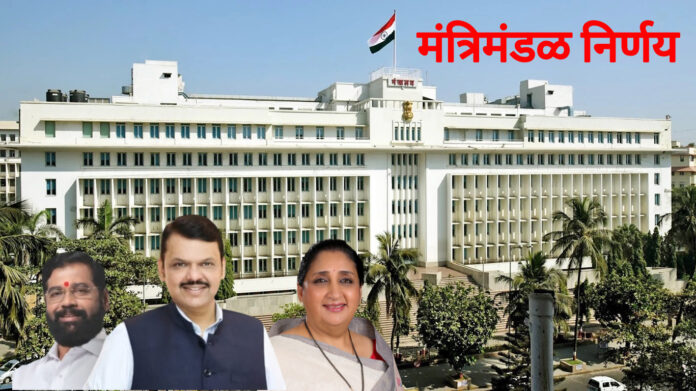
Maharashtra Cabinet Decisions

Maharashtra State Compressed Biogas Policy (CBG), 2026 announced
Approval was given in the Cabinet meeting for implementation of the Maharashtra State Compressed Biogas Policy, 2026. The meeting was chaired by Chief Minister Devendra Fadnavis. With the implementation of this policy, it will be possible to dispose of urban waste in an environment-friendly manner. At the same time, various problems arising from waste accumulation and pollution of water sources will be reduced, said Chief Minister Devendra Fadnavis.
Approval has been given to make a provision of Rs 500 crore for the year 2026–27 for implementation of this policy. Also, approval has been given to set up projects using necessary technology to make compressed biogas available as per requirement. For implementation of the policy, a steering committee will be established under the chairmanship of the Chief Secretary. The projects will be implemented on PPP and Hybrid Annuity basis. This policy will convert waste into energy and manure, creating employment and wealth.
The objective of the policy is to empower local self-government bodies for segregation, collection, processing, and conversion of urban waste into clean energy. Through this policy, production of compressed biogas and integration of solid waste management systems will be encouraged. This will reduce the burden on land used for waste disposal, improve public health, and enhance environmental quality by reducing greenhouse gas emissions. The main objective of the policy is to promote compressed biogas initiatives using urban and agricultural waste sources to reduce land degradation, air pollution, and boost the rural economy. This policy will reduce energy imports. Dependence on fossil fuels will decrease, carbon emissions will reduce, and clean fuel options will be available for transport, industrial, and domestic sectors.
Sustainable Waste Management – Open burning of urban organic solid waste, farm residues, livestock waste, and other biodegradable waste will be curbed, reducing pollution.
Circular Economy – Infrastructure will be created for collection, storage, and transportation of organic waste. Supply of raw materials for CBG projects. Farmers will get supplementary income through production of energy and organic manure from waste.
Investment and Employment – Investment will increase through public-private partnership. Employment will be generated in rural and urban areas.
A minimum capacity of 200 tonnes per day has been set for CBG projects. These projects can be implemented by local bodies, public sector companies, private developers, and oil and gas distribution companies in greenfield or brownfield form. Where sufficient waste is not available, provision has been made for cluster-based projects and projects using aggregation of agricultural residues with the help of farmer producer organisations.
To coordinate between raw material suppliers, project developers, and collection agencies, a digital integration system including portal and mobile app will be developed. Provision has been made to provide government land, land near waste processing centres, and reserved land for infrastructure on long-term lease. Provision has also been made for single-window clearance, land availability, and fast approvals.
The state-level steering committee will be headed by the Chief Secretary, while the district-level coordination committee will be headed by the District Collector. These committees will oversee project selection, coordination, implementation, and monitoring. Projects will be implemented as per the Public-Private Partnership Policy 2026 and Hybrid Annuity Model.
Basic pay to teachers of seven model colleges as per UGC guidelines
Approval has been given in today’s Cabinet meeting to provide basic pay to teachers of seven model colleges in the state as per the directions of the University Grants Commission, along with additional marks in recruitment of the Higher and Technical Education Department and related financial provisions. The meeting was chaired by Chief Minister Devendra Fadnavis.
Under the Central Government’s Human Resource Development Ministry, a scheme was launched during the Eleventh Five-Year Plan to establish one model college in districts with low enrolment rates. Maharashtra has seven such districts where model colleges have been established—Ghansawangi (Jalna), Buldhana, Shrivardhan (Raigad), Hingoli, Gadchiroli, Ambavade (Ratnagiri), and Talere (Sindhudurg).
A total of 43 courses are taught in these colleges, with about 2,510 students enrolled. Around 134 teachers are working on an hourly basis and 61 non-teaching staff on fixed pay. These employees had filed petitions in court seeking regularisation. As per the court’s decision, a proposal was submitted to provide these teachers with assistant professor basic pay plus dearness allowance as per UGC norms and to grant them an additional 10 marks in recruitment.
The Cabinet also approved a policy to appoint one principal and honorary professors in each college to ensure experienced faculty. Provision has also been made for the state’s financial share based on student strength, excluding central grants.
Land allotted for IT Park at Mouje Nagewadi in Satara district
Approval has been given to allot 42.55 hectares of land to the Maharashtra Industrial Development Corporation (MIDC) for setting up an IT park at Mouje Nagewadi in Satara district. The meeting was chaired by Chief Minister Devendra Fadnavis. The land will be provided to MIDC at agricultural land rates.
The IT park aims to boost the information technology sector in Satara and surrounding areas. The land (Survey No. 308/1) will be allotted as Class-2 occupancy to MIDC. Various IT companies will be able to set up projects, generating local employment and business opportunities for engineering and IT youth in the region.
Restructuring of premium for conversion of land tenure under ceiling law
The Cabinet approved amendments to the Maharashtra Agricultural Lands (Ceiling on Holdings) Act, 1961, and approved the Maharashtra Agricultural Lands (Ceiling on Holdings) (Conversion of Occupant Class-2 to Class-1) Rules, 2026. The meeting was chaired by Chief Minister Devendra Fadnavis. This decision will benefit 1,09,868 beneficiaries associated with 1,73,560.4 hectares of land.
Lands distributed about 40–50 years ago to landless persons, ex-servicemen, and weaker sections as Class-2 lands could not be used for non-agricultural purposes without prior permission and payment of premium. To address these difficulties, provisions have now been made to convert such lands to Class-1.
For lands not transferred after allotment, conversion premium will be 30% in urban areas and 25% in rural areas based on ready reckoner rates. For transferred lands, premium will be 30% (agricultural) and 25% (non-agricultural) in urban areas, and 25% (agricultural) and 20% (non-agricultural) in rural areas.
Cases with land value up to Rs 50 lakh can be approved at the District Collector level, while higher-value cases will require government approval.

Centre-State Double-Engine Partnership Will Take Bihar to New Heights of All-Round Development: Chief Minister
Key Decisions Taken: Patna, June 2026: Chief Minister Samrat Choudhary and Union Minister …
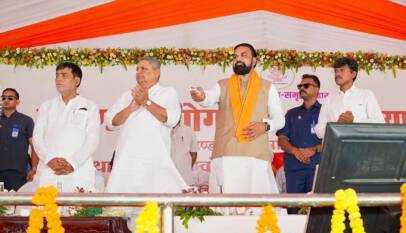
Centre-State Double-Engine Partnership Will Take Bihar to New Heights of All-Round Development: Chief Minister
Key Decisions Taken: Patna, June 2026: Chief Minister Samrat Choudhary and Union Minister for …