Not a Missing Link but a Connecting Link..! – Chief Minister Devendra Fadnavis

The ‘Missing Link’ in Mumbai–Pune Travel is a Marvel of Modern Engineering
Raigad–Alibag, May 2026 : “The ‘Missing Link’ on the Mumbai–Pune Expressway is not just a road, but an unparalleled global example of Indian engineering excellence. This project will not only save travel time but will also act as an ‘economic multiplier’ giving a boost of ₹70,000 crore to the state’s economy,” said Chief Minister Devendra Fadnavis here today.
Stating that it is more appropriate to call this project a “Connecting Link” rather than a “Missing Link,” the Chief Minister elaborated on the technical and safety aspects of the project while speaking at a press conference held after its inauguration.
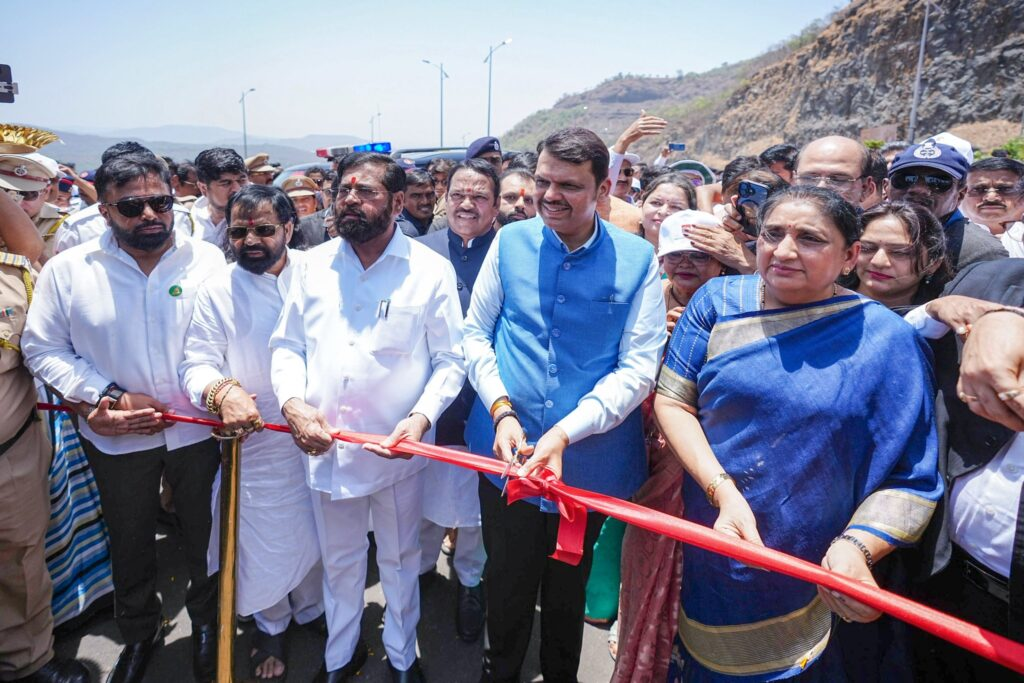
Deputy Chief Minister Eknath Shinde and Deputy Chief Minister Sunetra Ajit Pawar were prominently present on the occasion. Also present were Public Works Minister Shivendrasinh Bhosale, Women and Child Development Minister Aditi Tatkare, Employment Guarantee Minister Bharat Gogawale, Minister of State Meghna Sakore-Bordikar, Members of Parliament Sunil Tatkare and Shrirang Barne, Additional Chief Secretary (Home) Manisha Mhaiskar-Patankar, Additional Chief Secretary (Public Works) Milind Mhaiskar, Divisional Commissioner Rubal Agrawal, Special Inspector General of Police (Konkan Range) Dr. Sanjay Darade, District Collector Kishan Jawale, MSRDC Chairman and Managing Director Anil Gaikwad, Zilla Parishad Chief Executive Officer Neha Bhosale, Superintendent of Police Anchal Dalal, Co-Managing Director Rajesh Patil, other MSRDC officials, and representatives of Navayuga Company involved in tunnel construction.
Providing details about the project, Chief Minister Fadnavis said that passenger safety has been given top priority and the route is technically highly advanced. It includes modern firefighting systems, a water mist system, and emergency telephones every 50 meters. As a special safety feature, connectors have been constructed every 300 meters linking both tunnels, so that in case of an accident in one tunnel, passengers can be safely evacuated through the other. The entire stretch is under 24-hour CCTV surveillance, and an Intelligent Traffic Management System has been implemented to ensure lane discipline. He also warned that violators of traffic rules will now receive e-challans directly.
He further said that completing the project in extremely challenging geographical conditions—across valleys, mountainous terrain, and forests—was a major task. He expressed gratitude to expert institutions and companies from seven countries that contributed to the project.
Despite the challenges posed during the COVID period, the Mahayuti government accelerated the work, and today this project, costing ₹7,181 crore, has been successfully completed. The project will reduce the distance between Khopoli and Kusgaon by 6 kilometers and save commuters approximately 25 to 30 minutes of travel time.
The Chief Minister also recalled the historical significance of the Umbarkhind region, where the forces of Chhatrapati Shivaji Maharaj defeated the Mughals.
Referring to a video by MP Supriya Sule regarding traffic congestion on the Mumbai–Pune highway, he expressed regret to her and to the public. “Supriya Tai, today was the last time you got stuck in traffic. With the ‘Missing Link’ now operational, neither you nor any other traveler will face traffic congestion in the ghats,” he said. On the occasion of Labour Day, he also appreciated the efforts of workers and the MSRDC team who contributed to the project. He expressed confidence that this “Connecting Link” will further strengthen the Mumbai–Pune knowledge and technology corridor and significantly boost the state’s economy.
Deputy Chief Minister Eknath Shinde highlighted the collective effort behind the success of the project, stating that it is not the achievement of a single individual but of everyone who contributed. He appreciated the officials of MSRDC and the Public Works Department for completing the project despite challenges during the COVID period. He recalled that the project was once on the verge of cancellation, but Chief Minister Fadnavis accepted the challenge, issued clear instructions, and initiated the work. Shinde also mentioned that he himself was the MSRDC Minister at the time of the project’s foundation ceremony and continues to hold the same portfolio at the time of its inauguration, calling it a rare coincidence.
He further stated that the government is working on an “access-controlled grid” to ensure that travel from any part of Maharashtra to another can be completed within 7–8 hours. Just as the Samruddhi Expressway has made Nagpur–Mumbai travel smoother, this project will now make travel to Pune faster and safer.
Deputy Chief Minister Sunetra Ajit Pawar emphasized the global achievement of the project, noting that the 23.5-meter-wide tunnel constructed under this project is the widest in the world and has been recorded in the Guinness Book of World Records. She described it as a historic and proud moment for Maharashtra. She added that the project will reduce fuel consumption, resulting in savings of approximately ₹1 crore per day, lower pollution levels, and enhance road safety. The route will also open new avenues for industry, trade, and tourism, and with its modern safety systems and the country’s tallest cable-stayed bridge, it is expected to be recognized as a “smart expressway” in the future. She also thanked all the workers involved in the project on the occasion of Maharashtra Day and Labour Day.
Detailed Information about the ‘Missing Link’ Project
In 2002, the Mumbai–Pune Yashwantrao Chavan Expressway was opened for traffic in phases. However, while planning in 1996–97, a 13.30 km “Missing Link” between Khalapur and Kusgaon (Sinhgad Institute) was proposed but could not be completed at that time due to financial and technical challenges.
As a result, about 19 km of the existing Mumbai–Pune National Highway No. 4 was widened and used as a shared stretch of the expressway.
For Safe and Faster Travel – The ‘Missing Link’
Currently, the stretch between Adoshi Tunnel and Khandala Exit is six-lane. At this point, traffic from the six-lane expressway and the four-lane state highway merges, creating a total of ten lanes of traffic. Due to the ghat section, there are steep gradients and frequent landslides during the monsoon, often leading to closure of one lane toward Mumbai. To address these challenges and provide a safer alternative, the Missing Link project was undertaken.
Under this, the 5.86 km six-lane stretch between Khalapur and Khopoli has been expanded to eight lanes. For the remaining 12.30 km stretch from Khopoli Exit to Kusgaon (Sinhgad Institute), two tunnels and two viaducts have been constructed. In total, a modern 19.16 km route has been developed. On August 29, 2018, the Infrastructure Committee chaired by Chief Minister Devendra Fadnavis approved a capital expenditure of ₹6,895.36 crore for the project along with the formation of a Special Purpose Vehicle (SPV).
Construction of the World’s Widest Tunnels
Two tunnels in this project have been constructed using the New Austrian Tunneling Method (NATM). Each tunnel has a width of 23.50 meters, making them the widest in the world. Excavating these tunnels in the Sahyadri mountain ranges was a major engineering challenge. Detailed geological studies of different rock types were conducted to ensure safety.
Tunnel No. 1 is 1.58 km long, while Tunnel No. 2 is 8.86 km long. Notably, the second tunnel lies about 180 meters below the level of Lonavala Lake, posing additional challenges during blasting and construction, which were successfully managed by MSRDC.
Cable-Stayed Bridge in Tiger Valley – A Marvel of Engineering
A 650-meter-long cable-stayed bridge in Tiger Valley connects the two tunnels and is another highlight of the project. Built at a height of approximately 125 meters, it stands as an excellent example of advanced engineering. The bridge is supported by two pylons of 182 meters in height and a total of 240 cables. Advanced tests such as wind tunnel tests, fatigue and tensile tests, and stay cable tests were conducted internationally for this structure.
Transporting heavy machinery to this hilly and forested region and working under conditions of strong winds and heavy rainfall were significant challenges. Despite low visibility conditions, all safety measures were strictly followed to complete the project.
The new route will help avoid sharp curves and accident-prone areas in the ghat section, making travel safer. It will also reduce fuel consumption, saving approximately ₹1 crore per day and contributing to reduced pollution.
The Missing Link project will play a crucial role in the future development of Maharashtra, particularly benefiting regions like Western Maharashtra, Konkan, and Marathwada.





FIFA Chief Infantino Hails Messi’s ‘Timeless Brilliance’ After Record-Equalling World Cup Feat
New Delhi, June 2026 : FIFA President Gianni Infantino has showered praise on Lionel Messi…

FIFA Chief Infantino Hails Messi’s ‘Timeless Brilliance’ After Record-Equalling World Cup Feat
New Delhi, June 2026 : FIFA President Gianni Infantino has showered praise on Lionel …