South Korea Reiterates Kim Jong Un Is Producing Enough Fissile Materials For 20 Nuclear Warheads Annually.

Seoul; May 2026: South Korean President Lee Jae Myung has recently announced that North Korea will significantly expand its arsenal of nuclear warheads in the next decade. This expansion could force the United States and South Korea to reevaluate their ability to intercept a North Korean nuclear attack or neutralise the nuclear threat through preemptive strikes. North Korea will produce enough fissile material for as many as 20 nuclear warheads annually.
This production rate would allow North Korea to field 290 nuclear warheads by 2035, an equivalent nuclear arsenal to France, the world’s fourth-largest nuclear power by warhead count. Nuclear experts have already assessed that North Korea is likely increasing its nuclear warhead production capacity through expanded enrichment facilities. Workers’ Party of Korea (WPK) General Secretary Kim Jong Un tasked North Korea’s nuclear program with developing large nuclear warheads capable of threatening the United States and smaller tactical nuclear warheads to deter South Korea during the 09th Party Congress in February.
Expanding the production of fissile material needed for nuclear warheads is a critical step towards achieving this goal. An annual production of fissile material for 20 nuclear warheads would likely allow North Korea to enhance the survivability of its nuclear deterrent by ensuring it does not rest solely on a handful of critical systems. North Korea could also use an increased fissile material production rate to improve its ability to threaten the United States with long-range intercontinental ballistic missiles (ICBM). North Korean ICBMs can already reach the US mainland, but it is unclear if North Korea can currently field them at a sufficient scale to penetrate US missile defenses. Advances in fissile material production capacity could allow North Korea to pursue both a more survivable and more threatening nuclear armament that can deter its regional adversaries and the United States.
Meanwhile, in Russia, the government of Primorsky Krai, a Russian region bordering North Korea across the Tumen River, announced plans on April 30 to establish a working group to expand commerce with North Korea. The working group would support Russian businesses entering the North Korean market and increasing export volumes. The group listed shipments of organic fertilisers and fish products as export priorities. As per official sources, multiple Russian businesses have expanded exports and launched joint ventures with North Korea since 2025, including plans to launch a joint plastics factory in Vladivostok and North Korean construction of a meat-processing plant in Russia.
Increased economic cooperation between Primorsky Krai and North Korea could develop the Rason SEZ. Sanctions imposed by the UN Security Council (UNSC), the United States, and South Korea have historically constrained the growth of North Korean SEZs. Russia has expanded trade with North Korea in violation of UNSC sanctions since its 2022 invasion of Ukraine. The North Korean-Russian trade volume increased nine-fold the year after the invasion, going from approximately 3.78 million US dollars in 2022 to 34.4 million US dollars in 2023.
Furthermore, North Korea and Russia are set to launch a road bridge, across the Tumen River by June 19, 2026, that would supplement the existing Korea-Russia Friendship Bridge, a rail bridge with limited capacity for commercial road transport. The bridge would accommodate up to 300 vehicles per day, enabling Russian businesses to ship goods directly to the Rason SEZ. Russian investment in the Rason SEZ would allow North Korea to receive foreign capital without risking broader market liberalisation. North Korea could also seek to reduce trade dependence on the PRC by establishing an independent trade channel with Russia. North Korea and the PRC have recovered bilateral trade to pre-COVID-19 levels, reaching 2.73 billion US dollars in 2025, alongside the resumption of passenger train and air routes in March 2026.
Meanwhile, South Korean Ministry of Unification (MOU) will likely invite public consents on whether to prioritise coexistence with North Korea over reunification. South Korean Minister of Unification Chung Dong-young referred to inter-Korean relations as “ROK-Joseon relations” on April 25. This was the first time a high-ranking South Korean official used this terminology to refer to North Korea.
“Joseon” is the term that North Korea uses to refer to itself. South Korea typically uses “Bukhan” which means Northern Korea. South Korea’s terminology reflects its official position that does not recognise North Korea as a separate state. The MOU hosted an academic conference on April 29 regarding changing the official name of North Korea to “Joseon”, following Chung’s statement.
Vice Unification Minister Kim Nam-Jung stated that “recognising each other’s realities with respectful language and institutions” would help the two Koreas move towards peaceful coexistence. An unnamed MOU official stated on April 28 that the ministry intends to hold public discussions to decide on the official term for North Korea. On the other side, North Korea began referring to South Korea as the “Republic of Korea (ROK)” instead of “South Joseon” in 2023 following WPK General Secretary Kim Jong Un’s announcement of “hostile two-state relations”. North Korea’s terminology change was intended to express that the ROK and DPRK are separate nations, and no longer a single ethnic community.
The MOU’s desire for this terminology shift appears to be a conciliatory reciprocal measure to promote dialogue with North Korea. The MOU is showing respect for North Korea by referring to it by its official title, as Pyongyang now does for Seoul. This measure reflects broader MOU efforts to treat North Korea as a separate state. The MOU is also likely to prioritise short-term peaceful coexistence over long-term reunification. Chung emphasised the current impracticality of reunification on April 29 and argued that the immediate necessity for inter-Korean relations is the “institutionalisation of peace”, reiterating the Lee Jae Myung administration’s policy of peaceful coexistence with North Korea.
North Korea could perceive these measures as South Korea accepting North Korean demands and its preferred regional order, however. This attempt may also cause internal opposition within the Lee administration and the public. The South Korean Ministry of Foreign Affairs (MOFA) and South Korean security officials have often been misaligned with Chung’s MOU on North Korea policy. Chung argued for South Korea to not participate as a co-sponsor of the United Nations Human Rights Council’s North Korea human rights resolution in March to avoid provoking Pyongyang.
South Korean National Security Advisor Wi Sung-lac and MOFA has opposed the move. A Presidential civilian advisory group, the Peaceful Unification Advisory Council, stated that 51.6% of its April poll respondents do not recognise the North Korean regime despite the administration’s coexistence policy. This internal opposition underscores a significant gap between public opinion and MOU measures to respect the North Korean regime, a core principle of the peaceful coexistence policy.
Team Maverick.

Telangana CM Pushes Skill Training, Research and Overseas Job Support
Hyderabad, July 2026 : Telangana Chief Minister A. Revanth Reddy on Friday proposed settin…
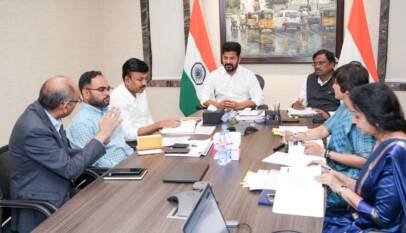
Telangana CM Pushes Skill Training, Research and Overseas Job Support
Hyderabad, July 2026 : Telangana Chief Minister A. Revanth Reddy on Friday proposed setting …