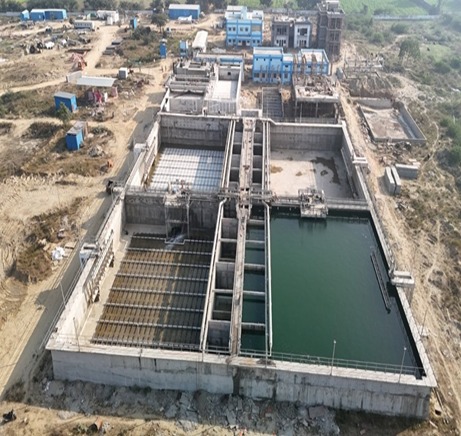
Uttar Pradesh Emerges as ‘Anchor State’ in Ganga Rejuvenation Under Namami Gange Mission

Lucknow, May 2026: Once identified with severe pollution, untreated sewage discharge and deteriorating water quality, the Ganga River in Uttar Pradesh is now witnessing a remarkable revival under the Namami Gange programme. Uttar Pradesh has emerged as the “anchor state” in India’s largest river restoration initiative, setting a new benchmark in Ganga rejuvenation.
Under the Namami Gange mission, the National Mission for Clean Ganga (NMCG) has approved investments worth Rs 16,201 crore for sewage infrastructure projects in the state. This accounts for nearly 45 per cent of the total sewage infrastructure investment sanctioned across the country under the programme. The scale of investment reflects both the seriousness of pollution challenges in Uttar Pradesh and the government’s determination to restore the river’s health through policy, technology and sustained monitoring.
Massive Investment and Impact Across the State
Out of 80 approved projects in Uttar Pradesh, 53 have already been completed. Of the planned 2,701 MLD (million litres per day) sewage treatment capacity, 1,520 MLD has become operational. Since Uttar Pradesh has the longest stretch of the Ganga and historically carried one of the heaviest pollution burdens, it became a key focus area under the mission.
Now, the results are beginning to show not just in government claims but also in official scientific assessments.
Historic Improvement Recorded by CPCB
The 2025 assessment report by the Central Pollution Control Board (CPCB) has formally acknowledged the significant improvement in the Ganga’s water quality.
In 2018, the entire stretch of the river from Kannauj to Varanasi had been classified as a “Priority-IV” polluted segment. Today, that continuous polluted stretch has effectively disappeared. Pollution is now limited to only three smaller stretches — Farrukhabad to Old Rajapur, Dalmau, and Mirzapur downstream to Tarighat.
These stretches have now been categorised under “Priority-V”, considered the lowest pollution category before being classified as non-polluted.
Nalin Kumar Srivastava, Deputy Director General of NMCG, said that according to CPCB’s independent monitoring, most stretches of the Ganga’s main channel in Uttar Pradesh are now meeting bathing-quality Biological Oxygen Demand (BOD) standards.
“This is not merely an administrative achievement but a measurable and genuine improvement in the river’s water quality after decades,” he said.
Major Transformation in Urban Sewer Infrastructure
Large-scale sewage infrastructure projects are underway in 11 major cities, including Varanasi, Prayagraj, Kanpur, Agra, Mathura, Vrindavan, Moradabad, Bhadohi, Bijnor and Shuklaganj.
The 55 MLD sewage treatment plant at Assi-BHU in Varanasi is currently handling the sewage needs of nearly 1.8 million people. Similarly, the 31 MLD and 35 MLD STPs in Agra are together benefiting around 2.5 million residents.
Common Effluent Treatment Plants (CETPs) at Jajmau and Mathura are already operational, while construction of the Banthar CETP in Unnao is progressing rapidly.
These projects are aimed at preventing untreated sewage from directly entering the Ganga.
Prayagraj Becomes a Model for Green STPs
Under Namami Gange Phase-II, Prayagraj has emerged as a model city for “Green STPs”. Four sewage treatment plants in the city are now generating a substantial part of their own energy requirements.
The 80 MLD Naini STP is producing nearly 5,900 units of electricity daily through solar energy and biogas, while the 42 MLD Naini STP’s 1,000 kW solar plant generates around 3,850 units daily.
The Jhunsi and Phaphamau STPs are also moving towards fully solar-powered operations.
Smooth Operations During Mahakumbh 2025
Even during Mahakumbh 2025, when Prayagraj witnessed the arrival of millions of pilgrims and a massive increase in wastewater load, these treatment plants continued to function uninterrupted.
The successful operation demonstrated that decentralised and energy-positive treatment systems could serve as a sustainable urban model for future India.
Advanced Technology Deployed at Assi Drain
At the Assi drain confluence area in Varanasi, NMCG has introduced “Advanced Oxidation Technology” as a key technological intervention to control pollution.
This system treats excess wastewater directly at the discharge point, ensuring untreated sewage does not flow into the river.
The technology has been installed in highly sensitive pollution zones and will continue to act as a frontline pollution-control mechanism until permanent sewer networks are fully completed.
Towards a Zero-Pollution Goal
The remaining polluted stretches at Farrukhabad-Old Rajapur, Dalmau and Mirzapur-Tarighat have already been identified and incorporated into the active project pipeline.
Future phases will focus on targeted investments, accelerated construction and intensive monitoring in these areas.
The transformation unfolding along the banks of the Ganga in Uttar Pradesh demonstrates how scientific monitoring, modern technology, effective governance and political commitment can together address even decades-old environmental challenges.
Today, along the Ganga, not only faith flows — change flows too.
Team Maverick.





World Cup Heavyweights England and Argentina Set for Blockbuster Semi-final Showdown
Atlanta, July 2026 : The stage is set for one of the biggest matches of the 2026 FIFA Worl…

World Cup Heavyweights England and Argentina Set for Blockbuster Semi-final Showdown
Atlanta, July 2026 : The stage is set for one of the biggest matches …